 Substitutes
How Do You Make Powdered Sugar at Home From Plain Granulated Sugar?
 By the CookClear writers
Checked against test kitchen and baking science sources
 Clear Answer
To make powdered sugar, blend 1 cup (200 g) of granulated sugar with 1 tablespoon (8 g) of cornstarch until it becomes a soft, fluffy powder, which yields roughly 1 3/4 to 2 cups. It works well in buttercream, cream cheese frosting, and glazes as long as you blend it fine and sift out any leftover crystals.
The catch is texture. A home blender can't quite match the industrial mills that make the bagged stuff, so your frosting may feel very slightly less silky. For most cakes, cookies, and cupcakes, nobody will notice.
What is store-bought powdered sugar, exactly?
Powdered sugar (also called confectioners' sugar or icing sugar) is plain granulated sugar ground into a very fine powder, with a small amount of starch mixed in. According to the American Society of Baking, commercial powdered sugar contains about 3 to 5 percent anticaking agent, usually cornstarch. That starch keeps the powder from absorbing moisture and clumping in the bag.
 On the menu11 questions
You'll often see "10X" on the label. That number describes how fine the grind is. The common grades are 6X, 10X, and 12X, and the higher the number, the finer the particles. 10X is what most supermarkets sell and what most frosting recipes assume.
When you make it at home, you're doing the same two things a mill does: grinding the sugar small and adding a little starch. The difference is how small you can get it.
The basic method, step by step
You need two ingredients and one appliance with a fast blade. Here's the process:
- Measure. Use 1 cup (200 g) granulated white sugar and 1 tablespoon (8 g) cornstarch. For a smaller batch, use 1/3 cup sugar and 1 teaspoon cornstarch.
- Load a dry container. Any moisture in the blender jar will make the sugar clump and stick to the walls. Wipe it out first if you just washed it.
- Blend. Start on low, then move to the highest speed. Run it until the sugar looks like soft, white flour rather than sparkly crystals.
- Rest before opening. Let the dust settle for a minute before you lift the lid. Otherwise you'll get a sweet cloud all over the counter.
- Check for grit. Rub a pinch between your fingers. If you feel sandy bits, blend again.
- Sift. Push the powder through a fine-mesh sieve. Return anything that won't pass through to the blender and blend it again.
The cornstarch goes in with the sugar from the start. It helps the mixture move around the blade and keeps the finished powder from caking. If you're using the sugar right away in a frosting, you can technically skip it, but it's cheap insurance, and it makes your homemade version behave more like the bagged one.
How much granulated sugar do you need for a frosting recipe?
Volume grows a lot when you grind sugar, because fine powder traps air. The American Society of Baking puts the conversion at about 1 3/4 cups powdered sugar per cup of granulated, and home cooks commonly report closer to 2 cups after fluffing. Weight, on the other hand, barely changes, aside from the small amount of starch you add.
That makes weighing on a scale the easiest path. If your frosting recipe gives grams, just make that many grams of homemade powdered sugar. If it gives cups, use this table to figure out how much granulated to start with. A cup of granulated weighs about 200 grams, and grams per cup of sugar is the number to convert from.
| Powdered sugar the recipe calls for | Granulated sugar to blend | Cornstarch to add |
|---|---|---|
| 1 cup | about 1/2 cup (100 g) | 1 1/2 teaspoons |
| 2 cups | about 1 cup (200 g) | 1 tablespoon |
| 3 cups | about 1 1/2 cups (300 g) | 1 1/2 tablespoons |
| 4 cups | about 2 to 2 1/4 cups (400 to 450 g) | 2 tablespoons |
Make a bit more than you think you need. Some of it always clings to the blender walls and lid, and a little stays behind in the sieve. Extra keeps fine in a jar. For a half batch, remember there are 16 tablespoons in a cup, so 1/2 cup of sugar takes 1/2 tablespoon of cornstarch.
Which appliance gives the finest powder?
Blade speed and jar shape count for more than brand, just as they do when a blender leaves chunks in smoothies.
| Appliance | Batch size | Result | Notes |
|---|---|---|---|
| High-speed blender | 1 to 2 cups | Finest, closest to 10X | Narrow jar keeps sugar near the blade |
| Standard blender | 1/2 to 1 cup | Good, may need a second pass | Smaller batches grind more evenly |
| Spice or coffee grinder | 1/3 cup or less | Very fine | Wipe out coffee oils first or the sugar tastes like coffee |
| Food processor | 1 to 2 cups | Coarser, less even | Wide bowl lets sugar fly around the blade |
| Mortar and pestle | A few tablespoons | Slow, uneven | Fine for dusting, impractical for frosting |
A food processor works for powdered sugar, but it takes longer and tends to leave a mix of fine powder and small crystals. If that's all you have, run it longer, scrape down the sides, and sift carefully.
Small batches beat big ones in every machine. A cup of sugar in a big blender jar grinds better than three cups, because the sugar stays down near the blade instead of packing against the walls. Commercial milling heats sugar to around 122°F, according to the American Society of Baking, and your blender heats it too. If you're making a large amount, work in rounds and let the jar cool between them.
Will homemade powdered sugar make gritty frosting?
It can, and that's the most common complaint. Buttercream doesn't have enough free water to dissolve sugar crystals, so any crystal left in the powder stays a crystal in your frosting. You feel it as a faint sandiness on the tongue.
A few habits fix most of it:
- Blend longer than seems necessary. The powder should look matte, not glittery.
- Sift every time. This catches the stubborn crystals before they reach the butter.
- Beat the frosting well. A few extra minutes of mixing gives the sugar more time to break down in the fat and any liquid.
- Add the liquid early. In American buttercream, mixing the milk or cream in with the first addition of sugar helps dissolve fine crystals.
- Choose forgiving frostings for a first try. Cream cheese frosting and simple glazes have more moisture, so they hide a slightly coarser grind better than stiff decorating buttercream.
Glazes are the easiest. A mix of powdered sugar and milk or lemon juice is wet enough that small crystals dissolve completely. For a powdered sugar dusting on brownies or French toast, homemade works well too, though it may soak in a little faster without a full anticaking dose.
Does it change how frosting tastes or holds up?
Taste is essentially the same. The sugar is the same sucrose, and 1 tablespoon of cornstarch per cup is close to what commercial producers use, so you won't get a starchy flavor. If you go much heavier on cornstarch, though, you can taste it as a faint chalky note, especially in uncooked frostings.
Structure is also close. Cornstarch adds a little body, which is one reason store-bought powdered sugar helps stiffen buttercream and whipped cream, a handy trick when cream won't firm up. Using the same 1 tablespoon per cup keeps your homemade sugar in that same range, so frosting set up with it should pipe and hold about the same.
Color is the one thing you might notice. Homemade powdered sugar can look a shade less bright white than the bagged kind, mostly because it's not quite as fine. Once it's beaten into butter, the difference mostly disappears.
Can you make powdered sugar without cornstarch?
You can skip it if you'll use all the sugar right away. Fresh powder without starch works fine in frosting and glazes. It just clumps quickly if you store it, especially in a humid kitchen.
If you avoid corn, other starches work the same way:
- Arrowroot powder: a direct 1 for 1 swap for cornstarch, as it is when thickening sauces.
- Tapioca starch: also works 1 for 1 and is neutral in flavor.
- Potato starch: works the same way, though use it lightly so it doesn't taste starchy.
Avoid flour. It isn't fine enough to blend in invisibly, and raw flour isn't meant to be eaten uncooked. That is a concern in frosting, which never gets baked.
What about other sugars?
The same blender method works on other dry sugars, with a few caveats.
Raw or turbinado sugar grinds into a light tan powder with a gentle molasses flavor. It's good in a brown butter or maple frosting, though it won't give you a pure white finish. Coconut sugar does the same and comes out darker still.
Brown sugar is a poor candidate. Its moisture from molasses makes it clump in the blender and turn pasty instead of powdery.
Liquid sweeteners can't be ground at all, and swapping honey for sugar in baking means adjusting the rest of the recipe. Granulated sugar substitutes such as erythritol or allulose can also be blended into a powder for sugar-free frosting. Those behave differently once mixed, so follow a recipe built for them rather than swapping cup for cup into a regular buttercream.
How long does homemade powdered sugar last?
Stored right, it keeps about as long as the bagged kind. Sugar doesn't spoil the way perishable food does, so the issue is texture, not safety.
Keep it in an airtight jar or container at room temperature, in a cool, dry spot away from strong smells. Sugar picks up odors, so don't store it next to your spice jars or coffee. If it forms soft lumps, sift it again or give it a quick pulse in the blender. If it has turned into hard clumps, it's easier to make a fresh batch.
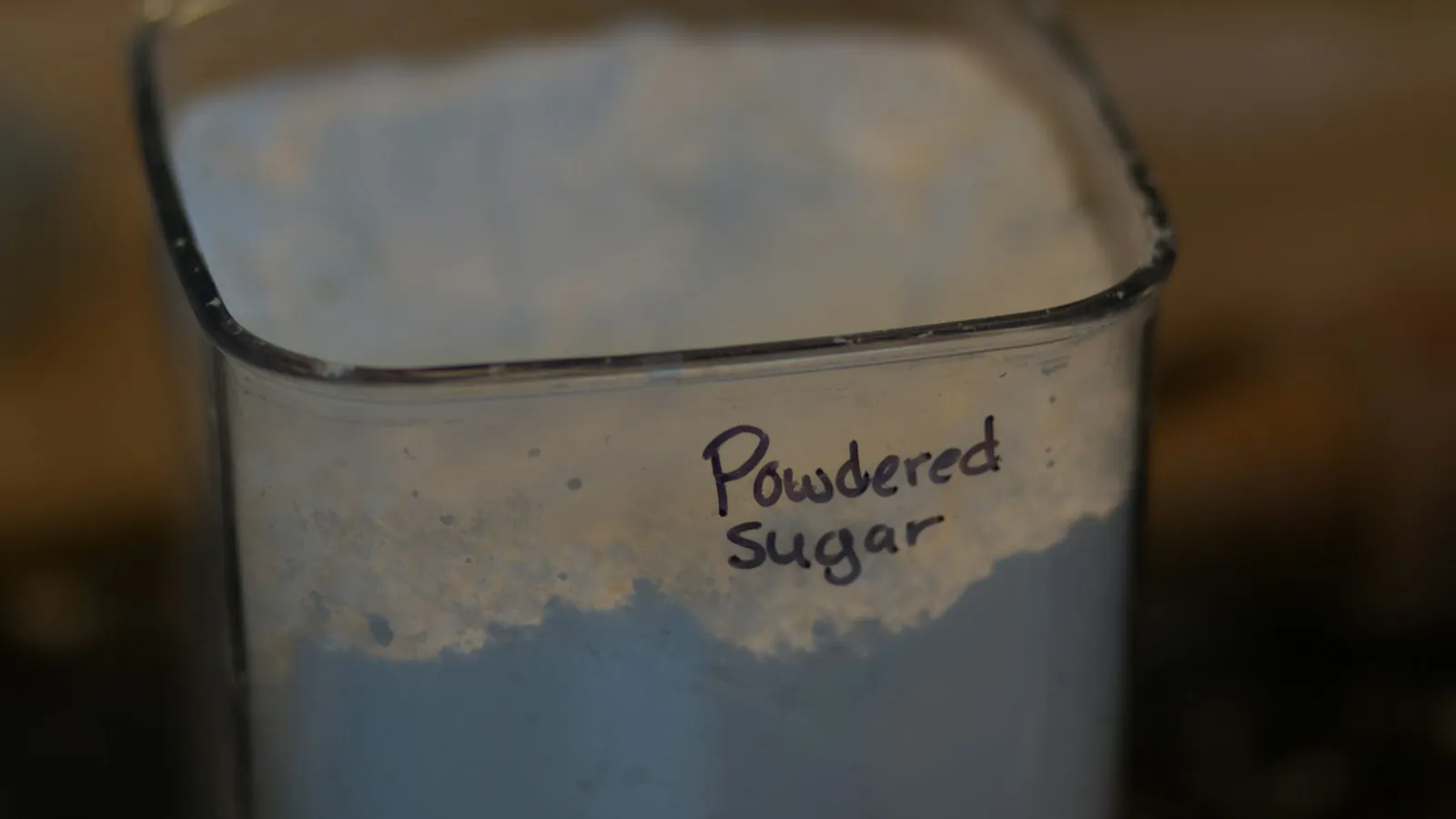
Label the jar. Homemade powdered sugar looks a lot like flour or cornstarch once it's in a plain container.
When it's worth just buying a bag
Making your own makes sense when you're mid-recipe and short a cup, when you need a small amount, or when you want a powdered version of raw or coconut sugar. It also helps if you're avoiding corn and want arrowroot or tapioca instead.
For big projects, like a three-layer cake or several dozen decorated cookies, the bagged stuff is less work. You'd be blending in batches, sifting several cups, and cleaning sugar dust out of the blender base. For a smooth, bright white decorating buttercream that has to pipe sharp edges, store-bought 10X also has a small edge in fineness.
For an everyday batch of frosting, though, a blender and a spoonful of cornstarch get you there in a few minutes. If you are short on buttermilk or eggs too, pantry substitutes for those are just as simple.
 How fine should homemade powdered sugar look?
Fineness decides whether frosting turns out silky or gritty, and that is hard to describe in words. Handle the Heat shows granulated sugar being ground to a powder in a blender.
How to Make Powdered Sugar | 5 Minute Baking Tip
By Handle the Heat on YouTube. Their method may vary a little from ours. Watch on YouTube
- Watch for the sugar to change from sparkly crystals to soft, white flour, the point where the method above says to stop blending.
- Notice how the powder is sifted afterward and what is left in the sieve, which the steps above say to blend again.
- Check the batch size against the ratio of 1 cup of sugar to 1 tablespoon of cornstarch, since small batches grind more evenly.


