Home / Measurements & Conversions
 Measurements & Conversions
How Much Does an Egg Weigh in Grams, and How Can You Split One in Half?
 By the CookClear writers
Checked against US standard measures, NIST conversions and test kitchen weights
 Clear Answer
A large egg weighs about 50 grams out of the shell, according to King Arthur Baking: roughly 30 to 35 grams of white and 14 grams of yolk. To use half an egg, whisk it until smooth and weigh out about 25 grams, or measure about 1 1/2 tablespoons plus 1/2 teaspoon.
Those numbers hold for the large eggs nearly every American recipe assumes. Other sizes run heavier or lighter, and that difference shows most when a recipe calls for several eggs or when you are cutting it down.
What are the USDA egg sizes by weight?
USDA egg sizes are set by the minimum net weight of a dozen, in ounces, under the USDA Agricultural Marketing Service standard for shell eggs (AMS 56). A carton labeled large has to weigh at least 24 ounces per dozen when it is packed, so the average egg inside is at least 2 ounces in the shell. Eggs slowly lose moisture after that, the same change a float test picks up. Individual eggs in the carton can vary a bit as long as the dozen hits the minimum.
 On the menu9 questions
| Size | Minimum per dozen (USDA) | Per egg in shell, at least | Per egg out of shell, rough estimate |
|---|---|---|---|
| Jumbo | 30 oz (about 850 g) | 2 1/2 oz (about 71 g) | about 62 g |
| Extra large | 27 oz (about 765 g) | 2 1/4 oz (about 64 g) | about 56 g |
| Large | 24 oz (about 680 g) | 2 oz (about 57 g) | about 50 g |
| Medium | 21 oz (about 595 g) | 1 3/4 oz (about 50 g) | about 44 g |
| Small | 18 oz (about 510 g) | 1 1/2 oz (about 43 g) | about 38 g |
| Peewee | 15 oz (about 425 g) | 1 1/4 oz (about 35 g) | about 31 g |
The first two columns come straight from the USDA standard, with grams converted at 28.35 grams per ounce. The last column is an estimate: King Arthur's 50 gram large egg, scaled up or down by the USDA minimums. Shell weight varies, so treat it as a working number for recipes.
If you ever need the same math in the other direction, the ounces and grams conversions work the same way for eggs as for any other ingredient.
How much does an egg weigh with the shell on?
A large egg in its shell weighs at least 2 ounces, or about 57 grams, on average across the dozen. Many weigh a few grams more, since packers only have to meet the minimum. Going by the USDA minimum and King Arthur's figure, the shell and the bit of white left inside it account for roughly 7 grams, which is why a 57 to 60 gram egg in the shell gives you close to 50 grams to cook with.
Weighing in the shell is handy when you are sorting a mixed batch, such as farm eggs or backyard eggs that were never graded. Set each egg on a scale and compare it to the table: anything around 57 to 63 grams in the shell behaves like a large egg in a recipe.
How much do the egg white and yolk weigh?
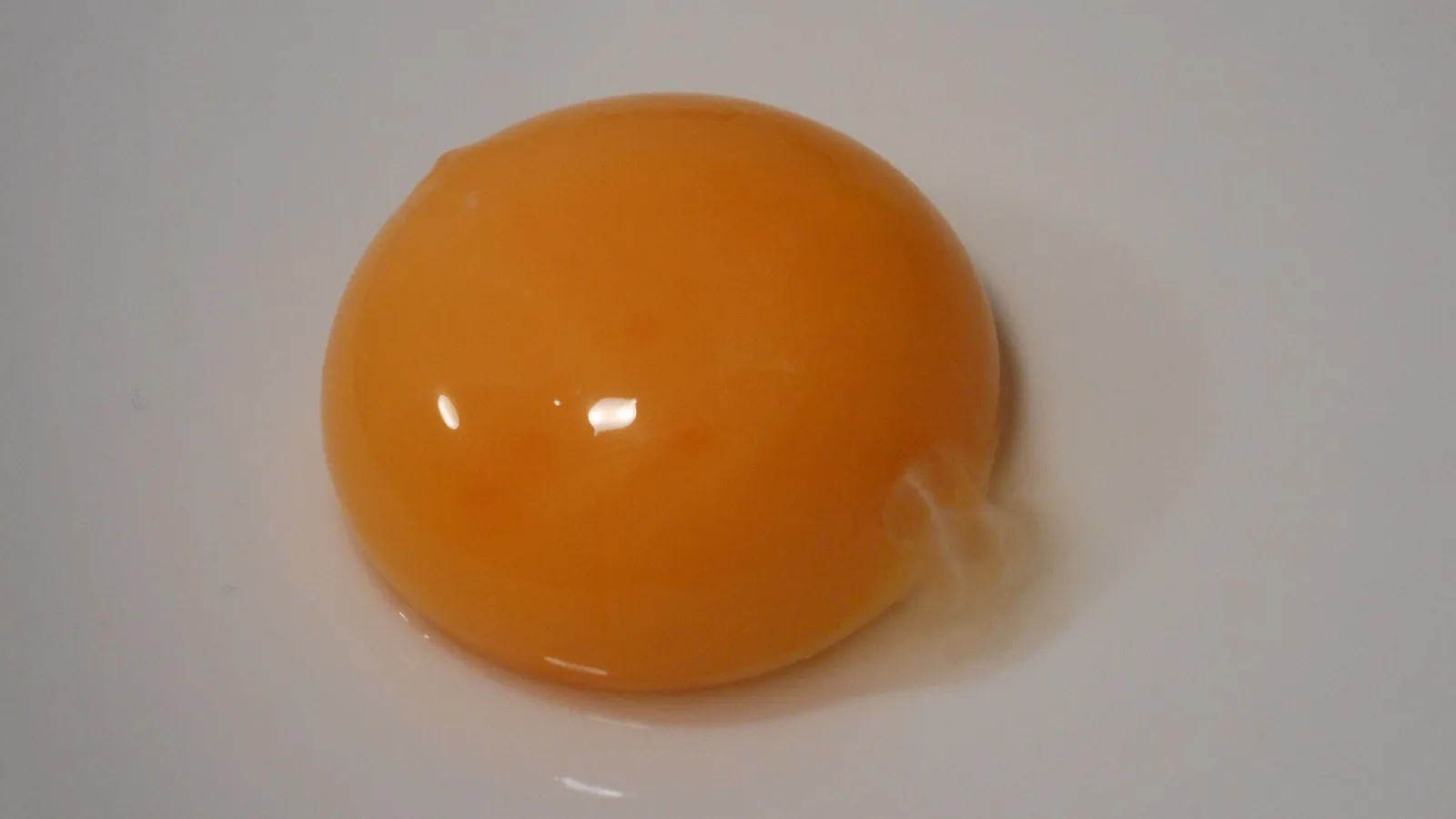
For egg white and yolk weight, King Arthur Baking lists a large white at 30 to 35 grams and a large yolk at 14 grams. Add a few grams of thin white that clings to the shell and the two halves land near the 50 gram whole egg.
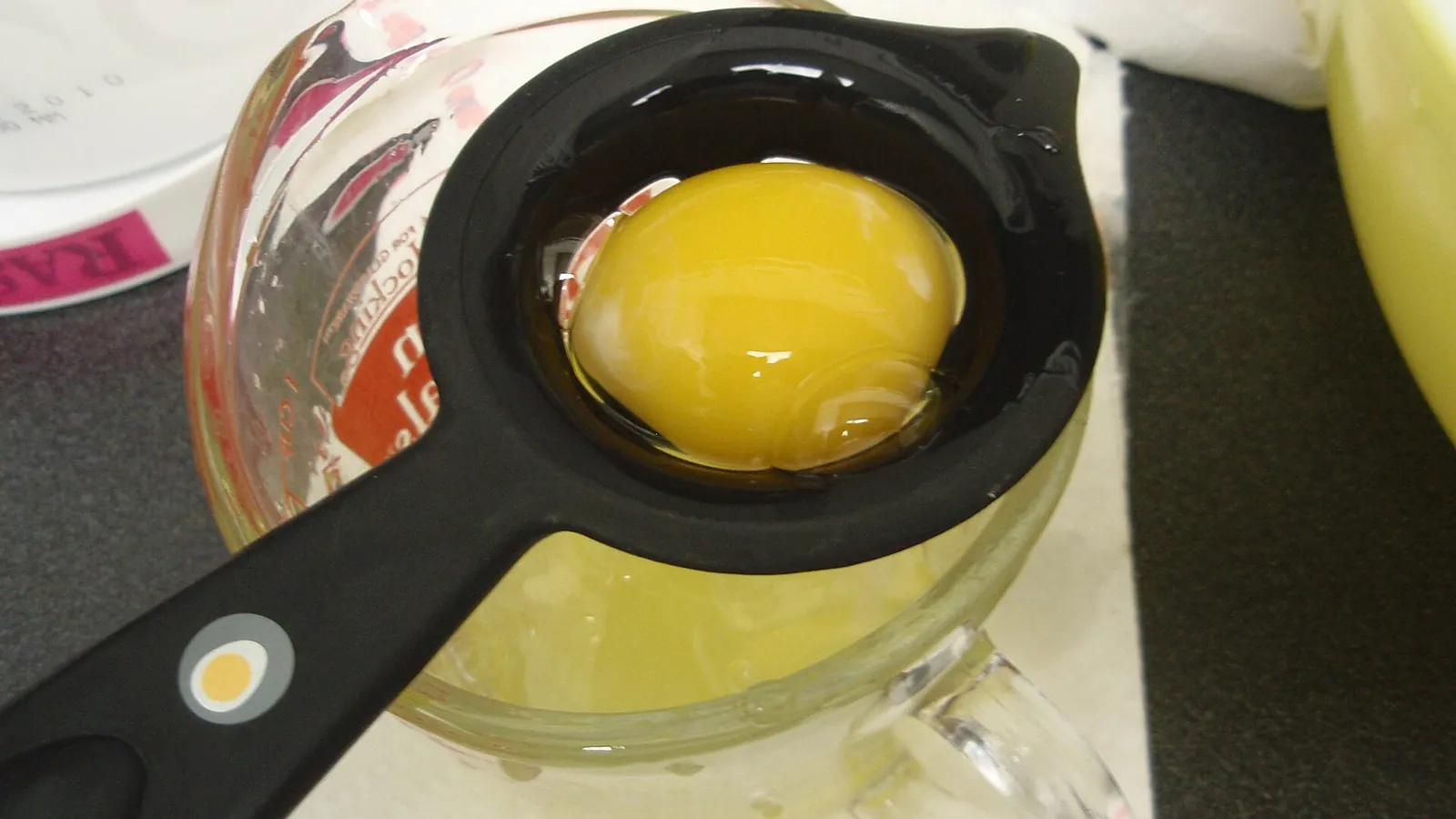
Here is how that breaks down for the sizes you are most likely to buy, scaled from the same large egg numbers:
- Large egg. About 30 to 35 g white and 14 g yolk.
- Extra large egg. About 34 to 39 g white and 16 g yolk.
- Jumbo egg. About 37 to 43 g white and 17 to 18 g yolk.
- Medium egg. About 26 to 31 g white and 12 g yolk.
The white is roughly two thirds of the egg and the yolk one third. That ratio is why recipes built on whites, like meringue or angel food cake, swing more with egg size than recipes built on yolks. When a recipe lists whites in grams, weigh them and ignore the count.
How many tablespoons in one egg?
One large egg is a little over 3 tablespoons once beaten. That is a calculated figure: 50 grams of egg at close to the density of water, divided by the 14.8 milliliter US tablespoon that NIST defines, comes to about 3 1/4 tablespoons. A large white is about 2 tablespoons and a large yolk about 1 tablespoon.
Volume works well enough for eggs because a beaten egg is a liquid. It does not pack the way flour does. The weak spot is measuring a thick, unbeaten white, which clings to the spoon and leaves you short. Beat first, then measure.
| Amount of large egg | Weight | Approximate volume |
|---|---|---|
| 1 whole egg | 50 g | 3 1/4 tablespoons |
| 1/2 egg | 25 g | 1 1/2 tablespoons plus 1/2 teaspoon |
| 1/3 egg | about 17 g | 1 tablespoon plus 1/2 teaspoon |
| 1/4 egg | about 12 to 13 g | 2 1/2 teaspoons |
| 1 white | 30 to 35 g | about 2 tablespoons |
| 1 yolk | 14 g | about 1 tablespoon |
If your spoons are hard to read for anything under a tablespoon, the teaspoon to tablespoon math is simple: 3 teaspoons make 1 tablespoon.
How to measure half an egg
Recipes end up asking for half an egg when you scale them down, and the math for halving a recipe works fine for everything except the egg you cannot cut in two. The fix is to turn the egg into a liquid first.
- Crack the egg into a small bowl or cup.
- Whisk with a fork for 20 to 30 seconds, until the white and yolk are one even color and you see no clear streaks. Unbeaten white is stringy and will slide out in one blob.
- Put a second bowl on your scale and press tare.
- Pour in beaten egg until the scale reads half of what the whole egg weighed. For a typical large egg, that is about 25 grams.
- No scale? Measure 1 1/2 tablespoons plus 1/2 teaspoon of the beaten egg instead.
Weighing the whole egg first is worth the extra 10 seconds. If your large egg comes in at 56 grams, half is 28, not 25. A digital kitchen scale that reads in 1 gram steps is precise enough for this.
The same method works for a third or a quarter of an egg. Divide the whole egg's weight by 3 or 4 and pour that amount.
What to do with the leftover half
Cover the extra beaten egg and refrigerate it. Use it within a couple of days for an egg wash on bread or pie crust, a batch of soft scrambled eggs, or the next half batch of cookies. Raw beaten egg should not sit at room temperature for more than 2 hours.
Can you substitute egg sizes in baking?
Yes, and for most recipes with one or two eggs you can swap sizes freely. The difference between a medium and an extra large egg is only about 12 grams, which a batch of muffins or cookies absorbs without trouble.
Past two eggs, the gap starts to add up. Three large eggs come to about 150 grams. Three jumbo eggs bring that to about 186 grams, nearly a whole extra large egg's worth of liquid, which can make a cake heavy or a custard loose. The easiest way to substitute egg sizes in baking is by total weight:
- Multiply the number of eggs in the recipe by 50 grams to get the target.
- Beat the eggs you have together.
- Weigh out the target amount and save the rest.
If you are working without a scale, this rough chart, based on the out-of-shell estimates for each size, gets you close:
| Large eggs called for | Medium | Extra large | Jumbo |
|---|---|---|---|
| 1 | 1 | 1 | 1 |
| 2 | 2 | 2 | 2 |
| 3 | 3 plus about 1 tablespoon beaten | 3, or 2 plus 2 1/2 tablespoons | 2 plus about 1 3/4 tablespoons |
| 4 | 4 plus about 1 1/2 tablespoons | 4 less about 1 1/2 tablespoons | 3 plus about 1 tablespoon |
| 6 | 7 | 5 plus about 1 1/2 tablespoons | 5 |
Treat these as kitchen estimates. The table rounds to spoonfuls so you can work fast, and the weight method is always more exact.
When eggs are out entirely, size swaps stop helping, and an egg substitute in brownies follows its own rules for moisture and binding.
My half-egg cake came out dense: what went wrong?
Small batches show egg errors fast. In a half batch, a few extra grams of egg make up a bigger share of the batter, so the texture shifts more than it would in a full recipe.
| What you see | Likely cause | Fix |
|---|---|---|
| Dense, rubbery crumb | Too much egg, often a whole egg used in place of half | Weigh 25 g of beaten egg instead of guessing |
| Dry, crumbly cake | Too little egg, usually unbeaten white left behind in the spoon | Whisk until smooth before measuring |
| Cookies spread thin and cakey at once | Jumbo eggs in a recipe written for large | Weigh total egg at 50 g per egg called for |
| Custard or quiche won't set | Small or medium eggs in a recipe built on large | Add beaten egg to reach the target weight |
| Meringue weeps or collapses | Whites counted, not weighed, and sugar ratio is off | Use 30 to 35 g per large white |
Most of these trace back to treating every egg as the same size. Once you think of eggs as about 50 grams each, they behave like any other measured ingredient.
Does egg size matter outside of baking?
Much less. Scrambled eggs, frittatas, fried rice, and meatballs all handle a few extra grams of egg without any change you would notice.
Timing is the one place it shows up on the stove. A jumbo egg takes a little longer to cook through than a medium one, so if you boil eggs for a runny yolk, stick to the size the timing was written for, and expect a bigger egg to need a little longer.
For quick reference across every unit in your kitchen, the full set of measurements and conversions puts egg weights alongside cups, spoons, and grams.
 Weighing and halving a beaten egg
Seeing an egg whisked smooth and poured onto a scale makes the half-egg method click faster than reading it. Watch for how loose the egg looks when it is ready to measure.
How to Measure Half an Egg - Dalya Rubin - It's Raining Flour Episode 83
By Dalya Rubin on YouTube. Their method may vary a little from ours. Watch on YouTube
- Check that the whole egg lands near 50 grams out of the shell, the King Arthur figure for a large egg.
- Look for an even yellow color with no clear streaks before any egg is poured off for measuring.
- Notice the tare step, then pour until the scale shows about 25 grams for half a large egg.


