Food Storage
When Are Ground Spices Too Old and Stale to Be Worth Using?
 By the CookClear writers
Checked against USDA and FDA food safety guidance
 Clear Answer
Rub a pinch between your fingers and smell it: if the aroma is faint, dusty, or hard to find, the ground spice is too old to be worth using. Faded color is the second sign, like pale paprika or grayish cumin. Old spices are a flavor problem, not a safety problem, and most hold their best flavor for one to four years depending on storage.
That range is wide on purpose. A jar of cumin kept in a dark drawer will outlast the same jar parked on a shelf above the stove by a long way. The date tells you less than what your nose tells you.
The pinch test, step by step
Smell is the most reliable check you have, because the flavor of a spice lives in its aromatic oils. When those oils evaporate or break down, the scent goes first and the taste follows. America's Test Kitchen recommends the same simple check: crumble a little between your fingers and take a whiff.
Here is how to do it properly:
- Shake about 1/4 teaspoon into your palm, a few times more than a cook's pinch. Do not sniff straight from the jar, since the headspace can hold a little trapped aroma that makes a tired spice seem better than it is.
- Rub it firmly between your thumb and fingers for a few seconds. The friction warms it and releases whatever oils remain.
- Smell your fingers. A good spice hits you right away. Cumin should be earthy and a little sharp, cinnamon sweet and warm, ginger bright and peppery.
- Look at the color in your palm. Compare it in your head to what that spice looks like fresh: deep brick red for paprika, rich tan-brown for cumin, bright yellow-orange for turmeric.
- Taste a few grains if you are still unsure. Fresh spices register on your tongue quickly. Stale ones taste flat, dusty, or faintly bitter.
If you have to really concentrate to smell anything, replace it. If the scent is there but softer than you remember, it still works, and you can simply use a bit more.
How long do ground spices last?
Shelf life for spices is a quality number, not a safety deadline. The USDA classifies spices as shelf-stable foods and notes that date labels on shelf-stable products are about quality. A three-year-old jar will not hurt you. It just will not do much for your food. Vanilla extract is the exception that keeps nearly forever.
The estimates vary depending on the source. McCormick is the more generous of the two big references here. America's Test Kitchen is stricter.
| Type | McCormick estimate | America's Test Kitchen estimate |
|---|---|---|
| Ground spices (cumin, ginger, paprika, chili powder) | 2 to 4 years | Within 1 year of buying |
| Whole spices (peppercorns, cumin seed, cinnamon sticks) | 3 to 4 years | 2 years |
| Dried leafy herbs (oregano, basil, rosemary) | 1 to 3 years | Within 1 year of buying |
| Seasoning blends | 1 to 3 years | Not listed separately |
| Extracts other than vanilla | 2 to 3 years | Not listed |
| Pure vanilla extract and salt | Indefinitely | Not listed |
A workable rule sits between those two columns. If you cook with a spice often and care how the dish tastes, treat one year as the point to start checking. If it passes the pinch test at two or three years, keep using it.
Why ground spices fade faster than whole ones
Grinding a spice breaks open the tiny cells that hold its aromatic oils. That exposes far more surface area to air, which is exactly what you want at the moment you cook, and exactly what you do not want while the jar sits in your cupboard for months.
A whole cumin seed or a whole nutmeg keeps most of its oils sealed inside until you crush or grate it. That is why both McCormick and America's Test Kitchen suggest buying whole when you can and grinding as you need it. A cheap blade coffee grinder kept only for spices handles cumin, coriander, fennel, and peppercorns in about 15 seconds.
Some spices are worth buying whole almost every time:
- Black pepper. Pre-ground pepper loses its bite noticeably faster than whole peppercorns in a mill.
- Nutmeg. A whole nutmeg and a microplane give you far more aroma than the powdered version.
- Cumin and coriander. Both are easy to toast in a dry skillet and grind in small batches.
- Cardamom. Pods keep their perfume well, while ground cardamom goes flat quickly.
Others, like ground ginger, turmeric, and paprika, are a hassle to grind at home. Buy those ground, but buy small jars.
Red spices tell you the most
Paprika, cayenne, chili powder, and Aleppo pepper are the easiest spices to judge by eye. Their red color comes from pigments that fade with light and age, and the color loss tracks closely with flavor loss. Fresh paprika is a vivid, almost glowing red. Old paprika turns brownish and dull, and it tastes like sweet dust.
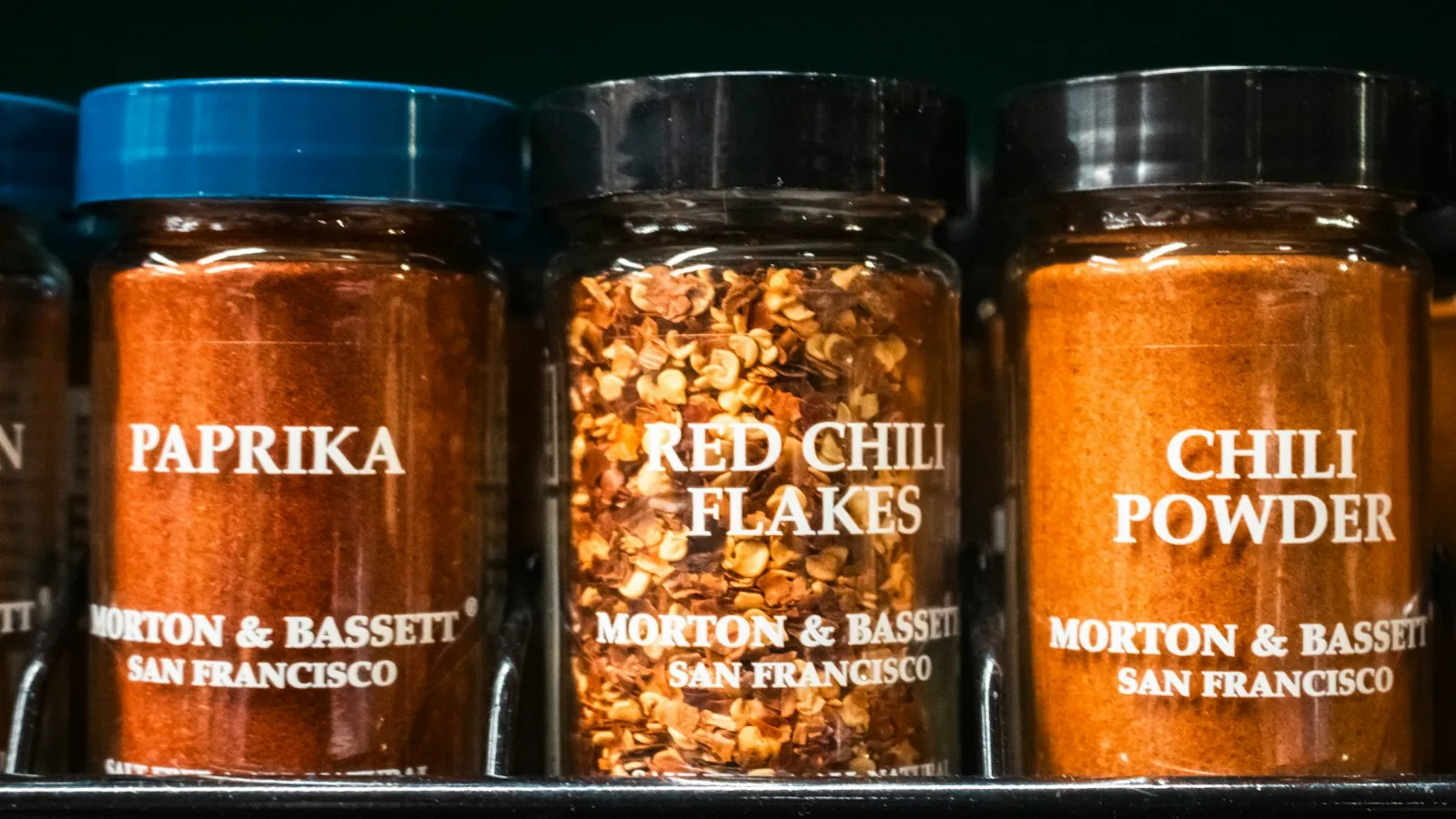
McCormick goes as far as recommending that you store members of the red pepper family, including paprika and chili powder, in the refrigerator to keep their color and freshness. If you buy a large tin of smoked paprika that you will work through slowly, the fridge is a reasonable home for it, as it is for a jar of natural peanut butter. Keep the lid tight so it does not pick up moisture or fridge smells.
Turmeric is the other spice where color helps. When its yellow goes muted and its earthy smell disappears, it is past its useful life.
What ruins spices in a home kitchen
Four things speed up the fade, and most kitchens supply all of them in the same spot.
- Heat. The cabinet or shelf above the stove is the worst place in the house to store spices. Both the USDA and McCormick specifically warn against storing shelf-stable foods above or beside the stove.
- Light. Clear jars on an open rack near a window look nice and lose color and aroma faster. A closed cabinet or drawer is better.
- Moisture. Shaking a jar directly over a steaming pot lets steam drift into it. That can cause clumping, and clumped spices tend to go stale unevenly. Measure into a spoon or your hand away from the pot instead. Brown sugar has the opposite problem, turning hard when it loses its moisture.
- Air. Loose lids and half-closed bags let aromatic oils escape. Keep containers tightly capped.
Should you freeze spices to make them last?
McCormick says no. Freezing does not extend the shelf life of dried herbs and spices, and repeatedly taking a jar in and out of the freezer can cause condensation, which speeds up flavor loss. The refrigerator suggestion above applies only to red pepper spices, not your whole collection.
Can you bring tired spices back to life?
Partly. Heat wakes up whatever aromatic oils are left, which is why a spice that seems weak in the jar can still taste decent once it is cooked properly. You have two good ways to do this.
Blooming means heating spices in oil, usually with your aromatics, until they are very fragrant. Watch the garlic, since it turns bitter if it scorches. America's Test Kitchen puts that at about 30 seconds. Many of the flavor compounds in spices dissolve in fat, so blooming carries them through the whole dish instead of leaving them sitting on the surface.
Dry toasting works in an empty skillet over medium heat. America's Test Kitchen gives about 1 to 3 minutes for ground spices and 3 to 5 minutes for whole spices. Stir constantly and pull the pan as soon as you smell them, because ground spices go from toasted to burned in seconds.
These tricks help a spice that has faded, not one that is gone. If the pinch test gives you nothing, heat will not create flavor that is not there.
Using an old jar when you have nothing else
If a spice is weak but not dead, you can still get by. Start with about 1.5 times the amount the recipe calls for, taste, and add more if you need it. Bloom it in oil early in cooking rather than stirring it in at the end.
Be careful doing this with blends that contain salt, like some chili powders, taco seasonings, and Cajun mixes. Doubling up on a weak blend also doubles the salt. Check the label, and if salt is listed near the top, add the blend gradually and adjust your other salt to match.
Also check for anything beyond staleness. A musty or moldy smell, visible mold, clumps that are damp rather than just packed, or tiny insects or webbing in the jar are all reasons to throw it out without a second thought. Those are moisture or pest problems, and they apply even to a jar you bought last month.
Keeping your spice rack from getting old in the first place
The easiest fix is buying less at a time. A big jar of a spice you use twice a year is almost guaranteed to go stale before you finish it. Small jars, or bulk bins where you can buy just a few tablespoons, cost more per ounce but waste less.
A few habits that help:
- Write the date on the lid with a permanent marker when you open a new jar. McCormick suggests this too, and it ends the guessing.
- Check the printed best-by date. McCormick notes that if one of its products has no best-by date at all, it is already past the recommended shelf life, which mostly means very old jars.
- Do a yearly sweep. Pick one day a year, such as a spring cleanout, run the pinch test on everything, and replace what fails.
- Store in a drawer or a cabinet away from the stove, ideally with labels facing up or out so you can see what you have and stop buying duplicates.
- Keep spices in their original tight-sealing containers unless you are moving them into something airtight and opaque.
Most people find that a handful of spices get used constantly and stay fresh on their own, while the rest sit for years. Those slow-moving jars are the ones worth testing and, when they fail, replacing in the smallest size you can find. The same cool, dark, tightly closed approach suits much of the rest of pantry food storage.
 What does a fresh ground spice look and smell like?
Color and aroma are the two checks for old spices, and both are easier to judge once you have seen how a fresh spice behaves. Gordon Ramsay's channel is a useful reference for spice cooking.
Gordon's Cooking & Shopping Guide For Spices
By Gordon Ramsay on YouTube. Their method may vary a little from ours. Watch on YouTube
- Compare the color of a fresh spice with the faded look described for paprika, cayenne and turmeric.
- Notice how a fresh spice is handled and released into a dish, then compare it with the pinch test of rubbing and smelling.
- Look at how much spice goes in, and think about the extra amount you would use if yours has softened but still smells.