 Food Storage
What Does a Best By Date Actually Mean for Food Safety at Home?
 By the CookClear writers
Checked against USDA and FDA food safety guidance
 Clear Answer
Yes, in most cases. According to the USDA Food Safety and Inspection Service (FSIS), a "Best if Used By" date marks peak flavor and quality, not safety, so properly stored food with no signs of spoilage is fine to eat after it. The one federally required safety date in the U.S. is the "Use-By" date on infant formula.
The date on a box of crackers or a jar of peanut butter is the manufacturer's best guess about when the product tastes and feels the way they intended. Past it, chips may go a little stale or a spice may taste flat, which affects quality but won't make you sick.
Who decides what date goes on the package?
The manufacturer does. Except for infant formula, federal regulations do not require product dating at all. FSIS states this directly: dating on meat, poultry, and egg products is voluntary. When a company does print a date, it has to be truthful and not misleading, and on meat and poultry it must show a month and day (plus the year for shelf-stable and frozen products) with a phrase next to it explaining what the date means.
 On the menu9 questions
Because there's no single federal standard, you see a mix of wording: best by, best before, use by, sell by, freeze by. In 2019 the FDA sent a letter to the food industry encouraging companies to settle on one phrase, "Best if Used By," to signal quality rather than safety. FSIS recommends the same phrase for the products it oversees.
The reason both agencies care is waste. USDA estimates that about 30% of the food supply is lost or wasted at the retail and consumer levels, and it names confusion over date labels as one contributor. Coverage of the FDA's 2019 push cited estimates that date confusion accounts for roughly 20% of the food thrown away in American homes.
What each date label actually means
Here's how FSIS defines the common phrases. Notice that only one row is about safety, and it applies to a single product.
| Label | What it tells you | Is it a safety date? |
|---|---|---|
| Best if Used By / Best Before | When flavor and quality are at their peak | No |
| Sell-By | How long the store should display the product, for inventory | No |
| Use-By | Last date recommended for use at peak quality | No, except on infant formula |
| Freeze-By | When to freeze the product to keep peak quality | No |
| Pack date (eggs, cans) | When the food was packed or canned | No, it's a code, not a deadline |
A sell-by date is aimed at the store. Buying milk or chicken on its sell-by date is fine; it just means you should plan to use it, freeze it, or check it within the normal storage window once it's home.
Why infant formula is the exception
Infant formula is the only food where the federal government requires a date, and the FDA requires that it be a "Use-By" date. FSIS notes that this is the only date type tied to both safety and nutrient content: up to that date, the formula is expected to deliver the nutrients listed on the label.
Babies often rely on formula as their only food, so a drop in nutrients is far more serious than it would for an adult eating a varied diet. The FSIS guidance is simple: do not buy or use baby formula after its Use-By date. This is the one label you should treat as a hard stop.
How to tell if food past its date is still good
The date stops being useful once you have the food in front of you. FSIS says foods should remain safe until spoilage is evident, as long as they've been handled properly. Spoilage shows up as an off odor, an off flavor, or an off texture. If you notice any of those, throw the food out.
Use this sequence when you find something past its date:
- Check how it was stored. Refrigerated food needs to have stayed at 40°F (4°C) or below. Anything left out above 40°F for more than 2 hours (or more than 1 hour when it's 90°F or hotter) should be discarded, date or no date.
- Look at the package. Bulging lids, swollen or leaking cans, deep dents along the seam, and rust are reasons to toss canned goods regardless of the date.
- Smell it. Sour, ammonia-like, or rancid smells mean spoilage.
- Look at it closely. Mold, slime, or a sticky film are signs to discard. A color change alone in meat or poultry is not a spoilage indicator, according to FSIS.
- Taste only if everything else passes. A small taste can tell you if crackers are stale or oil has gone rancid, but never taste something that already smells or looks off.
The bacteria that cause food poisoning (like Salmonella or Listeria) usually don't change how food smells or looks. Spoilage bacteria do. That's why the storage history in step 1 tells you more than the sniff test. A food that's been sitting at a warm temperature can look and smell fine and still make you sick. Fresh produce rarely carries a date at all, so look and smell do the work there, as with a ripe cantaloupe that smells sweet at the stem end.
Shelf-stable foods last the longest past the date
Pantry staples are where the best by date means the least. Canned food, dry pasta, rice, flour, cereal, and crackers don't support bacterial growth while they're sealed and dry, so the main risk past the date is quality loss.
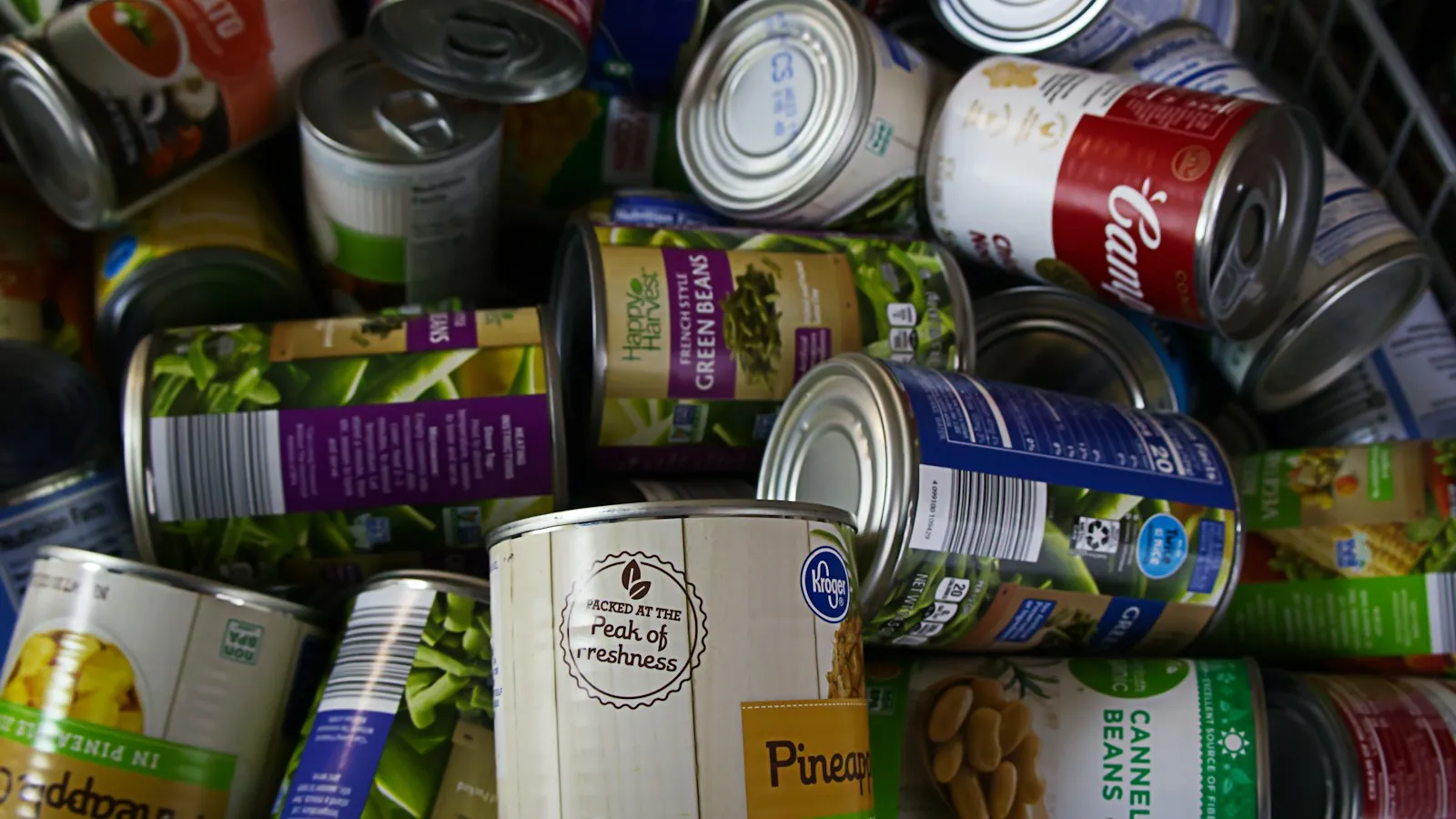
For canned foods, FSIS gives these quality windows:
- High-acid canned foods (tomatoes, fruit, pickled items): best quality for 12 to 18 months.
- Low-acid canned foods (meat, poultry, fish, most vegetables): best quality for 2 to 5 years.
The codes stamped on cans are usually packing codes for tracking, not best by dates meant for you. A can that's intact, not swollen, and stored in a cool, dry cupboard is safe well beyond those windows, though the texture and color may slowly fade. Once opened, the clock changes; an open jar of pasta sauce, for example, gets about a week.
Dry goods follow the same idea. Old flour can smell stale or rancid (especially whole wheat, which contains oil from the germ), and old crackers lose their crunch. Those are taste problems. Pantry pests and moisture are the actual reasons to throw dry goods out.
What about refrigerated foods like meat, eggs, and deli items?
Here the date on the package counts for less than how long the food has been in your fridge. The FoodSafety.gov cold storage chart gives storage times based on a fridge at 40°F (4°C) or below and a freezer at 0°F (-18°C) or below.
| Food | Refrigerator | Freezer |
|---|---|---|
| Ground meat (beef, turkey, chicken, pork) | 1 to 2 days | 3 to 4 months |
| Fresh chicken, whole | 1 to 2 days | 1 year |
| Fresh chicken, pieces | 1 to 2 days | 9 months |
| Steaks (beef, veal, lamb, pork) | 3 to 5 days | 4 to 12 months |
| Bacon | 1 week | 1 month |
| Hot dogs, unopened | 2 weeks | 1 to 2 months |
| Hot dogs, opened | 1 week | 1 to 2 months |
| Lunch meat, unopened | 2 weeks | 1 to 2 months |
| Lunch meat, opened or deli-sliced | 3 to 5 days | 1 to 2 months |
| Deli salads (egg, chicken, tuna, macaroni) | 3 to 4 days | Doesn't freeze well |
| Eggs in the shell | 3 to 5 weeks | Don't freeze in the shell |
Raw ground meat and chicken only keep 1 to 2 days in the fridge, which may be shorter than the time left before the sell-by date. Go by the day you bought it. Also, once you open a package of lunch meat or hot dogs, the clock resets to the shorter "opened" time, no matter what the package date says.
Ready-to-eat foods like deli meats and deli salads deserve extra care because Listeria can grow slowly even at refrigerator temperatures. Pregnant people, older adults, and anyone with a weakened immune system should stick closely to these windows.
Eggs have their own code
Egg cartons with the USDA grade shield carry a three-digit pack date: 001 is January 1 and 365 is December 31. If the carton also shows a sell-by date, it can't be more than 30 days past the pack date. State laws govern sell-by and expiration dates on eggs, and some states don't allow sell-by dates at all.
Fresh eggs in the shell keep 3 to 5 weeks in the fridge, so they're often fine for a few weeks past a sell-by date. Store them in their original carton on a shelf, not in the door, where the temperature swings every time you open the fridge. Hard-cooked eggs are different, since hard boiled eggs keep about 7 days in the fridge, peeled or not.
Freezing stops the clock on safety
If you won't use something before its date, freeze it. FSIS and FoodSafety.gov both note that food kept continuously at 0°F (-18°C) or below stays safe indefinitely. The freezer times in the table above are about quality, since flavor and texture slowly decline and freezer burn creeps in over months.
A "Freeze-By" date is a nudge to get the product into the freezer while it's still at its best. Freezing on or before that date gives you better results when you thaw it. Freezing something the day after doesn't make it unsafe; it just means the quality starts from a slightly lower point.
A few habits help:
- Freeze meat in its original package if you'll use it within a couple of months. For longer storage, overwrap it with foil or a freezer bag to limit freezer burn.
- Write the freeze date on the package with a marker. The printed best by date is meaningless once it's frozen.
- Thaw in the refrigerator, in cold water, or in the microwave, never on the counter. If it thaws and you change plans, refreezing thawed meat has its own rules.
Can stores sell or donate food past its date?
Yes. FSIS says foods that show no signs of spoilage may be sold, purchased, donated, and eaten past the date on the package. That's why you'll sometimes find marked-down items at discount grocers and why food banks accept items past their best by date.
Infant formula is again the exception. Because its Use-By date is a federal requirement tied to nutrient content, it shouldn't be bought, sold, or used after that date. Check how long each item keeps once opened, because food storage times vary by food.
 What date labels on packages really tell you
The wording on a package is easy to misread, and the differences between labels are easier to see when someone points at real examples. How to Adult sorts out which dates are about quality and which are about safety.
Food Poisoning & Dead Batteries: Expiration Dates for Everything EXPLAINED!
By How to Adult on YouTube. Their method may vary a little from ours. Watch on YouTube
- Compare each label named with the table above and note which one is tied to safety, which is infant formula Use-By.
- Notice what signs of spoilage are mentioned, such as smell, texture, and mold, and match them to the checklist above.
- Listen for the storage advice, like keeping refrigerated food at 40°F or below, since storage history matters more than the date.


