 Kitchen Tools
What Stops Food From Sticking to a Stainless Steel Pan for Good?
 By the CookClear writers
Checked against manufacturer instructions and test kitchen reviews
 Clear Answer
Food stops sticking to stainless steel when the pan is hot before the oil goes in and you leave the food alone until it releases. Preheat the empty pan over medium for 2 to 3 minutes, add the oil, and wait until it shimmers. Cold or wet food, or moving it before it browns, will make it stick no matter how much oil you use.
Most people who fight their stainless pan are doing the reverse: oil goes into a cold pan, food goes in a minute later, and it gets nudged every 20 seconds. Fixing the timing solves this; more oil doesn't.
What is actually happening when food grabs the pan?
Stainless steel looks smooth, but under magnification its surface is full of tiny pits and ridges. When raw protein (chicken, fish, eggs) touches that surface, the proteins slip into those gaps and form chemical bonds with the metal itself. Iron and other metals in the steel bond readily with the sulfur and other reactive spots on protein molecules. That's the "glue" you feel when you try to flip a chicken breast and half of it stays behind.
 On the menu10 questions
Heat changes the picture in two ways. First, metal expands as it heats, and a hot, evenly heated surface gives food less chance to wedge into it before it starts to cook. Second, and more important, a hot pan instantly turns the moisture on the food's surface into steam. That thin layer of vapor acts as a cushion, and the outer layer of protein sets (coagulates) in a fraction of a second, before it has time to bond with the steel.
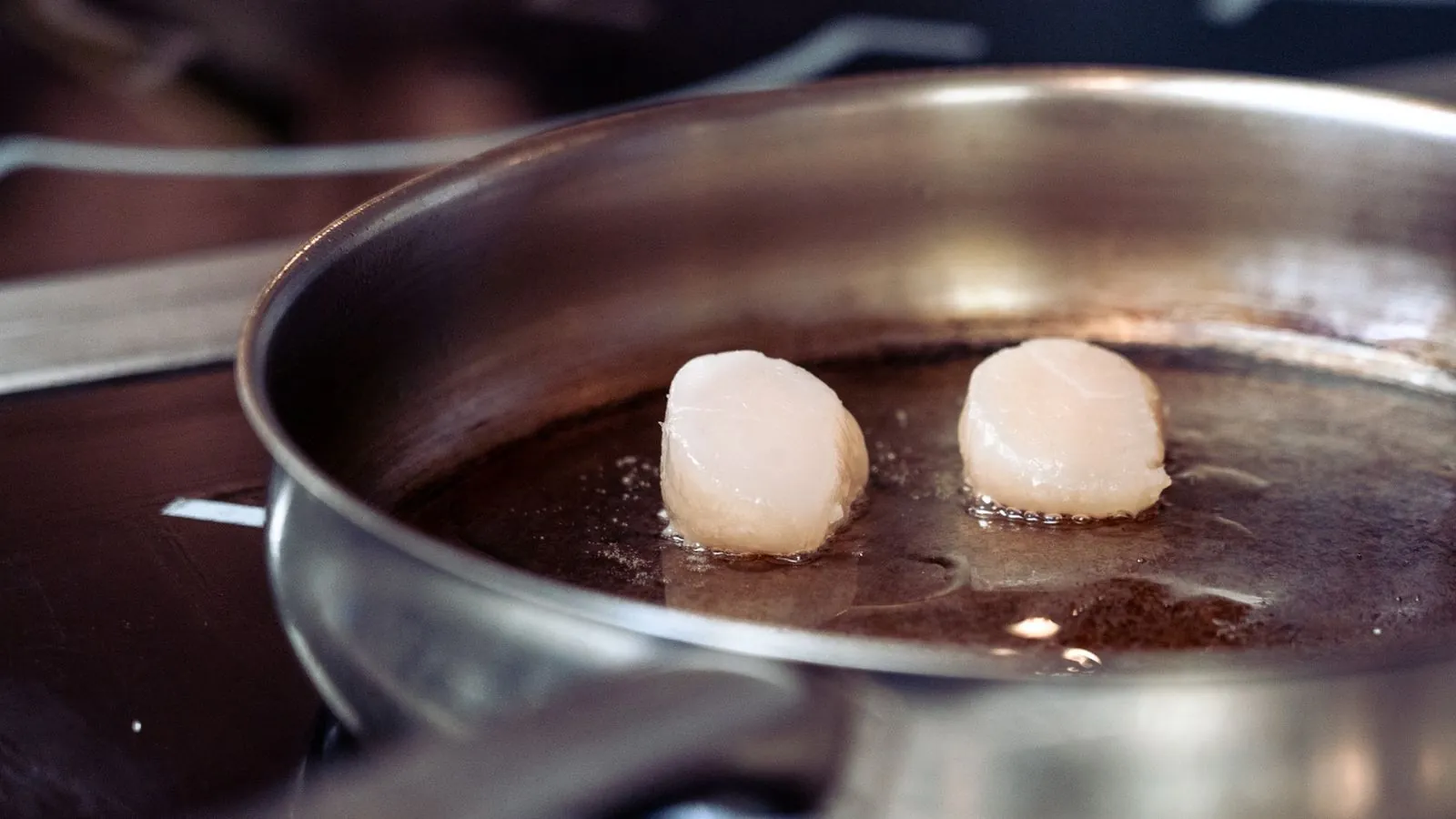
Oil helps, but only as a middle layer. If the pan is cool, the oil sits there and the food pushes right through it to the metal. If the pan is properly hot, the oil fills in the surface texture and keeps food floating on a thin film while it browns.
The usual culprits, ranked
These causes are listed roughly in order of how often they're the problem.
| Cause | What you'll notice | Fix |
|---|---|---|
| Pan not preheated long enough | Food doesn't sizzle loudly when it lands | Heat the empty pan 2 to 3 minutes on medium, then test |
| Oil added to a cold pan and heated with it | Oil smokes before the steel is evenly hot | Heat the pan first, then add oil |
| Moving food too soon | Food tears, leaves a skin on the pan | Wait until it releases with a gentle shake, often 3 to 5 minutes |
| Food straight from the fridge | Pan temperature crashes, sizzle fades | Let meat sit 15 to 20 minutes, or use fewer pieces |
| Wet surface on the food | Sputtering, steaming, gray color | Pat dry with paper towels, salt just before cooking |
| Overcrowding | Liquid pools in the pan, nothing browns | Leave at least 1 inch between pieces, cook in batches |
| Heat way too high | Oil smokes heavily, food scorches and sticks as it burns | Medium to medium-high is plenty for most pans |
| Leftover residue on the pan | Sticking in the same spots every time | Scrub with Bar Keepers Friend or a baking soda paste |
If you only fix the first and third rows, most sticking goes away.
How hot should a stainless steel pan be, and how can you tell?
You don't need a thermometer, the same as when checking frying oil heat. The simplest check is the water droplet test, which relies on something called the Leidenfrost effect. When a pan is hot enough (somewhere around 380 to 400°F at the surface for this test), a drop of water doesn't boil away. Instead it forms a ball that glides around the pan on its own cushion of steam.
- Put the clean, dry, empty pan on medium heat.
- After about 2 minutes, flick in a few drops of water.
- If they sizzle and evaporate quickly, the pan isn't ready. Wait 30 seconds and try again.
- If they break into several small balls that scatter, you're close.
- If one drop holds together as a single bead and skates across the surface like mercury, the pan is ready.
- Wipe out any water, add your oil, and give it 15 to 30 seconds until it shimmers and flows like water when you tilt the pan.
- Add the food. You should hear a strong, steady sizzle right away.
Heavy tri-ply and 5-ply pans take a little longer than thin ones, sometimes 3 to 4 minutes, because there's more aluminum core to heat. On induction it can happen in under 90 seconds, so start testing early.
One caution: don't let the oiled pan sit for minutes after it shimmers. Most cooking oils start breaking down and smoking somewhere between 400 and 520°F depending on the type, and burnt, sticky oil makes things worse.
When to flip food in a stainless pan, and why waiting matters
This is where most people go wrong even when the pan is hot. When food first hits a hot pan, it will stick for a bit. That's normal. As the surface browns, the proteins finish setting, moisture leaves the outer layer, and the crust physically shrinks away from the metal. At that point the food releases on its own.
If you try to flip it during the stuck phase, you tear the crust that was forming. Now raw protein is exposed again, and it bonds to the pan in a fresh spot. That's how you end up with a pan full of chicken skin and a bald chicken breast.
A rough sense of release times at medium-high:
- Chicken breast or thighs: 4 to 6 minutes on the first side
- Salmon, skin side down: 4 to 5 minutes
- Thin white fish: 2 to 3 minutes
- Scallops: 1 1/2 to 2 minutes
- Pork chops, 1 inch thick: 3 to 4 minutes
- Burger patties: 3 to 4 minutes
Test by giving the pan a short shake or pushing the edge of the food with a thin spatula. If it resists, give it another 30 to 60 seconds. If it slides, flip it.
Does the food itself make a difference?
A lot. Cold food is one of the most overlooked causes. A pound of chicken straight from a 38°F fridge pulls a surprising amount of heat out of the pan the moment it lands. The surface temperature drops below the point where moisture flashes to steam, and the food sits in its own liquid, sticking and steaming instead of searing.
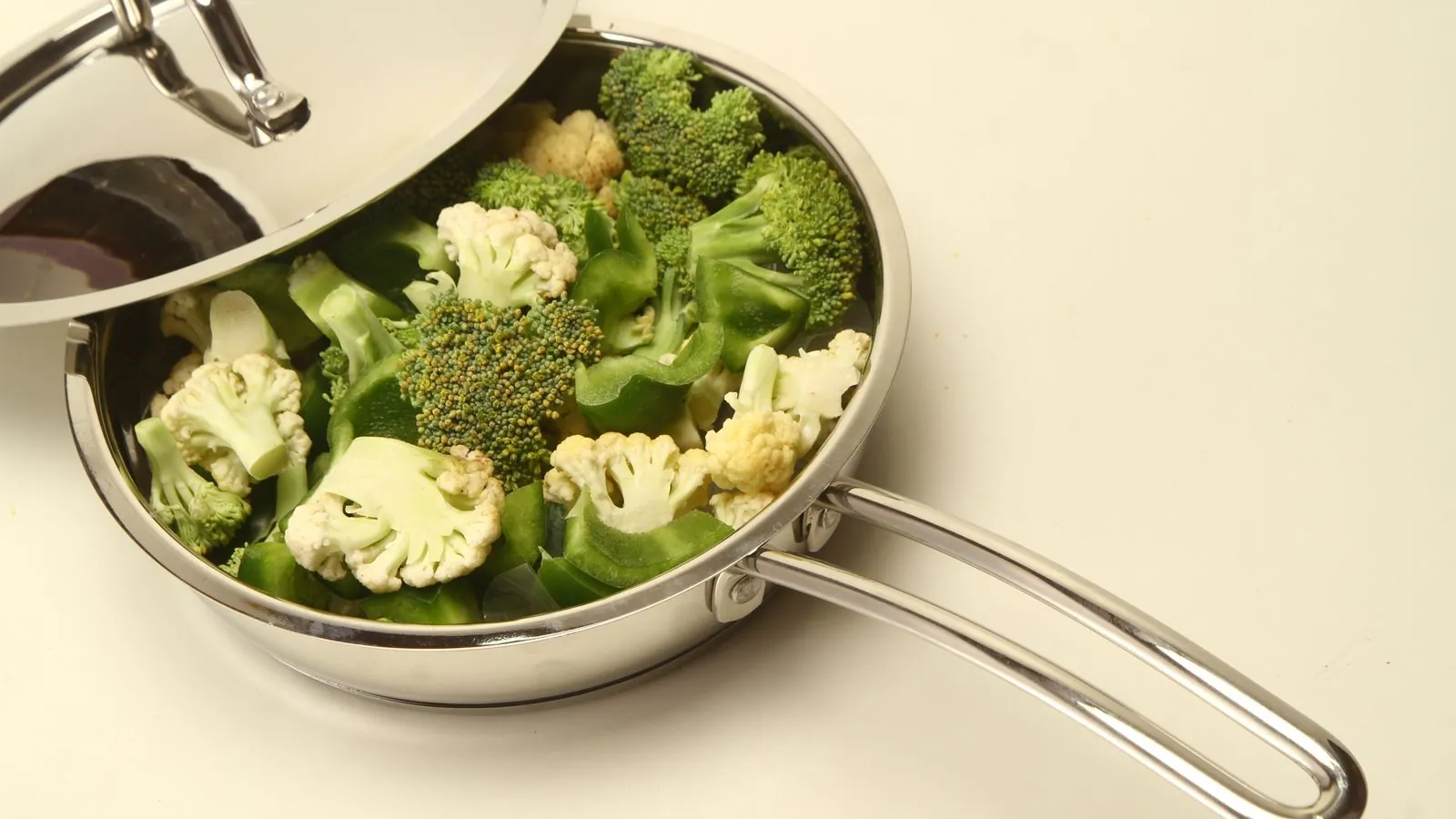
You don't need to leave meat out for an hour. Letting it sit for 15 to 20 minutes while you prep takes the deep chill off, and that's comfortably within the USDA's 2-hour limit for perishable food at room temperature. Patting it dry does more than the time on the counter.
Moisture is the other half. Water on the surface has to boil off before browning can start, and while it's boiling the food sits at about 212°F, too cool to brown and release. Pat proteins dry with paper towels right before they go in. If you marinated, scrape off excess marinade, especially sugary ones, which caramelize and glue themselves to steel.
Some foods are just stickier than others:
- Eggs are the hardest. They're mostly water and protein and they set slowly at the temperatures that keep them tender. Use more fat (a tablespoon of butter for two eggs), medium-low heat after a good preheat, and let them set before moving. Many cooks simply keep a nonstick pan for eggs.
- Fish with delicate flesh tears easily. Skin-on fillets are much more forgiving if you cook them skin side down and leave them.
- Starchy foods like potatoes release surface starch that sticks. Rinse and dry cut potatoes, and give them a few extra minutes before stirring.
- Breaded or floured items usually release well once the coating crisps, as long as there's enough oil.
How much oil do you actually need?
Not as much as you'd think, if the pan is right. For searing, 1 to 2 teaspoons in a 10-inch pan is enough to coat the bottom in a thin film. For a 12-inch pan, about 1 tablespoon. You want a layer that covers the whole cooking surface when you swirl it, with no dry patches.
Pouring in more oil doesn't fix a cold pan, and too much oil in a stainless steel pan can work against you: the food shallow-fries unevenly, splatters, and the oil can still pool away from the edges where food is sticking. If you've been adding oil to stop sticking and it isn't working, the issue is almost certainly heat or patience.
Choose an oil that handles heat. Canola, vegetable, peanut, grapeseed, and avocado oil all work well for searing. Extra virgin olive oil is fine at medium heat but starts smoking sooner, and butter's milk solids burn above roughly 350°F, so add butter later in cooking or mix it with oil.
Can you season stainless steel like cast iron?
You can, sort of. Heating a thin coat of oil in the pan until it just begins to smoke, then wiping it out, leaves a light polymerized film that helps with eggs and fish for a while.
The catch is that it doesn't last. Stainless steel doesn't hold seasoning the way porous cast iron does, and the first good scrub or trip through the dishwasher removes it. It helps for a specific job (say, a batch of fried eggs on Sunday), but getting the heat and timing right gets you further.
What about the spots where food always sticks?
If food sticks in the same areas every time, look at the pan. Stainless steel picks up a thin layer of polymerized oil and burnt-on residue over time, often visible as a yellowish or brown haze or a rainbow tint. That rough, tacky layer grabs food.
To strip it:
- Wet the pan and sprinkle on Bar Keepers Friend (or make a paste of baking soda and a little water).
- Scrub with a non-scratch sponge, working with the grain of the metal if you can see one.
- Rinse well and dry completely.
The rainbow discoloration (heat tint) is harmless and doesn't cause sticking on its own, but the same cleaner removes it.
Uneven heat can also be the cause. A thin, single-layer stainless pan on a small burner develops hot and cool spots, and food sticks in the cool zones. A heavier clad pan, or matching the burner size to the pan base, evens things out. On gas, a pan wider than the flame ring often has cold edges. On a thin pan, matching cookware to the burner helps.
Getting stuck food off the pan without wrecking dinner
If something does stick, don't pry at it. Give it another minute; it may release as it browns. If it's truly stuck at the end, those brown bits (the fond) carry a lot of flavor. Pour in 1/4 to 1/2 cup of wine, stock, or water while the pan is still hot and scrape with a wooden spoon. That turns the stuck layer into a quick pan sauce and cleans the pan at the same time.
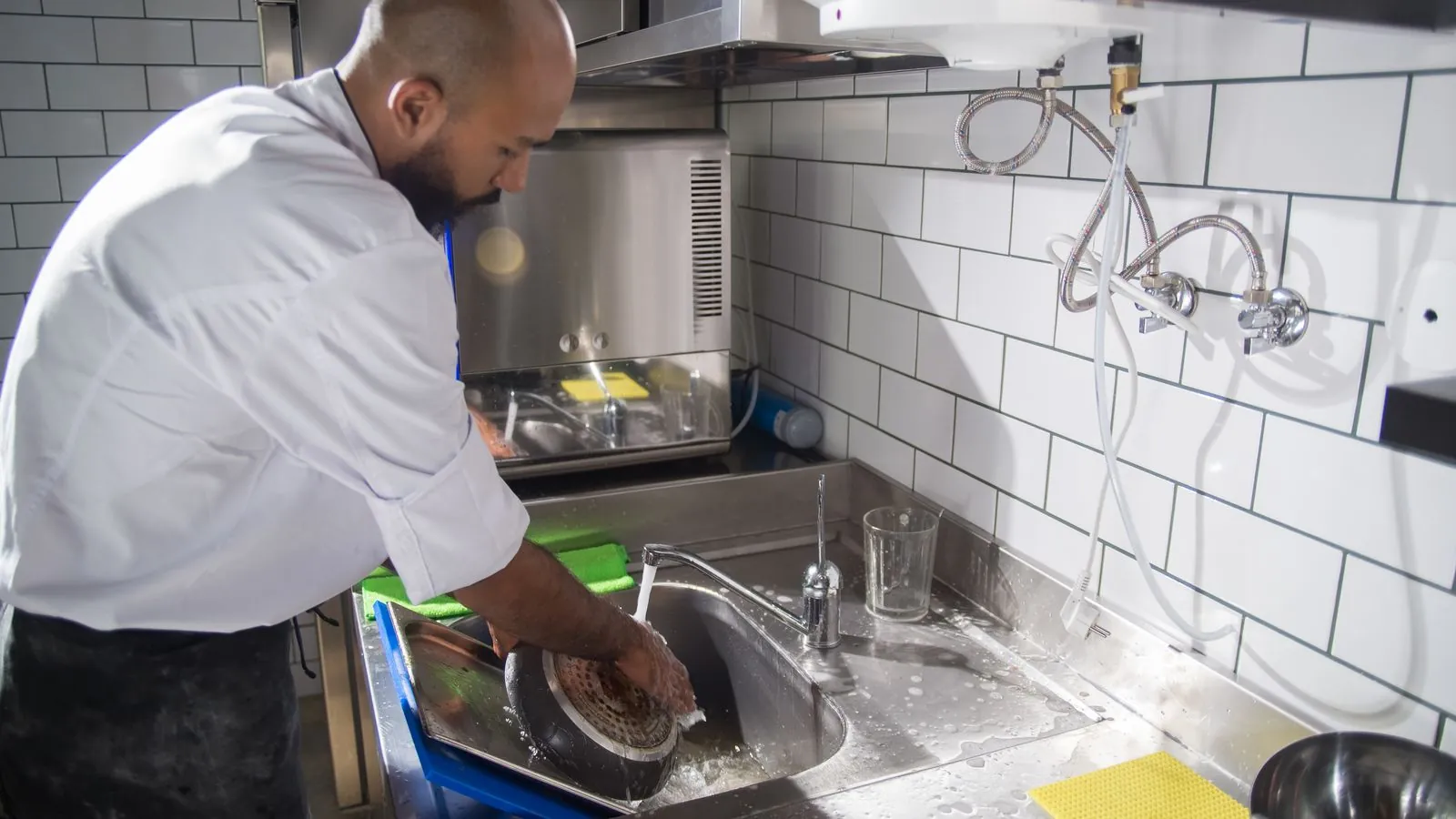
For a pan that's already cooled with burnt bits, fill it with an inch of water, bring it to a simmer for 5 minutes, and scrape. Most residue lifts right off. Skip steel wool, which leaves scratches that give food even more to grab.
 How the water droplet test looks in a hot pan
A skating bead of water is hard to judge from words alone. Tom's Kitchen shows how food releases from stainless steel.
Does Seasoning A Stainless Steel Pan Make it Non-Stick and Easier to Clean?
By Tom's Kitchen on YouTube. Their method may vary a little from ours. Watch on YouTube
- Compare the water in the pan with the single bead that skates like mercury above.
- Notice how long the food sits untouched before it moves.
- Compare the sizzle when food lands with the strong, steady sound described above.


