 Cooking Times
How Long Do You Bake a Sweet Potato So the Inside Turns Soft and Sticky?
 By the CookClear writers
Checked against USDA safe temperatures and test kitchen timing
 Clear Answer
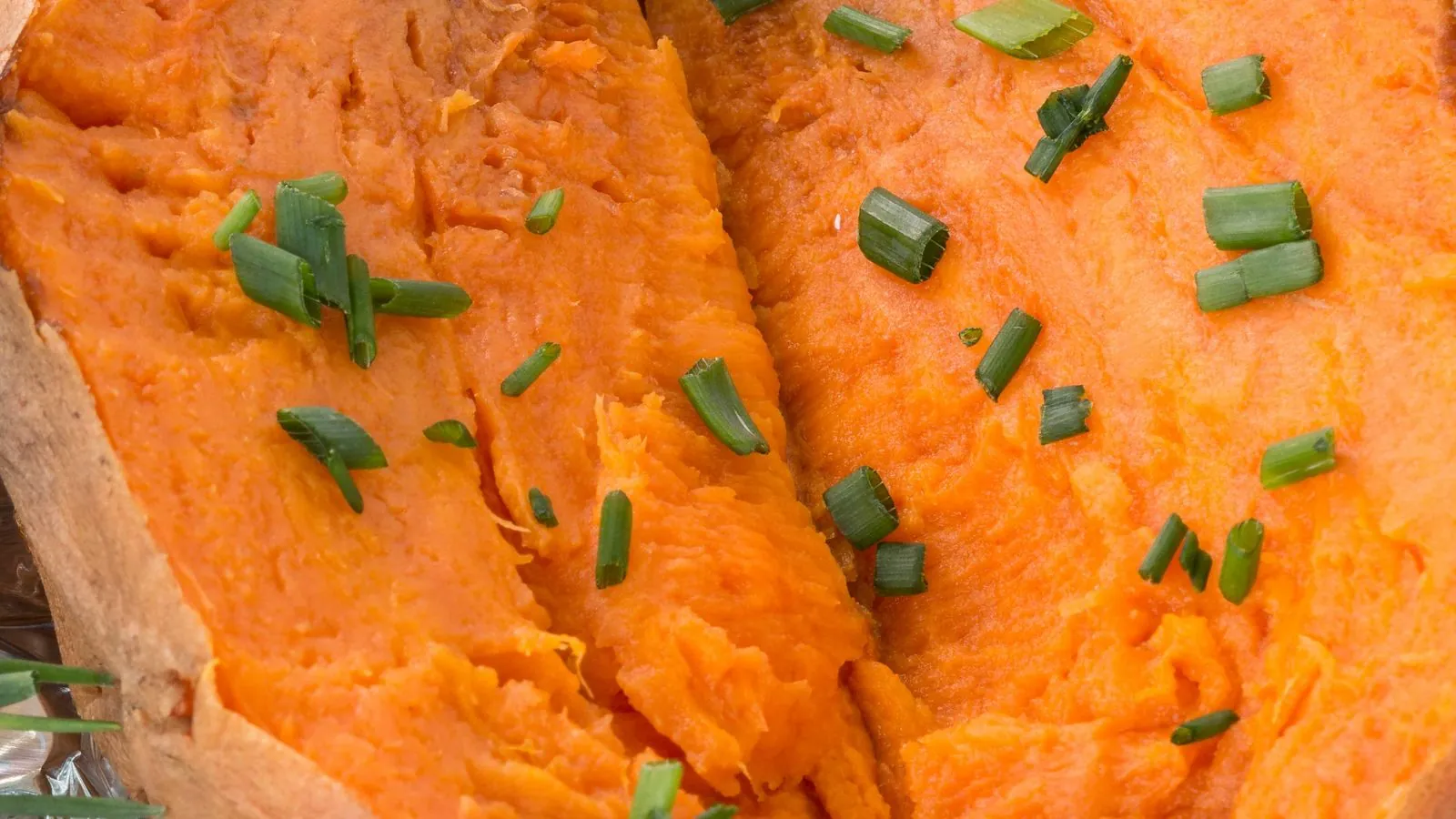
A medium sweet potato (about 8 to 10 ounces) needs 50 to 60 minutes at 400°F to turn fully soft, and closer to 70 to 75 minutes if you want the flesh truly syrupy with caramel leaking from the skin. The target is an internal temperature of about 205 to 212°F. Pull it at 190°F and it will be cooked but still a bit dry and starchy.
Most recipes stop at "fork tender," which is the bare minimum. A sweet potato keeps getting better well past that point, and a little extra time makes it soft enough to eat with a spoon.
Baking times by size and oven temperature
Size makes the biggest difference, because heat has to travel all the way to the center. A fat, round potato takes far longer than a long, skinny one of the same weight. Use these numbers as a starting point, then check with a thermometer or a skewer. When you are timing other dishes in the same oven, oven cooking times work the same way: use the clock to plan and a thermometer to decide.
| Potato size (weight) | 375°F | 400°F | 425°F |
|---|---|---|---|
| Small (5 to 7 oz) | 50 to 60 min | 40 to 50 min | 35 to 45 min |
| Medium (8 to 10 oz) | 60 to 75 min | 50 to 60 min | 45 to 55 min |
| Large (11 to 14 oz) | 75 to 90 min | 60 to 75 min | 55 to 70 min |
| Extra large (15 oz and up) | 90+ min | 75 to 90 min | 70 to 85 min |
For a syrupy center, add 10 to 15 minutes to any of those times. Sweet potatoes are forgiving. The skin protects the flesh, and the high sugar and moisture content keep the inside from drying out the way a russet can.
Why does extra time make it sweeter and softer?
Two things happen inside a sweet potato as it heats. First, an enzyme called amylase converts starch into maltose, a sugar. It works best between roughly 135 and 170°F, so a slow climb through that range gives you a sweeter potato than a fast one.
Second, once the center passes about 200°F, the pectin holding the cell walls together breaks down quickly. America's Test Kitchen found that holding sweet potatoes in the 200°F-plus zone is what produces the creamy, almost pudding-like texture. That is why a potato that is "done" at 190°F still tastes a bit stiff, while one at 210°F collapses into silk.
The syrup you see bubbling out of the skin is sugar-rich juice that has been pushed out as the flesh softens. When it starts to caramelize on the pan, you are in the right territory.
How do you know when a sweet potato is done?
A thermometer gives you the clearest answer. Slide an instant-read probe into the thickest part from the side, so you hit the true center.
- 190 to 200°F: Cooked and edible, but the flesh is still slightly firm and pale.
- 205 to 212°F: Soft, creamy, and deeply sweet. This is the target.
- Skin check: The skin looks puffed and loose, with wrinkles near the ends.
- Squeeze test: Pressed gently with an oven mitt, it gives all the way through, with no firm core.
- Syrup: Dark, sticky juice is leaking from the ends or any holes you poked.
If you don't own a thermometer, a skewer should slide into the center with zero resistance, like pushing into soft butter. Any drag in the middle means it needs more time.
Step-by-step: the oven method that works
This is the plain approach I come back to, and it needs nothing beyond a sheet pan and some foil or parchment.
- Heat the oven to 400°F with a rack in the middle. Line a rimmed sheet pan with foil or parchment, because the syrup will burn onto bare metal.
- Scrub the potatoes under running water and dry them well. Dry skin roasts; wet skin steams.
- Poke each one 4 to 6 times with a fork. This gives steam an exit and lets the syrup escape where you can see it.
- Rub lightly with oil and salt if you want edible, slightly crisp skin. Skip it if you plan to scoop out the flesh.
- Bake directly on the lined pan, spaced at least an inch apart, for 50 minutes for medium potatoes.
- Check the temperature. Keep going in 10-minute rounds until the center reads 205°F or higher.
- Rest 5 minutes, then slit the top lengthwise and push the ends toward the middle to open it up.
Picking potatoes that bake evenly
Choose potatoes that are similar in size and shape if you are baking several at once. Mixed sizes mean one is perfect while another is still hard in the middle, or you overshoot the small ones waiting on the big one.

Medium potatoes with a fairly even thickness from end to end bake most predictably. Very long ones with skinny tips will have those tips dry and chewy by the time the center is soft. If that's all you have, wrap just the thin ends in a small piece of foil partway through.
Look for firm skin with no soft spots, wrinkles, or sprouts. Orange-fleshed varieties like Beauregard and Garnet are the moistest and most syrupy. Japanese sweet potatoes (purple skin, pale yellow flesh) are drier and starchier, so they turn fluffy and chestnut-like rather than syrupy, and they often need a few extra minutes.
Should you wrap sweet potatoes in foil?
Usually no. Foil traps steam, so the potato cooks in its own moisture. You get a soft but wetter interior with soggy skin and less of that concentrated, caramelized flavor around the edges.
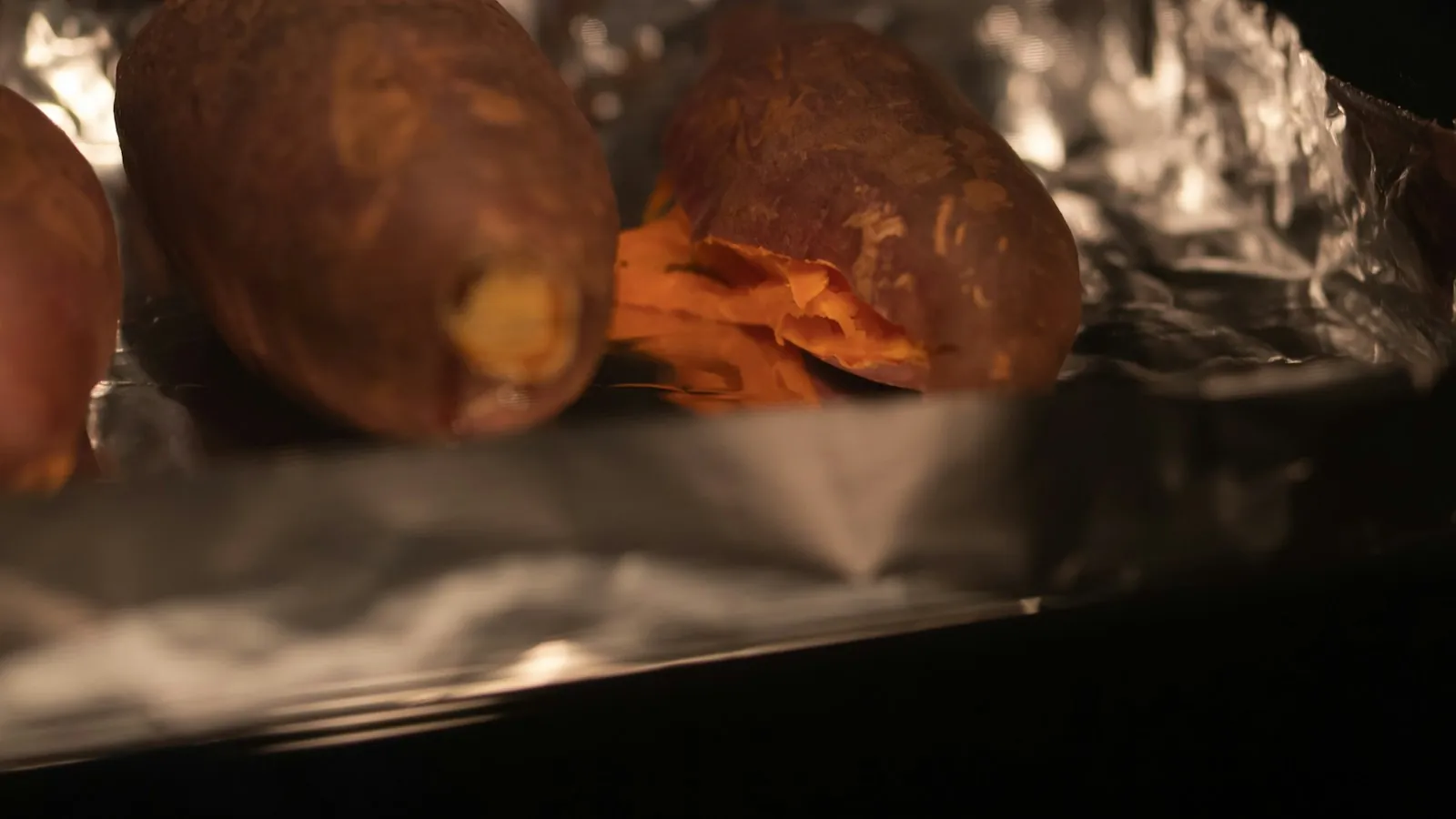
Unwrapped potatoes lose some surface moisture as they bake, which concentrates the sugar right under the skin, where the flavor is strongest. Line the pan with foil instead of wrapping the potatoes, and you get the easy cleanup without the steaming.
The one case for wrapping is holding them. If dinner is running late, wrap finished potatoes in foil and they'll stay hot for 30 to 45 minutes.
Does a higher oven temperature make it faster?
Yes, but only somewhat, and it changes the result. At 425 or 450°F, the outside heats quickly while the center lags, so the potato spends less time in the range where amylase makes sugar. You save 10 to 15 minutes but give up some sweetness.
At 350 to 375°F, the potato climbs slowly and turns very sweet, but the total time stretches past an hour for anything medium-sized. 400°F is a good middle ground: sweet, soft, and done in about an hour. It's a good setting for roasting butternut squash alongside, too.
If you are baking alongside something else at 350°F, that's fine. Add 20 to 25 minutes to the 400°F time and rely on the thermometer.
Can you speed it up with the microwave?
You can, and it works better than you might expect. Microwave a medium potato for 4 to 5 minutes (poked first) to jump-start the center, then move it to a 425°F oven for 25 to 35 minutes to finish and develop flavor in the skin.
America's Test Kitchen goes further with this idea: they microwave until the center reaches about 200°F, then bake at 425°F for a full hour to hold it in the softening zone. It's long, but it reliably produces the creamiest result.
A potato cooked only in the microwave will be soft but noticeably less sweet. It races through the amylase range in a couple of minutes, so much less starch converts to sugar.
| Method | Total time (medium potato) | Texture | Sweetness |
|---|---|---|---|
| Oven only, 400°F | 50 to 75 min | Creamy to syrupy | High |
| Microwave, then 425°F oven | 30 to 40 min | Soft, good skin | Medium-high |
| Microwave only | 8 to 10 min | Soft, a bit wet | Lower |
Why is my baked sweet potato still hard or stringy?
Hardness almost always means it simply needed more time. Ovens run hot or cold by 25°F or more, and a dense potato can fool you. Put it back in and check every 10 minutes.
Stringiness is partly the variety and partly age. Some sweet potatoes, especially older or larger ones, have more fibrous strands no matter how long you bake them. Cooking to 205°F or higher softens them as much as possible, and whipping the flesh with a fork helps.
A pale, dry interior usually points to a white or Japanese variety, or a potato pulled too early. Neither is a mistake, just a different result than the orange, syrupy kind.
Storing and reheating leftover sweet potatoes
Follow the usual food-safety rule: refrigerate cooked sweet potatoes within 2 hours, since bacteria grow fastest between 40 and 140°F. In a covered container, they keep 3 to 5 days in the fridge.
To reheat, warm whole potatoes at 350°F for 15 to 20 minutes, or microwave the flesh for 1 to 2 minutes, stirring halfway. Reheat until steaming hot throughout (165°F). Cold baked sweet potato is also good straight from the fridge, mashed into oatmeal or blended into a smoothie.
Baked flesh also freezes well. Scoop it out, mash it, and freeze in a flat bag for up to 3 months. It goes straight into pies, muffins, or soup.
 What a soft, syrupy baked sweet potato looks like
Color and squish are hard to judge from numbers alone, and a baked sweet potato changes a lot in its last 15 minutes. Martha Stewart's kitchen shows the potato prepped, baked and opened.
How to Make Martha Stewart’s Baked Sweet Potatoes | Best Oven-Baked Recipe
By Martha Stewart on YouTube. Their method may vary a little from ours. Watch on YouTube
- Watch how the potato is poked and prepped, and compare it with the 4 to 6 fork pokes and the lined pan described above.
- Look for the puffed, loose skin and any dark syrup at the ends, which the checklist above links to the 205 to 212°F target.
- Compare how the flesh looks when split open with the difference between a merely cooked potato at 190°F and a creamy one.


