Cooking Times
How Long Should a Frozen Turkey Thaw in the Fridge Before You Roast It?
 By the CookClear writers
Checked against USDA safe temperatures and test kitchen timing
 Clear Answer
Give it one full day in the refrigerator for every 4 to 5 pounds of turkey. A 12-pound bird needs about 3 days, a 16-pound bird about 4 days, and a 20-pound bird about 5 days. That is the USDA's rule of thumb, and in practice the slower end (4 pounds per day) is the safer number to plan around.
Most people underestimate this by a day or two. The turkey goes into the fridge on Tuesday night for a Thursday dinner, and on Thursday morning the cavity still has a block of ice in it. Count backward from the day you cook, not the day you shop.
Thawing times by turkey size
Here is the math worked out for common sizes, from a small bird for four to the pound or more per person a big gathering calls for. The "plan for" column uses the slower 4-pounds-per-day pace and rounds up, because a fridge that runs a little cold or a crowded shelf will slow things down.
| Turkey weight | USDA range | Plan for | Move to fridge for a Thursday dinner |
|---|---|---|---|
| 4 to 8 lb (breast or small bird) | 1 to 2 days | 2 days | Tuesday morning |
| 8 to 12 lb | 2 to 3 days | 3 days | Monday morning |
| 12 to 16 lb | 3 to 4 days | 4 days | Sunday morning |
| 16 to 20 lb | 4 to 5 days | 5 days | Saturday morning |
| 20 to 24 lb | 5 to 6 days | 6 days | Friday morning |
If you are cooking on a day other than Thursday, just count back the same number of days. A 14-pound bird for a Saturday dinner goes into the fridge on Tuesday.
A turkey breast on its own follows the same rate. Bone-in breasts around 6 to 8 pounds usually need a little under 2 days.
Why the fridge takes so long
A frozen turkey is a big, dense block that starts around 0°F. Your refrigerator sits at about 37 to 40°F, which is only a few degrees above freezing. Heat moves into the bird slowly, and the center thaws last.
The cavity is the stubborn part. Air does not circulate well inside it, and the giblet bag is often frozen solid in there. You can have legs that bend freely while the inside is still icy.
The slow pace keeps every part of the bird below 40°F the entire time, so bacteria never get a chance to multiply. The USDA calls the fridge the safest thawing method for exactly that reason. The counter is not on the list at all, because the outer layer of meat sits in the 40 to 140°F danger zone for hours while the middle is still frozen.
How to set it up in the fridge
- Check your fridge temperature. Use an appliance thermometer if you have one. You want 40°F or below. Around 37°F is ideal.
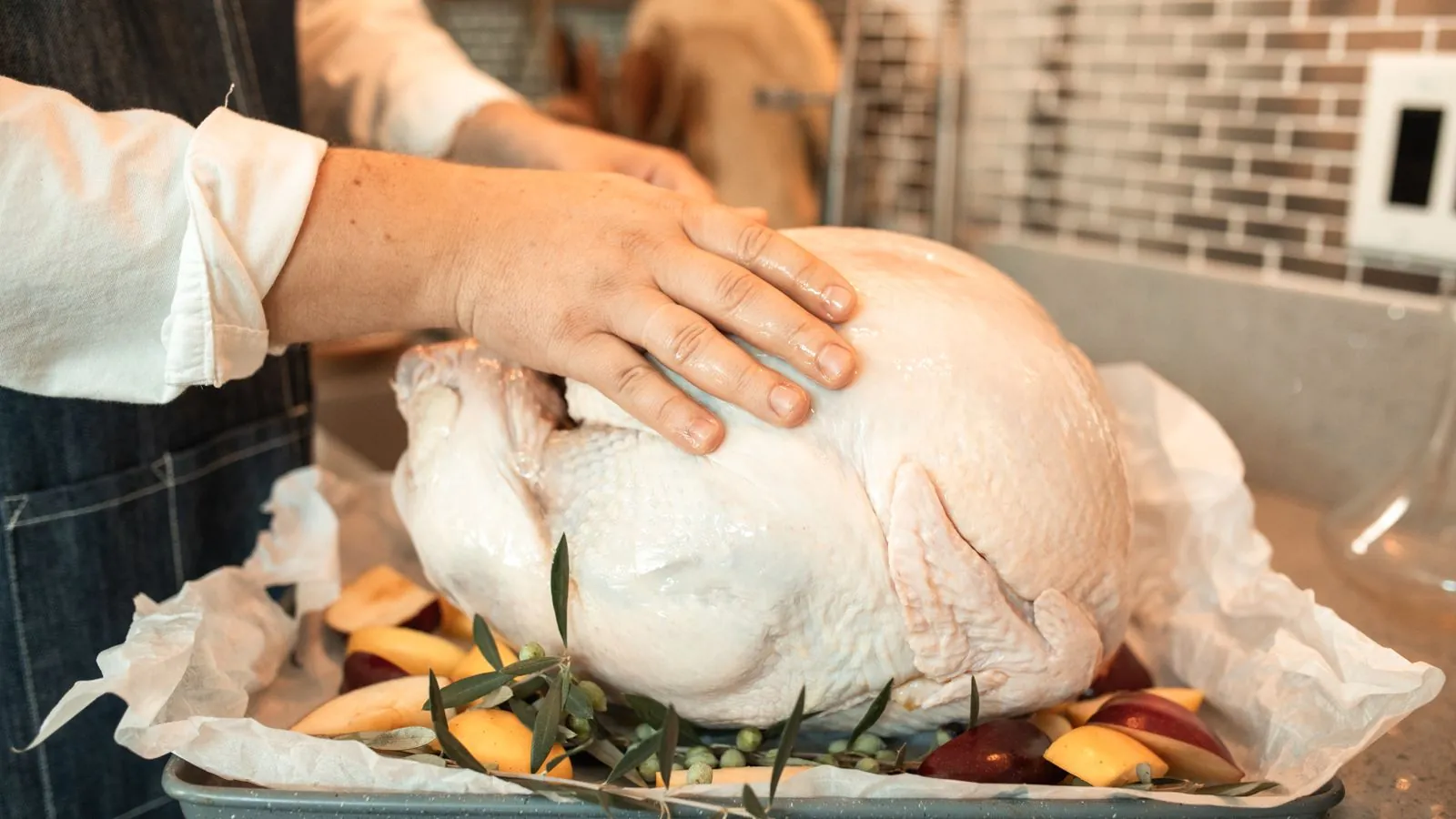
- Leave the turkey in its original wrapper. Do not unwrap it. The plastic keeps it from drying out and keeps juices contained.
- Set it in a rimmed pan. A sheet pan, roasting pan, or large baking dish works. Thawing birds leak, and the wrapper often has a small tear you can't see.
- Put it on the bottom shelf. Raw poultry always goes below ready-to-eat food so drips can't land on anything.
- Leave space around it. Cold air has to reach the bird. A turkey jammed between milk jugs and leftovers thaws slower.
- Write the date on the wrapper. It helps you track the days, especially in a busy holiday week.
You don't need to flip it or do anything else during those days. Just leave it alone.
How to tell the turkey is fully thawed
A thawed turkey feels soft when you press the breast and thighs, and the legs move easily at the joints. Those are good signs, but the cavity is the better test.
Reach inside and pull out the neck and the giblet bag. If they come out easily and you feel no ice crystals deep inside, you're done. If the giblets are stuck to the inside wall, the bird needs more time.
A few ice crystals in the cavity on cook day are not a disaster. You can run cold tap water through the cavity for a few minutes to loosen them. Anything more than that, and you should switch to the cold water method.
A partly frozen turkey cooks unevenly. The breast reaches temperature and dries out while the thighs and the area near the bone lag behind. It also makes your cooking time hard to predict, and a thermometer reading can be misleading if the probe hits a frozen spot.
How long a thawed turkey keeps in the fridge
Once the turkey is fully thawed, the USDA says you can keep it in the refrigerator for 1 to 2 more days before cooking. That's raw poultry's normal fridge life.
This gives you a useful buffer. If your math says Sunday, putting it in on Saturday is fine. A bird that finishes thawing a day early simply waits in the fridge until you need it.
What you don't want is a bird that finished thawing on Sunday and gets cooked the following Thursday. That's too long. If plans change, check whether the bird is still safe to refreeze before you do anything else.
Ran out of time? Use cold water
If it's the day before and the turkey is still a rock, the cold water method is the fast backup. It takes about 30 minutes per pound, so a 14-pound bird needs roughly 7 hours.
- Keep the turkey in a leakproof bag. If the wrapper is torn, put the whole bird inside a large sealed plastic bag so water can't get to the meat.
- Submerge it breast side down in a clean sink, cooler, or big pot of cold tap water.
- Change the water every 30 minutes so it stays cold.
- Cook the turkey right away once it's thawed. Don't put it back in the fridge for later.
Do not use warm or hot water. It warms the outer layer into the danger zone long before the inside thaws.
You can also combine methods. Many cooks give the bird a few days in the fridge, find it still icy in the middle, and finish it with a couple of hours in cold water. That works well.
What about the microwave?
The USDA allows microwave thawing if the turkey fits and you cook it immediately afterward. In reality, most microwaves can't hold anything bigger than a small breast, and the edges start to cook while the center is frozen. Save it for small cuts.
Can you just cook it frozen?
Yes. It's safe to roast a turkey straight from frozen, according to the USDA. It just takes about 50% longer than a thawed bird of the same size.
You can't remove the giblets until partway through cooking, you can't season under the skin, and you can't stuff it. The texture is usually a bit less even. It's a fine emergency option, but the fridge method gives you a better turkey.
Whichever route you take, the finished bird needs to reach 165°F in the thickest part of the breast, the innermost part of the thigh, and the innermost part of the wing. A roast chicken gets the same three-spot check on a smaller scale. Check all three with an instant-read thermometer.
Can you refreeze a turkey thawed in the fridge?
You can. Food thawed in the refrigerator can go back in the freezer without cooking, according to the USDA, as long as it stayed cold the whole time and is still within its 1 to 2 day window.
Expect some quality loss. Every freeze and thaw breaks down more of the muscle's cell walls, which means more moisture leaks out during cooking. A twice-frozen turkey is a bit drier, so brining or a good amount of gravy helps.
Turkeys thawed in cold water or the microwave are different. Those should be cooked before you refreeze them.
Why is my turkey still icy on cook day?
It is usually one of these:
- Starting the count from the wrong day. The thaw days are full days before cooking. If you need 4 days for a Thursday dinner, Sunday is day one.
- Guessing the weight. Check the label. A "big turkey" might be 14 pounds or 22 pounds, and that difference is two full days.
- Overloading the fridge. During the holidays the fridge fills up and the door opens constantly. That can push the temperature up or slow airflow around the bird. Clear space early, starting with leftovers past their days.
- A fridge set too cold. If your fridge runs at 34°F, the turkey can take an extra day. That's safe but slow.
- Leaving it on the counter "just for a few hours" to speed it up. The surface warms into the danger zone fast. Don't do it, even for part of the thaw.
- Forgetting the giblets. They're usually in the cavity, sometimes also in the neck cavity. Check both before you cook.
Planning backward from cook day
The easiest way to get this right is to make a short schedule as soon as you buy the bird. Take the weight, divide by 4, and round up. That's how many days it needs in the fridge. Add one more day if your fridge is packed or runs cold.
Here's an example for a 15-pound turkey and a Thursday dinner:
- 15 divided by 4 is 3.75, so plan for 4 days.
- Count back 4 days from Thursday: Sunday.
- Put the turkey in the fridge Sunday morning.
- Check the cavity Wednesday afternoon. If it's thawed, it can wait in the fridge until Thursday.
- If it's still icy Wednesday night, give it a few hours in cold water Thursday morning.
Checking the day before gives you time to react if the center is still frozen.
If you're buying a frozen turkey well ahead of time, it can stay in the freezer indefinitely at 0°F and remain safe. Quality is best within about a year. So there's no rush to buy late, only a need to move it to the fridge on time. Once the bird is thawed, plan the roasting around cooking times for the cut and size you bought.
 Thawing a turkey safely, day by day
The cavity is the hard part to judge from a written schedule, and seeing a bird handled in its wrapper helps you picture the setup. WGN News covers the fridge and cold water methods for a holiday turkey.
Butterball Experts: How to thaw the turkey quickly and safely
By WGN News on YouTube. Their method may vary a little from ours. Watch on YouTube
- Look at how the turkey sits in its wrapper in a pan on the bottom shelf, as in the setup steps above.
- Compare the pace they describe with the rule of 1 day per 4 to 5 pounds and the 30 minute water changes.
- Pay attention to how they check the cavity and giblets, since ice crystals deep inside mean the bird needs more time.