Home / Measurements & Conversions
 Measurements & Conversions
What Is the Simplest Way to Convert Cups to Grams for a Whole Recipe?
 By the CookClear writers
Checked against US standard measures, NIST conversions and test kitchen weights
 Clear Answer
To convert cups to grams, multiply each cup amount by that specific ingredient's weight per cup: about 120 grams for all-purpose flour, 198 grams for granulated sugar, and 213 grams for packed brown sugar. There is no single number that works for everything. Work line by line, use one trusted chart, and round sensibly.
Why can't one number convert every cup to grams?
A cup measures space. A gram measures mass. How much an ingredient weighs in that space depends on how dense it is and how much air sits between the bits.
 On the menu9 questions
A cup of water weighs roughly 237 grams because the US customary cup holds about 236.6 milliliters and water weighs very close to 1 gram per milliliter. A cup of flour weighs about half that, because flour is light and full of air. A cup of honey weighs far more, about 336 grams, because it is thick and heavy.
How to convert a recipe to grams, step by step
This works for cookies, cakes, quick breads and most sauces.
- Copy the ingredient list onto a fresh card or a note, leaving a column for grams.
- Pick one source for weights and stick with it. Mixing charts mixes assumptions. The figures here follow the King Arthur Baking ingredient weight chart.
- Convert every amount into cups or fractions of a cup first. For example, 3/4 cup plus 2 tablespoons is 0.875 cup, since there are 16 tablespoons in a cup.
- Multiply that number by the ingredient's grams per cup. Flour at 0.875 cup is 0.875 x 120 = 105 grams.
- Leave butter in sticks or convert it from the wrapper: one stick is 1/2 cup, which King Arthur lists as 113 grams.
- Handle teaspoons and tablespoons of leaveners, salt and spices separately, using per spoon weights instead of cup math.
- Round each result sensibly, then write the final grams next to the cups.
- Bake it once and make notes. If the texture matches what you expect from the cup version, your conversion is locked in.
Many bakers stop at step 7 and never measure in cups again for that recipe. If you are still deciding whether weighing is for you, the case for a scale over measuring cups is mostly about flour.
What does a grams per cup chart look like for common ingredients?
This grams per cup chart lists 15 everyday baking ingredients. Values come from the King Arthur Baking ingredient weight chart. Where King Arthur lists only a half or quarter cup, the cup figure is that number doubled or quadrupled, and the table says so.
| Ingredient | Grams per 1 cup | Note |
|---|---|---|
| All-purpose flour | 120 | Spooned and leveled |
| Bread flour | 120 | Same as all-purpose on this chart |
| Whole wheat flour | 113 | King Arthur Premium 100% |
| Granulated sugar | 198 | |
| Brown sugar, packed | 213 | Light or dark |
| Confectioners' sugar | 113 | Unsifted |
| Unsweetened cocoa powder | 84 | From 42 g per 1/2 cup |
| Butter | 226 | From 113 g per 1/2 cup (1 stick) |
| Old-fashioned rolled oats | 89 | |
| Honey | 336 | From 21 g per tablespoon |
| Maple syrup | 312 | From 156 g per 1/2 cup |
| Vegetable oil | 198 | |
| Milk | 227 | King Arthur figure |
| Sour cream or yogurt | 227 | |
| Chocolate chips | 170 |
Flour is the line to get right first, and it is also where charts disagree. Some writers use 125 or 130 grams per cup, and the differences behind a cup of flour in grams come down to how the cup was filled. Sugar varies less, though a cup of sugar in grams still changes between granulated, brown and powdered.
For butter, the stick wrapper already does the work. Each US stick is 1/2 cup and 8 tablespoons, and the stick of butter markings let you cut 2 tablespoons (about 28 grams) without a scale.
How do you convert tablespoons to grams for small ingredients?
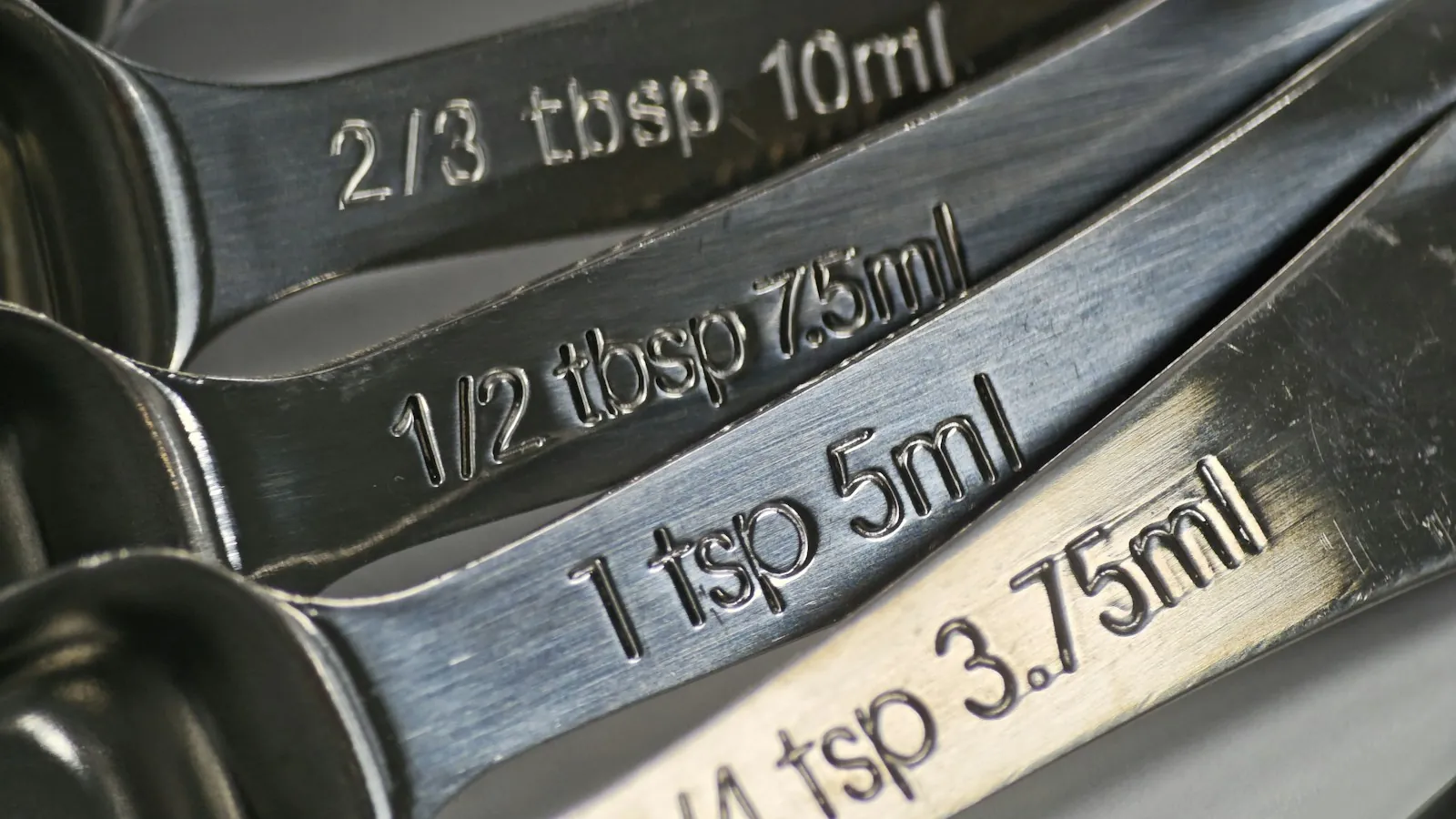
Tablespoons to grams works the same way as cups: each ingredient has its own weight per spoon. The math just gets smaller. One tablespoon is 1/16 of a cup, and one teaspoon is 1/3 of a tablespoon.
For anything that also appears in the cup chart, you can divide. Flour at 120 grams per cup is 7.5 grams per tablespoon. Granulated sugar at 198 grams per cup is about 12 grams per tablespoon.
Leaveners, salt and yeast are a different story. They are measured in small amounts, and their weights per spoon are worth knowing directly:
- Baking powder: 4 grams per teaspoon
- Baking soda: 6 grams per teaspoon (King Arthur lists 3 grams per 1/2 teaspoon)
- Table salt: 18 grams per tablespoon, or 6 grams per teaspoon
- Diamond Crystal kosher salt: 8 grams per tablespoon
- Morton kosher salt: 16 grams per tablespoon
- Instant yeast: 9 grams per tablespoon, and 7 grams for the 2 1/4 teaspoons in one packet
- Honey: 21 grams per tablespoon
A tablespoon of Diamond Crystal weighs half what a tablespoon of Morton does, because the flakes are hollow and light. If a recipe says "1 tablespoon kosher salt" and you have the other brand, converting to grams is the only reliable way to get the same saltiness.
A simple rule: under about 10 grams, keep using your measuring spoons unless the recipe was written in grams. Most home scales read in 1 gram steps, so 4 grams of baking powder could show as 3 or 5. A level teaspoon is just as close.
Which liquids convert one to one, and how many grams in a cup of milk?
Water is the easy one. One milliliter of water weighs about 1 gram, so you can convert straight from the volume. A US customary cup is 236.6 milliliters, which makes a cup of water about 237 grams. Many charts and nutrition labels round the cup to 240 milliliters (the FDA uses 240 mL for labeling, and NIST lists 240 mL as the kitchen approximation), so you will also see 240 grams.
That cup size difference is small, under 2 percent, but it trips people up when a recipe was written with a metric cup. A US cup vs a metric cup is 236.6 versus 250 milliliters, which is about 13 grams of water per cup.
How many grams in a cup of milk depends on which source you follow. Milk is slightly denser than water, around 1.03 grams per milliliter for whole milk according to dairy science measurements, so a full US cup works out to roughly 243 grams. King Arthur lists 227 grams, which matches 8 ounces by weight. Either works in a home recipe because the gap is about 16 grams of mostly water. The charts here follow King Arthur for consistency.
Other liquids at a glance:
| Liquid | Grams per 1 cup | Close to water? |
|---|---|---|
| Water | About 237 | Yes, 1 g per mL |
| Milk, heavy cream, buttermilk | About 227 to 243 | Slightly heavier by volume |
| Vegetable oil | 198 | Lighter, oil floats |
| Honey | 336 | Much heavier |
| Maple syrup | 312 | Much heavier |
Oil surprises people. It looks like water in a measuring cup but weighs about 16 percent less. Syrups go the other direction, so never convert honey or maple syrup at 1 gram per milliliter. If you are using honey instead of sugar, the weight difference also changes how much liquid the batter can take.
How should you handle rounding gram conversions?
Rounding gram conversions keeps the numbers usable without throwing the recipe off. Nobody needs the half gram in 157.5.
Use these rounding habits:
- Round flour, sugar and other bulk ingredients to the nearest 5 grams. On 300 grams of flour, 2 grams either way is under 1 percent.
- Round liquids to the nearest 5 grams too, or to the nearest 10 for amounts over 500 grams.
- Keep anything under 20 grams to the nearest whole gram, since 1 gram there is a bigger share.
- Leave leaveners, salt and yeast exact, or keep them in spoons.
- Round each ingredient once, at the end, not at every step of a calculation.
When you scale a converted recipe up or down, scale the exact grams first and round after. Doubling a rounded 155 gives 310, while doubling the true 157.5 gives 315. That small gap can stack up across six ingredients.
Why did my cookies come out different after I converted to grams?
It usually traces back to one line.
| What you see | Likely cause | Fix |
|---|---|---|
| Dry, crumbly dough or cake | Recipe writer scooped flour, so their cup held more than 120 g, or you used a chart with a lower figure | Check whether the source gives its own grams per cup and use that |
| Cookies spread flat, batter thin | Your chart's flour weight is lower than the writer's measuring style | Add 5 to 10 g flour per cup and test again |
| Too salty or bland | Kosher salt brand differs from the recipe's | Convert salt by brand: 8 g per tablespoon Diamond, 16 g Morton |
| Heavy, gummy crumb | Honey or syrup converted at 1 g per mL | Use 21 g per tablespoon of honey, 312 g per cup of maple syrup |
| Bitter or soapy taste | Baking soda rounded up on a coarse scale | Measure leaveners with spoons |
| Brown sugar weighs far less than expected | Sugar is hard and lumpy, so it won't pack | Soften the brown sugar first, then pack and weigh |
Both flour problems have one source: a cup conversion is only as good as your guess about how the original cook filled their cup. If a recipe author ever mentions their own flour weight, trust it over any chart.
Which recipes are worth converting first?
Not every recipe needs grams. Soups, stews, rice and stir-fries forgive a little extra of anything. Start where weight makes a visible difference:
- Cookies and brownies you bake often
- Layer cakes and cupcakes
- Bread, pizza dough and anything with yeast
- Pie crust and biscuits, where flour to fat ratio decides tenderness
- Recipes you plan to double or halve
Keep your converted cards in one place. For more cup, spoon and weight equivalents, the full set of kitchen measurement conversions fills in the rest.
 Weighing cups of flour, sugar and milk side by side
Seeing three ingredients poured into the same cup and then weighed makes the per ingredient idea click quickly. A good demonstration shows the scale readings change even though the cup never does.
How to Convert Cups of Flour to Grams | Baking by Weight
By Katie Kimball on YouTube. Their method may vary a little from ours. Watch on YouTube
- How far apart a cup of flour (about 120 grams) and a cup of sugar (about 198 grams) land on the same scale.
- Whether the flour is spooned and leveled or scooped, since scooping pushes it well past 120 grams.
- Where the milk reading falls relative to the 227 to 243 gram range for one US cup.


