Food Storage
Does Cooked Rice Freeze Well, or Does It Turn Mushy When Reheated?
 By the CookClear writers
Checked against USDA and FDA food safety guidance

 Clear Answer
Yes, cooked rice freezes very well and comes back close to its original texture if you cool it quickly, freeze it in thin flat portions, and reheat it straight from frozen. Use it within 1 to 3 months for the best texture. Mushy rice almost always means it went in too wet, froze slowly in a thick block, or thawed too long.
Why does frozen rice turn mushy in the first place?
Rice is mostly starch and water. When cooked rice cools, its starch slowly firms back up (cooks call this retrogradation), which is why fridge rice feels hard and dry. Freezing pauses that process better than the fridge does, so frozen rice often reheats softer and fresher than three-day-old refrigerated rice.
The mush comes from ice. When water freezes slowly, it forms large ice crystals that rupture the surface of each grain. On reheating, that water leaks out, the broken surfaces turn gummy, and the grains stick together. A fast freeze makes smaller crystals and does less damage.
Extra surface moisture makes it worse. Rice that was a little overcooked, or that went into a container while still steaming, carries a film of water that freezes into a glaze of ice. When that melts, it has nowhere to go but into the rice.
How to freeze cooked rice the right way
This method works for white, brown, jasmine, basmati, and most medium-grain rice. It takes about 5 minutes of hands-on time.
- Cook it slightly firm. Use about 2 tablespoons less water per cup of dry rice than you normally would, or pull it a minute or two early. Rice that is perfect on day one tends to go soft after freezing.
- Spread it out to cool. Tip the hot rice onto a rimmed baking sheet in a layer about 1 inch deep or less. Steam escapes fast, and the rice drops in temperature much quicker than it would in a pot.
- Get it cold within 2 hours. Food safety rules call for cooked food to be refrigerated or frozen within 2 hours (1 hour if the room is above 90°F). A thin layer on a sheet pan usually stops steaming in 10 to 15 minutes and can go into the fridge or freezer soon after.
- Portion it. Scoop 1 to 2 cups into quart zip-top freezer bags. One cup of cooked rice is a good single serving; 2 cups covers a batch of fried rice for two.
- Press it flat and squeeze out the air. Flatten each bag to about 1/2 to 3/4 inch thick. Thin packs freeze faster (smaller ice crystals) and reheat evenly without a cold center.
- Label and freeze flat. Write the date and the type of rice. Lay the bags flat on a tray until solid, then stand them up like files to save space.
If you prefer containers, use small, shallow ones and fill them nearly to the top so there is little air. Deep tubs freeze slowly in the middle, and the center rice is the part that ends up gluey.
Is it safe to freeze rice you already refrigerated?
It can be, with limits. Cooked rice can carry spores of Bacillus cereus, a bacterium that survives boiling. If rice sits warm, those spores can grow and produce toxins that reheating will not destroy. That is why cooked rice gets so much food-safety attention, and why cooling it fast counts for more than the freezer itself.
The rules to follow come straight from USDA guidance on leftovers:
- Refrigerate or freeze cooked rice within 2 hours of cooking.
- Keep the fridge at 40°F or below and the freezer at 0°F.
- Use refrigerated leftovers within 3 to 4 days.
- Reheat leftovers to 165°F.
So if your rice went into the fridge promptly and it is only a day or two old, freezing it is fine. The clock does not reset, though. Freezing stops bacterial growth but does not kill what is already there, so freeze rice early rather than on day four. If rice sat on the stove or counter for hours after dinner, throw it out instead of freezing it.
How long does frozen cooked rice last?
At a steady 0°F, frozen food stays safe indefinitely, according to USDA. Quality is not. Rice slowly dries out and picks up freezer smells over time, even in a good bag.
| Rice type | Best quality in freezer | Notes |
|---|---|---|
| Plain white rice (long grain, jasmine, basmati) | 1 to 3 months | Freezes the best of all types |
| Brown rice | 1 to 3 months | Holds texture well thanks to the bran layer |
| Short-grain or sushi rice | Up to 1 month | Stickier; good for onigiri or rice bowls, not for sushi rolls |
| Wild rice | 3 to 6 months | Very sturdy, barely changes |
| Rice with sauce, butter, or vegetables (pilaf, fried rice) | 1 to 2 months | Fat helps keep grains separate |
| Risotto | Not recommended | Turns gluey; better reborn as arancini |
Past these windows the rice is still safe if it stayed frozen, but expect drier, slightly stale-tasting grains. Freezer burn shows up as white, dry patches. You can cut those away, or simply use that rice in soup where nobody will notice the texture.
Which kinds of rice freeze best?
Long-grain rice is the most forgiving. Varieties like basmati and standard long-grain white have more amylose, a type of starch that keeps grains separate and firm. They come out of the freezer fluffy and distinct, which makes them ideal for pilaf, burrito bowls, and fried rice.
Brown rice is a close second. The bran coating acts like a jacket, so grains stay intact. Many people prefer cooking brown rice in big batches and freezing it, since it takes 40 to 45 minutes to cook from scratch.
Short-grain and sushi rice are higher in amylopectin, the sticky starch. They freeze fine for rice bowls, onigiri, or eating plain, but seasoned sushi rice firms up and loses its texture, so make it fresh for rolls.
Rice cooked with a little fat, such as a teaspoon of butter or oil per cup of dry rice, freezes with less clumping. The fat coats each grain and keeps them from fusing.
The best way to reheat frozen rice so it stays fluffy
Do not thaw it on the counter or in the fridge first. Slow thawing gives melting ice time to soak into the grains, which is exactly how you get mush. Go straight from frozen to hot.
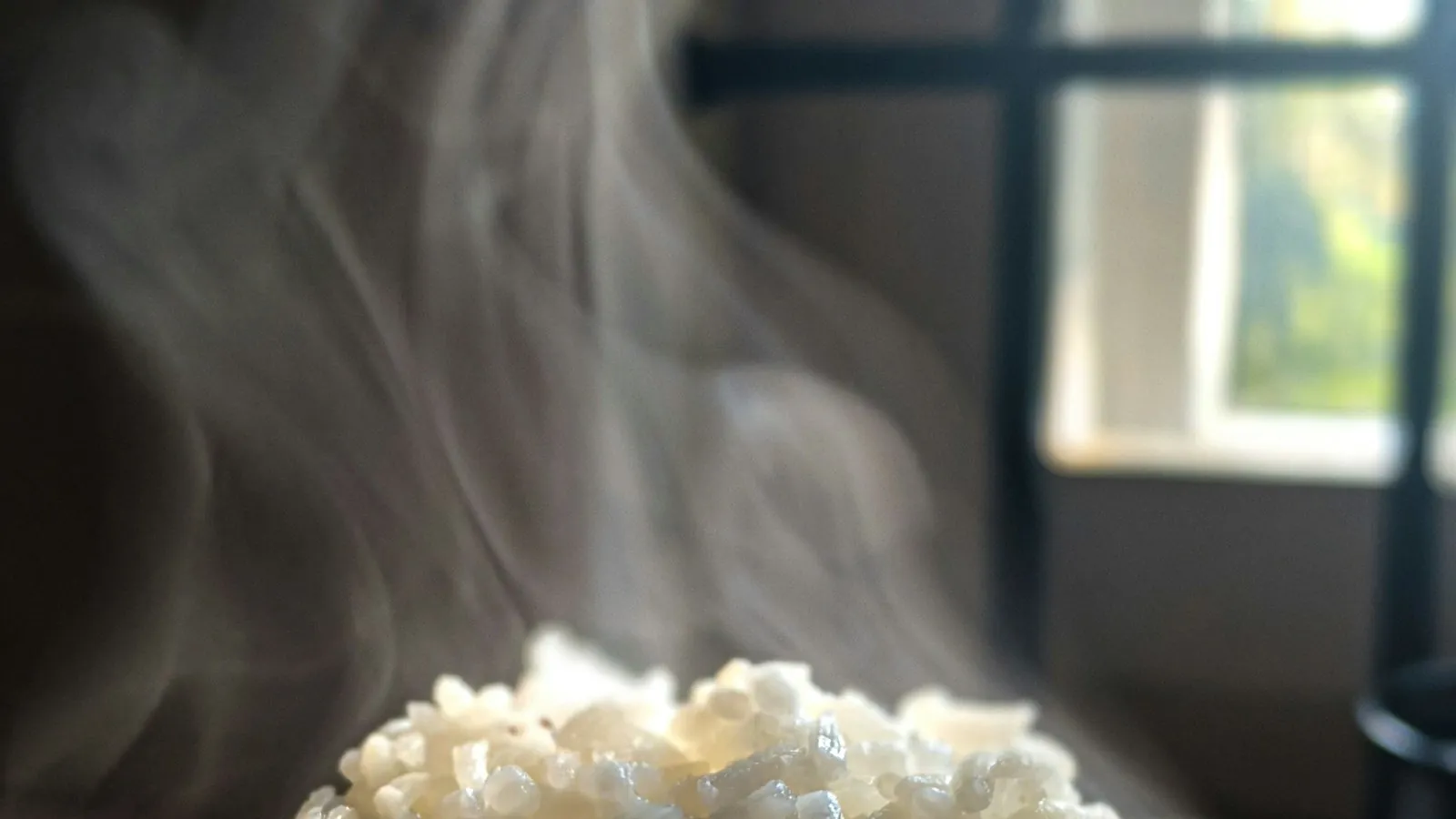
Microwave (fastest)
- Break the frozen rice into a microwave-safe bowl. If it is in a flat bag, you can snap it into pieces before opening.
- Sprinkle on about 1 tablespoon of water per cup of rice.
- Cover loosely with a lid or a damp paper towel to trap steam.
- Microwave on high for 2 to 3 minutes per cup, stirring halfway through to break up clumps.
- Check that it is steaming hot all the way through. USDA guidance is 165°F for reheated leftovers; an instant-read thermometer makes this easy.
Stovetop
Put the frozen rice in a saucepan with 1 to 2 tablespoons of water per cup. Cover and heat over medium-low for 5 to 8 minutes, breaking it up with a fork as it softens. Uncover for the last minute if it looks wet. If some grains still feel hard, the same steam-and-rest fix for crunchy rice works here.
Straight into the dish
Frozen rice works well for fried rice without the mush. Its surface is already dry, so it crisps rather than steams. Break up the frozen chunks and add them to a hot, oiled wok or skillet, stirring until every grain is hot. For soup, congee, or casseroles, drop the frozen rice in during the last 5 to 10 minutes of cooking.
What goes wrong, and how to fix it
| Problem | Likely cause | Fix next time |
|---|---|---|
| Mushy, wet grains | Rice frozen while steaming, or thawed slowly | Cool on a sheet pan first; reheat from frozen |
| Hard, dry grains | Not enough moisture when reheating, or too long in the freezer | Add a splash of water and cover while reheating; use within 3 months |
| Hot edges, icy center | Portions too thick | Freeze in flat bags 1/2 to 3/4 inch thick |
| Off or "freezer" taste | Air in the bag or container | Squeeze out all the air; double-bag for long storage |
| One giant frozen clump | Packed while warm and sticky | Cool fully first; flatten and freeze on a tray |
If a batch does come out soft, use it where softness helps. Rice pudding, congee, rice soup, and stuffed peppers all welcome tender rice.
Is it better to refrigerate or freeze rice?
For anything longer than a day or two, freezing wins. Refrigerated rice has a 3 to 4 day window and gets noticeably harder each day as the starch firms up. Frozen rice stays close to how it was the day you made it.
The fridge makes sense if you plan to make fried rice tomorrow, since day-old chilled rice is a little drier and fries well. For everything else, the freezer keeps rice closer to freshly cooked, the same reasoning that favors freezing for most food storage beyond a couple of days. A good habit is to cook a double batch (a rice cooker makes this hands-off), eat half, and freeze the rest in flat 1-cup packs the same night. On busy weeknights that saves 20 to 45 minutes of cooking time, and the rice is ready in about 3 minutes.
A few practical tips from batch cooking
- Make it plain. Freeze rice unseasoned, or only lightly salted, so it works in any meal later.
- Skip the rinse after cooking. Rinse raw rice to remove loose starch, but never rinse cooked rice before freezing. It adds water you will have to fight later.
- Freeze in recipe-sized amounts. If your fried rice recipe calls for 3 cups, freeze 3-cup packs.
- Keep the freezer cold. A freezer that is opened all day or packed too full may run above 0°F, which lets ice crystals grow. A cheap freezer thermometer tells you where you stand.
- Use older bags first. Put new bags at the back so the oldest rice gets used before it dries out.
 What properly frozen rice looks like in the bag
Flat, dry portions are the whole trick to rice that reheats fluffy, and that is hard to picture from a description. Great Lakes Country shows the whole path from cooling to reheating.
How to Freeze Cooked Rice - Best Method for Easy Fried Rice
By Great Lakes Country on YouTube. Their method may vary a little from ours. Watch on YouTube
- Look at how thin the rice is spread when it cools, then compare it with the 1 inch layer on a sheet pan above.
- Notice how flat the portions are pressed before freezing, since the 1/2 to 3/4 inch thickness is what prevents icy centers.
- Compare the reheated grains with the advice on adding a splash of water and covering the rice, and see whether they stay separate.