Home / Measurements & Conversions
 Measurements & Conversions
Are There 8 Ounces in a Cup for Both Liquid and Dry Ingredients?
 By the CookClear writers
Checked against US standard measures, NIST conversions and test kitchen weights
 Clear Answer
There are 8 fluid ounces in a US cup, and that holds for any ingredient because fluid ounces measure space, not weight. Weight ounces are a different unit, so a cup of all-purpose flour weighs only about 4 1/4 ounces, while a cup of granulated sugar weighs about 7.
Why do fluid ounces and ounces share a name?
Both units come from the old English system, and both got called "ounces" long before anyone worried about the difference. Today they measure two separate things:
 On the menu10 questions
- Fluid ounce (fl oz). A unit of volume. One US fluid ounce is about 29.57 milliliters, and 8 of them make a cup of about 236.6 milliliters.
- Ounce (oz), also called the avoirdupois ounce. A unit of weight, or mass. One ounce is about 28.35 grams, and 16 of them make a pound.
So with fluid ounces vs ounces, one tells you how much room something takes up and the other tells you how heavy it is.
Recipes and packages often drop the "fl" and just write "oz," which leaves you to figure out from context which one they mean.
How many ounces are in common cup measurements?
Since a cup is 8 fluid ounces, every fraction of a cup converts cleanly. This is the table to keep taped inside a cabinet door.
| Cup measure | Fluid ounces | Tablespoons | Milliliters (US customary) |
|---|---|---|---|
| 1/8 cup | 1 fl oz | 2 | about 30 |
| 1/4 cup | 2 fl oz | 4 | about 59 |
| 1/3 cup | 2 2/3 fl oz | 5 1/3 | about 79 |
| 1/2 cup | 4 fl oz | 8 | about 118 |
| 2/3 cup | 5 1/3 fl oz | 10 2/3 | about 158 |
| 3/4 cup | 6 fl oz | 12 | about 177 |
| 1 cup | 8 fl oz | 16 | about 237 |
| 2 cups (1 pint) | 16 fl oz | 32 | about 473 |
| 4 cups (1 quart) | 32 fl oz | 64 | about 946 |
Milliliter figures are rounded from the US customary fluid ounce of 29.57 mL. Each fluid ounce equals 2 tablespoons, so once you know the tablespoons in a cup you can rebuild most of this from memory. The larger jumps, from pints to quarts to gallons, follow the same doubling pattern, and having the cups in a quart handy makes scaling soup or brine much quicker.
How many ounces in half a cup?
Half a cup is 4 fluid ounces, or 8 tablespoons. That answer works for any liquid. If the recipe means weight, half a cup of flour is roughly 2 1/8 ounces and half a cup of granulated sugar is about 3 1/2 ounces, so the right number depends entirely on the ingredient.
Is a cup of flour 8 ounces?
No. A cup of all-purpose flour weighs about 4 1/4 ounces, or 120 grams, according to King Arthur Baking's ingredient weight chart. That is barely half of 8.
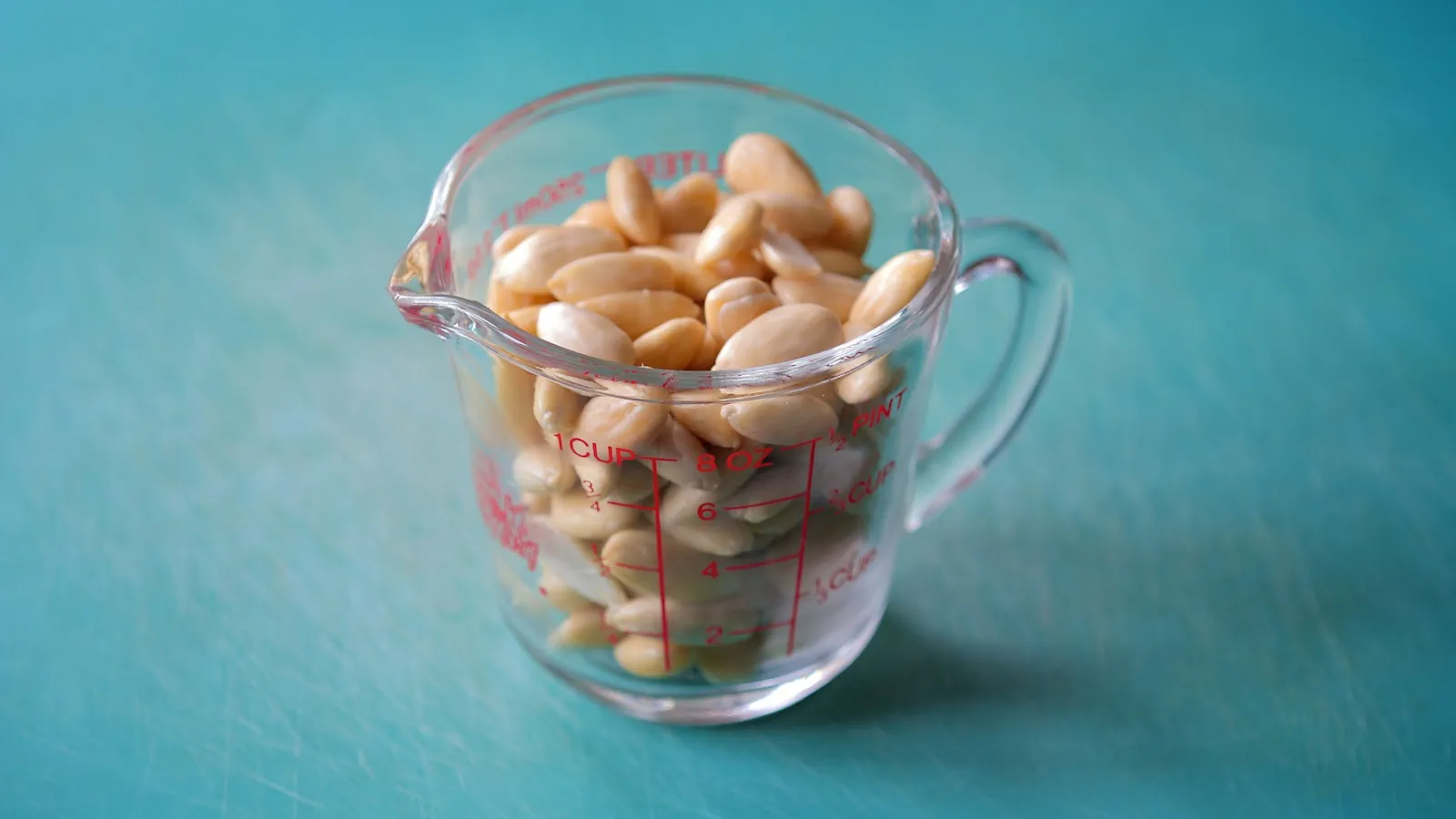
Flour is light and full of air. Fill a cup with it and much of the space is gaps between tiny particles. Water has no gaps, so a cup of water weighs a lot more. How you fill the cup changes the result too: scooping straight from the bag packs flour down and can push a cup well past 4 1/4 ounces. That swing is the main reason bakers who switch to a kitchen scale for flour see more consistent cakes and cookies.
If a recipe lists "8 ounces flour," it almost always means weight, which works out to almost 2 cups of spooned and leveled all-purpose flour. Measuring out 1 cup because you read "8 ounces" as a cup would leave the dough short by nearly half. If you switch to grams, remember the weight of a cup of flour changes by type, from cake flour to whole wheat.
What does a cup weigh for common ingredients?
The same 8 fluid ounces can land far apart on a scale. Figures come from King Arthur Baking's ingredient weight chart, which is the source most home bakers in the US work from. Other publishers list slightly different weights for some items, so a recipe developed elsewhere may assume a few grams more or less.
| Ingredient (1 cup) | Weight in ounces | Weight in grams |
|---|---|---|
| All-purpose flour, spooned and leveled | 4 1/4 oz | 120 g |
| Confectioners' sugar, unsifted | 4 oz | 113 g |
| Old-fashioned rolled oats | about 3 1/8 oz | 89 g |
| Chopped chocolate | 6 oz | 170 g |
| Granulated sugar | 7 oz | 198 g |
| Vegetable oil | 7 oz | 198 g |
| Brown sugar, packed | 7 1/2 oz | 213 g |
| Milk or heavy cream | 8 oz | 227 g |
| Butter (2 sticks) | 8 oz | 227 g |
| Honey | about 12 oz | about 336 g |
The honey figure is worked out from King Arthur's 21 grams per tablespoon, times 16 tablespoons. Honey, molasses and syrups are much denser than water, which is why a cup of honey feels so heavy in your hand. Keep that in mind when you swap honey for sugar, because the volume and the weight move in different directions.
Butter is the one solid that lines up neatly: a cup is 2 sticks and 8 ounces by weight. The wrapper markings make it simple, and knowing the measurements on a stick of butter saves you from pressing butter into a measuring cup.
Does a cup of water weigh 8 ounces?
Close, but not exactly. A US cup of water weighs about 8.3 ounces, or roughly 236 grams, because a milliliter of water weighs about 1 gram.
For cooking, that small gap almost never matters. King Arthur rounds a cup of milk to 8 ounces (227 grams), and most cooks treat water the same way. The near match only holds for water and thin, watery liquids like milk, broth, coffee and juice. Oil is lighter than water, so a cup weighs about 7 ounces. Honey and corn syrup are heavier. For everything else, assume the weight and the fluid ounces will not agree.
Dry ounces vs liquid ounces: are they really different?
There is no official "dry ounce" in US kitchen measuring. When people say dry ounces vs liquid ounces, they usually mean weight ounces vs fluid ounces. A dry ingredient measured by weight uses ordinary ounces. A liquid measured by volume uses fluid ounces.
What does differ is the cup you use:
- Liquid measuring cups are clear, with a spout and markings below the rim. You fill to the line and read it at eye level. The extra headroom keeps liquid from spilling.
- Dry measuring cups come in nested sizes and are meant to be filled to the brim and leveled with a straight edge.
Both hold the same 8 fluid ounces at the 1 cup mark. The difference is accuracy in use. Leveling flour in a glass liquid cup is nearly impossible, and filling a dry cup to the very rim with milk means spilling some on the way to the bowl. Use each for its own job and the numbers stay true.
How do you tell which kind of ounce a recipe means?
Most recipes give you enough clues if you look for them. Run through these checks:
- The label says "fl oz." That is volume. Use a liquid measuring cup.
- The ingredient is a liquid and the amount is in ounces. Usually volume, so 6 ounces of milk means 3/4 cup. Some precise baking recipes weigh liquids, so check whether other ingredients are listed by weight.
- The ingredient is a solid and the amount is in ounces. Almost always weight. "4 ounces chocolate" or "8 ounces cream cheese" means the weight on the package, not a cup measure.
- The recipe also lists grams. Then the ounces are weight. Grams never measure volume.
- The ingredient comes in a package sized in ounces. A 14 ounce can of sweetened condensed milk is labeled by weight, while a 32 ounce carton of broth is labeled in fluid ounces. Read the label for "fl" before you assume.
My recipe says 8 ounces of shredded cheese. Is that 1 cup?
No, and this is where the two ounces cause the most trouble. Recipes that call for shredded cheese in ounces mean weight, the same way a bag at the store is sold by weight. Loosely packed shredded cheese is light and fluffy, so 8 ounces by weight takes up a good deal more than a single cup. If you only have measuring cups, start with about 2 cups for 8 ounces and adjust from there, or weigh it if you have a scale. The same logic applies to chopped nuts, chocolate chips and grated vegetables: they are sold and listed by weight, and a cup of them weighs less than 8 ounces.
Do US and metric cups hold the same ounces?
Not quite. A US customary cup holds about 236.6 milliliters, which is 8 US fluid ounces. Nutrition labels in the US use a rounded cup instead: the FDA defines 1 cup as 240 milliliters and 1 fluid ounce as 30 milliliters for labeling. A metric cup, used in Australia, New Zealand and Canada, is 250 milliliters, a little over 8 1/2 US fluid ounces.
The gap between 236.6 and 250 milliliters is about 5 percent. In a soup or a pot of rice, nobody will notice. In a cake recipe that uses several cups of flour and liquid, it can shift texture a bit, and the US cup vs metric cup question is worth checking when you bake from a recipe written abroad.
When should you weigh instead of measuring by the cup?
Volume works well for liquids and for forgiving dishes. Weight works better whenever an ingredient can pack, settle or trap air. A few rules of thumb:
- Measure water, milk, broth, juice and oil in fluid ounces with a liquid measuring cup.
- Weigh flour, cocoa, powdered sugar, brown sugar, shredded cheese and chopped add-ins when a recipe gives weights.
- Use measuring spoons for small amounts like baking soda, salt and spices, since most home scales are not precise enough for a few grams.
- Weigh sticky ingredients like honey and peanut butter straight into the bowl to skip scraping a cup.
If you want to move a favorite recipe over to weights, a cups to grams chart lets you rewrite it once and stop guessing. Spoons and butter sticks follow the same logic, so the other measurements and conversions you meet in a recipe convert just as cleanly.
 Watching 8 ounces of liquid and a cup of flour side by side
Reading that a cup of flour weighs about half of what a cup of milk does is one thing. Seeing the scale numbers next to each other makes the two kinds of ounces click.
Fluid Ounces vs Ounces - What's the Difference?
By Chef Tom Atkinson on YouTube. Their method may vary a little from ours. Watch on YouTube
- Check where the liquid sits against the 8 fluid ounce line, read at eye level rather than from above.
- Compare the weight of a spooned and leveled cup of flour with the 4 1/4 ounce (120 gram) target.
- Notice how much heavier a cup of a dense liquid is next to 8 ounces of milk or water.


