Home / Measurements & Conversions
 Measurements & Conversions
How Do You Measure a Stick of Butter in Tablespoons, Cups and Grams?
 By the CookClear writers
Checked against US standard measures, NIST conversions and test kitchen weights
 Clear Answer
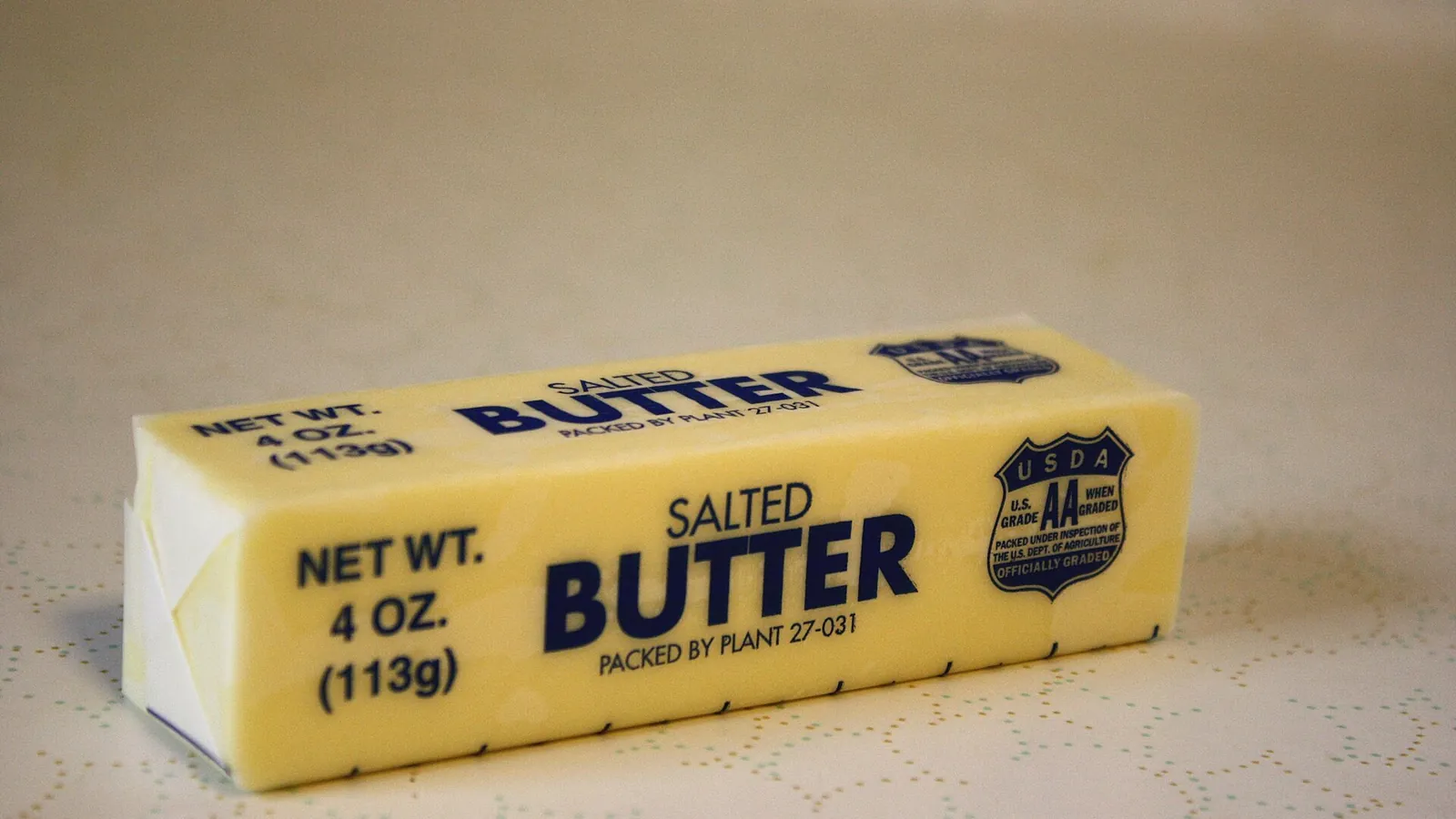
One standard US stick of butter is 8 tablespoons, which equals 1/2 cup, 4 ounces, or about 113 grams. Four sticks make a 1 pound box, so a full pound is 32 tablespoons, 2 cups, or about 454 grams.
How many tablespoons and cups are in a stick of butter?
A stick of butter in tablespoons is 8, and in cups it is 1/2. The math comes straight from US customary units: a cup is 16 tablespoons, so half a cup is 8. Knowing how many tablespoons fill a cup makes every other butter conversion easy to work out.
 On the menu10 questions
Here is the full chart.
| Butter | Tablespoons | Cups | Ounces (weight) | Grams |
|---|---|---|---|---|
| 1 tablespoon | 1 | 1/16 | 1/2 | about 14 |
| 2 tablespoons | 2 | 1/8 | 1 | about 28 |
| 1/4 stick | 2 | 1/8 | 1 | about 28 |
| 1/2 stick | 4 | 1/4 | 2 | about 57 |
| 3/4 stick | 6 | 3/8 | 3 | about 85 |
| 1 stick | 8 | 1/2 | 4 | about 113 |
| 1 1/2 sticks | 12 | 3/4 | 6 | about 170 |
| 2 sticks | 16 | 1 | 8 | about 227 |
| 3 sticks | 24 | 1 1/2 | 12 | about 340 |
| 4 sticks (1 pound) | 32 | 2 | 16 | about 454 |
Gram figures follow the King Arthur Baking ingredient weight chart, which lists 8 tablespoons (1/2 cup) of butter at 4 ounces and 113 grams. The ounces in this table are weight ounces, not fluid ounces.
A teaspoon of butter is a third of a tablespoon, so if a recipe calls for something like 5 teaspoons, the rule that there are 3 teaspoons in a tablespoon tells you that is 1 tablespoon plus 2 teaspoons.
How many grams in a stick of butter, exactly?
A 4 ounce stick weighs 113.4 grams, since one avoirdupois ounce is 28.35 grams. Recipes round that to 113 grams, and some round further to 115 grams. The 2 gram difference will not change a cake.
Two other numbers float around, and both come from rounding:
- The FDA label number. Nutrition labels use 28 grams per ounce and 1 tablespoon of butter as a 14 gram serving, which works out to 112 grams per stick. That rounding is for labeling, not baking.
- The European block. Butter in much of Europe is sold in 250 gram blocks, so a European recipe that says "half a block" means 125 grams, about 12 grams more than a US stick.
If a recipe was written in grams, weigh the butter and skip the conversion entirely. When you need to convert cups to grams for a whole recipe, butter is the easy line: 1 cup is about 227 grams.
Is 4 ounces of butter the same as 1/2 cup?
Yes, for butter it works out. A stick weighs 4 ounces and also takes up 1/2 cup of space, which is 4 fluid ounces. That neat match is a coincidence of butter's density being close to water's, and it does not hold for most ingredients.
Honey is much heavier than water and flour much lighter, so the difference between weight ounces and fluid ounces catches a lot of cooks when they move on to other ingredients.
Why do East Coast and West Coast butter sticks look different?
The sticks come in two shapes in the US, and the East Coast vs West Coast butter sticks question comes up every time someone moves across the country and finds their butter dish no longer fits.
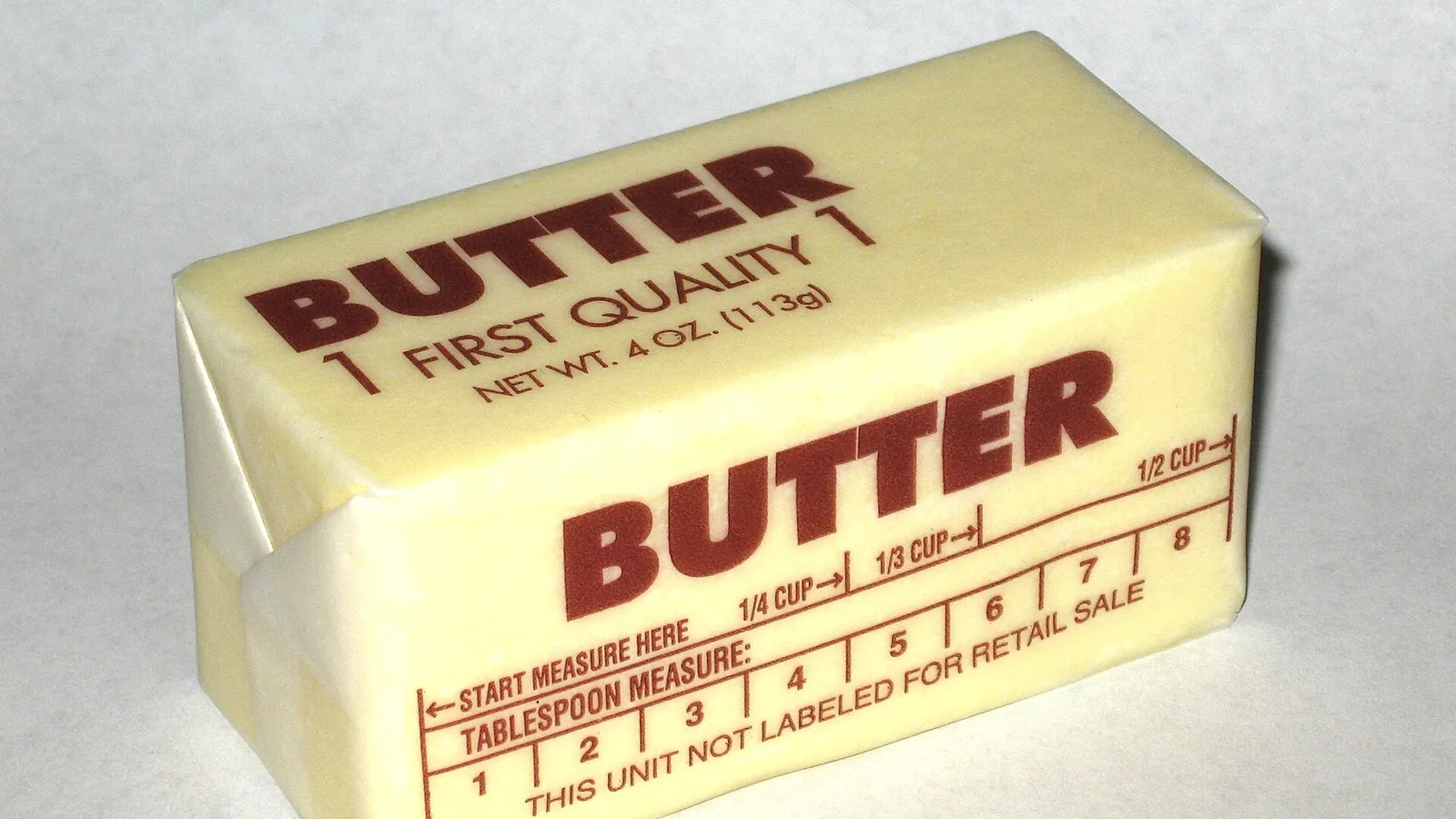
- Elgin sticks. These are the long, thin sticks common east of the Rockies, about 4 3/4 inches long and 1 1/4 inches wide, usually packed four to a box in a long carton.
- Western stubbies. Common in the West, these are about 3 1/8 inches long and 1 1/2 inches wide, short and fat, packed in a squatter carton.
Both are 4 ounces and 8 tablespoons. The size difference traces back to the packaging machines dairies bought. Many Western plants installed newer equipment around the mid-1970s that cut shorter, wider sticks, according to Food Network's account of the history.
In a recipe, the shape makes no difference. It only affects your butter dish and for eyeballing a tablespoon: on a stubby, each tablespoon slice is shorter, so if you are used to Elgin sticks, a "1 inch" tablespoon will be too much butter on a Western stick.
How do you read butter wrapper markings?
Most stick wrappers have lines printed along one side, and learning how to read butter wrapper markings saves you from ever pulling out a measuring spoon. Each line marks 1 tablespoon. Many wrappers also label 1/4 cup at the 4 tablespoon mark and 1/3 cup between the fifth and sixth tablespoon lines.
To cut along the wrapper:
- Set the stick on a cutting board with the printed side up.
- Find the end where the numbering starts. On many wrappers it reads 1 through 8 from one end.
- Line a sharp knife up with the mark you need and press straight down through the paper.
- Peel the wrapper back from the piece you cut, and fold it over the rest of the stick to store it.
Cut while the butter is cold so the wrapper doesn't slip, and know the lines can drift a little if the wrapper went on crooked. For 1/3 cup in a delicate pastry, a scale is safer: 1/3 cup of butter is about 76 grams.
How do you measure butter from a tub or block?
Imported butter often comes in 8 ounce blocks, and plenty of households keep a tub. To measure butter from a tub or block without guessing, use one of these.
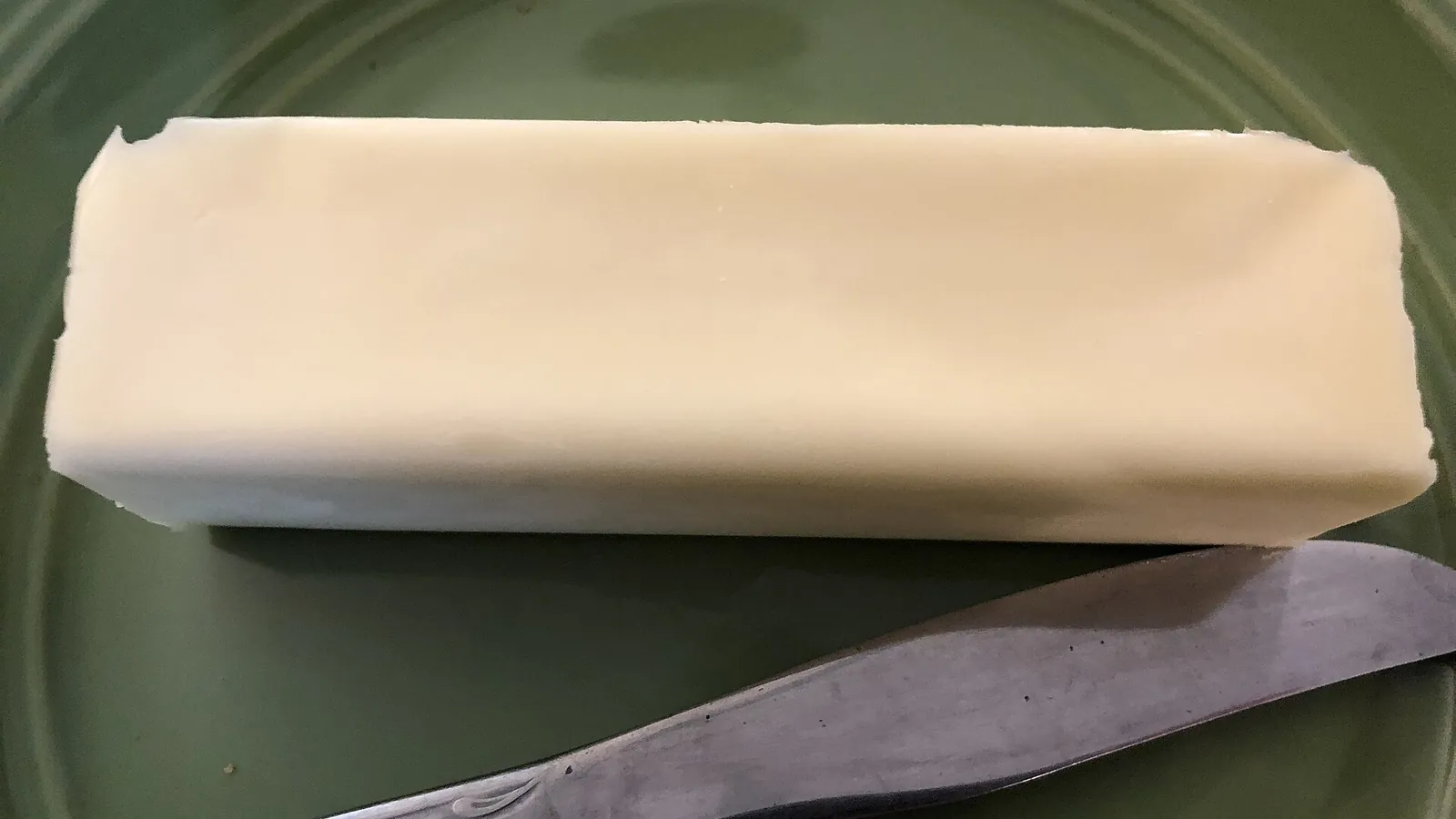
By weight. The easiest way. Put a bowl on a scale, press tare, and cut off butter until you reach the grams you need: 113 grams per stick, about 14 grams per tablespoon. The case for a kitchen scale over measuring cups is strongest with oddly shaped butter.
By ruler. For a rectangular block, measure the length and divide. An 8 ounce block equals 2 sticks, so cut it in half for one stick, then each half into 8 for tablespoons.
By water displacement. Fill a 2 cup liquid measure to 1 cup with cold water. Add pieces of cold butter until the water reaches 1 1/2 cups. That is 1/2 cup of butter. Push the butter under the surface with a spoon to read it, then pour off the water.
By packing a measuring cup. For soft butter from a tub, press it firmly into a dry measuring cup with a spatula, working out air pockets, and level the top.
Whipped butter and spreads in tubs
Whipped butter has air beaten into it, so a cup of whipped butter holds less actual butter than a cup of stick butter. Measure it by weight or skip it for baking. Tubs labeled "spread" are a different product, often with more water and less fat, and they bake differently. Butter sold as butter in the US has to be at least 80 percent milkfat, which is what recipes assume.
Salted versus unsalted doesn't change any of these measurements, only the salt in the recipe. If you only have salted, the adjustments for using salted butter in baking are small and easy.
Melted butter vs solid butter: do you measure before or after?
Weight doesn't change when butter melts. A stick weighs about 113 grams cold or melted. Volume also stays close: one melted stick gives you about 1/2 cup of liquid, maybe a hair less once some foam settles.
With melted butter vs solid butter, the wording changes the amount:
- "1/2 cup butter, melted" means measure 1/2 cup (one stick), then melt it.
- "1/2 cup melted butter" technically means melt first, then measure 1/2 cup of liquid.
Both land nearly the same, and on a scale 113 grams is 113 grams either way.
Browned butter and clarified butter are the exceptions. Browning cooks off water, and clarifying removes water and milk solids, so you end up with less than you started with. King Arthur lists 1/4 cup of ghee at 44 grams, compared with 57 grams for 1/4 cup of regular butter. If a recipe calls for "1/2 cup browned butter," start with a little more than a stick and measure after cooking.
Melted butter in cookie dough makes chewier, flatter cookies than softened butter, which is one of the reasons cookies spread flat when a recipe is followed with the wrong butter state.
What you see when a butter measurement goes wrong
When a butter recipe turns out off, the cause is usually the amount or the form, not the oven.
| What you see | Likely cause | Fix |
|---|---|---|
| Cookies greasy and very flat | Used a full cup (2 sticks) when the recipe meant 1/2 cup | Recheck: 1/2 cup is 1 stick, 8 tablespoons, 113 g |
| Cake dry and crumbly | Measured whipped butter or spread by volume | Use stick butter, or weigh 113 g per stick |
| European recipe too dry or too rich | Treated a 250 g block as 2 US sticks (227 g) | Weigh the grams the recipe lists |
| Too much butter on a Western stick | Cut tablespoons by eye using Elgin stick lengths | Follow wrapper lines or weigh 14 g per tablespoon |
| Browned butter recipe came out stiff | Measured raw butter instead of browned | Brown extra, then measure the liquid |
A quick rule keeps it straight: sticks times 8 gives tablespoons, sticks divided by 2 gives cups.
Converting butter in recipes from other countries
British, Australian, and European recipes usually list butter in grams, which makes them easy if you have a scale. Without one, divide the grams by 113 to get US sticks, or by 14 to get tablespoons. A recipe calling for 200 grams is about 1 3/4 sticks, or 14 tablespoons.
Ounces in older UK recipes are the same weight ounces as in the US. Cup measures are trickier, because a metric cup is 250 milliliters while a US customary cup is about 237 milliliters. For butter that gap is roughly 6 grams per half cup, and the differences between US and metric cups matter more for liquids and flour than they do here.
If you are swapping butter for an oil in a recipe, volume conversions change too, since oil is 100 percent fat and butter is not. Swapping olive oil for butter usually calls for about three quarters as much oil. For more kitchen math like this, the full set of measurements and conversions puts cups, spoons, ounces, and grams side by side.
 Cutting a stick of butter into exact tablespoons
Seeing a stick sliced along its wrapper lines and checked on a scale makes these numbers easier to remember.
How to Measure Butter
By Cooking Calories on YouTube. Their method may vary a little from ours. Watch on YouTube
- Each wrapper line should give a slice close to 14 grams, and 8 of them add up to about 113 grams.
- Notice where the 1/4 cup mark falls at 4 tablespoons, half the stick, and the 1/3 cup mark just past the fifth line.
- Compare the stick shape on screen with yours: Elgin sticks are about 4 3/4 inches long, Western stubbies about 3 1/8 inches, both 8 tablespoons.


