 Cooking Times
How Long to Roast a Turkey Per Pound, From a 12 to a 24 Pound Bird?
 By the CookClear writers
Checked against USDA safe temperatures and test kitchen timing
 Clear Answer
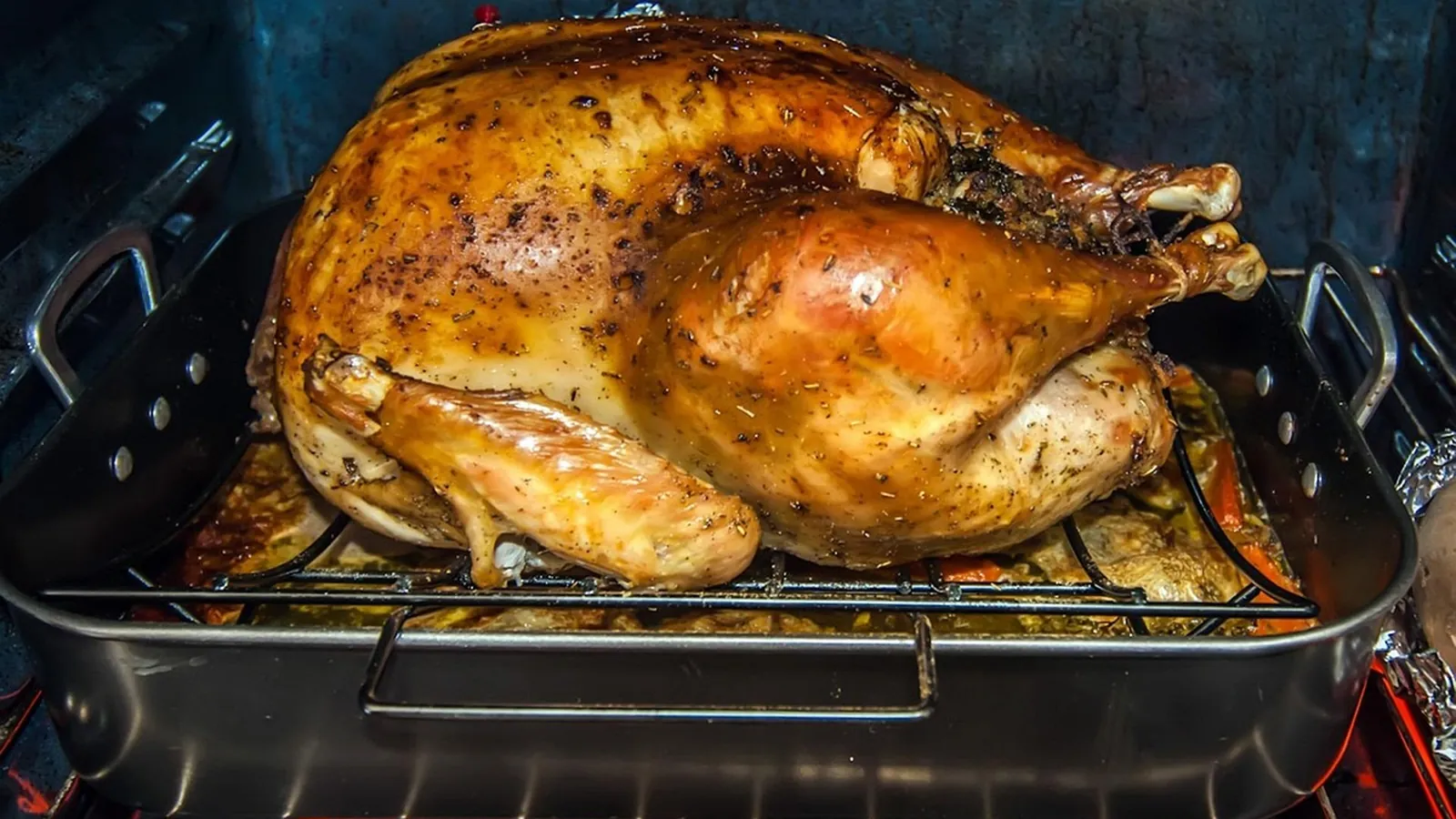
At 325°F, plan on about 13 to 15 minutes per pound for an unstuffed turkey, which works out to 2 3/4 to 3 hours for 12 pounds and 4 1/4 to 4 1/2 hours for 20 pounds. A stuffed bird needs roughly 15 to 45 minutes more. The clock gets you close; a thermometer reading of 165°F tells you it is done.
Per-pound math is a planning tool. Bigger birds cook fewer minutes per pound than small ones, because a turkey gets heavier much faster than it gets thicker, and heat only has to travel to the middle of the thickest part. That is why the time charts work in weight bands instead of one flat number.
 On the menu12 sections
Turkey roasting times by weight at 325°F
These ranges come from the USDA's roasting timetable for a fresh or fully thawed whole turkey in a 325°F oven, the lowest oven temperature the agency recommends for poultry. Use the low number to start checking and the high number to plan dinner.
| Turkey weight | Unstuffed | Stuffed |
|---|---|---|
| 8 to 12 lb | 2 3/4 to 3 hours | 3 to 3 1/2 hours |
| 12 to 14 lb | 3 to 3 3/4 hours | 3 1/2 to 4 hours |
| 14 to 18 lb | 3 3/4 to 4 1/4 hours | 4 to 4 1/4 hours |
| 18 to 20 lb | 4 1/4 to 4 1/2 hours | 4 1/4 to 4 3/4 hours |
| 20 to 24 lb | 4 1/2 to 5 hours | 4 3/4 to 5 1/4 hours |
Butterball's own chart runs shorter for midsize birds: 3 to 3 1/2 hours for a 10 to 18 pound unstuffed turkey and 3 1/2 to 4 hours for 18 to 22 pounds. The two charts disagree because ovens, pans and starting temperatures vary so much. Plan around the USDA times and check early, and a fast bird simply rests a little longer.
If you are still sizing the bird, figure about a pound per guest for a whole turkey with bones. And if the bird is frozen, it has to thaw in the fridge, about one day per 4 to 5 pounds, before any of these times apply.
What changes the time
A few things push a turkey off the chart in either direction:
- Starting temperature. A bird straight from a 37°F fridge cooks slower than one that sat out while the oven heated. Keep it in the fridge until it goes in; the chart assumes a cold bird.
- A partly frozen center. An icy cavity can add an hour or more, and the breast overcooks while the thighs catch up.
- Your oven. A dial that reads 325°F may hold 300°F or 350°F. If past roasts have run long, test whether the oven runs hot or cold before the holiday.
- The pan. A dark, low-sided roasting pan browns and cooks faster than a deep pan that shields the thighs. A rack under the bird lets heat reach the bottom.
- Opening the door. Each look lets out heat. Baste less, or not at all, and the bird finishes sooner.
Turkey roasting time at 350
The USDA publishes its timetable for 325°F only, and so does Butterball for regular ovens, so there is no official chart for 350°F. Expect a bird at 350°F to finish somewhat ahead of the 325°F ranges, and treat that as guidance. Start checking the temperature a good 30 to 45 minutes before the low end of the 325°F time.
The higher setting gives browner skin, and the breast has less margin. Tent the breast loosely with foil once the skin looks deep golden. Going much hotter only makes sense for a flattened bird, which cooks in a fraction of the time.
How long to cook a stuffed turkey
Stuffing slows the roast because the bread mixture in the cavity has to heat all the way through. Compare the two columns in the table: a stuffed 12 to 14 pound bird takes 3 1/2 to 4 hours instead of 3 to 3 3/4.
Food safety is the bigger issue. The center of the stuffing must reach 165°F, and it often lags behind the meat. When the breast is done and the stuffing is not, the breast keeps cooking while you wait. That is why the USDA suggests baking stuffing in a dish on its own.
If you do stuff the bird, a few habits help:
- Mix the stuffing right before it goes in, never the night before.
- Use about 1/2 to 3/4 cup per pound of turkey and pack it loosely, since it swells.
- Bake extra in a greased casserole during the last hour.
- After the 20-minute rest, check the stuffing center again before scooping it out.
Convection turkey cooking time
Moving air speeds things up a lot. Butterball's convection chart at 325°F lists 2 to 2 1/2 hours for a 10 to 18 pound unstuffed turkey and 2 1/2 to 3 hours for 18 to 22 pounds. That is close to an hour less than the same bird in a still oven.
Ovens differ, and some convert the setting for you. Read how convection changes recipes and decide whether your oven already drops the temperature. Either way, start checking about an hour sooner than you would without the fan, and use a low-sided pan so air can reach the legs.
How long to cook a spatchcocked turkey
Cutting out the backbone and pressing the bird flat changes everything. America's Test Kitchen roasts a butterflied 12 to 14 pound turkey at 450°F for 80 to 100 minutes, turning the pan once after 40 minutes. That is about half the time of a whole bird.
The flat shape puts the thighs and breast at the same height, so they finish closer together. The high heat crisps the skin all over. Lay the bird skin side up on a rack set over a rimmed pan, tuck the wing tips, and check the breast starting at 80 minutes.
When to start checking
Start reading the temperature at the low end of the chart. For a 16-pound unstuffed bird that means about 3 3/4 hours in. If the bird has browned early, or your oven has run fast before, take a first reading 30 minutes sooner.
The bird is safe at 165°F in the thickest part of the breast, the innermost part of the thigh and the innermost part of the wing. Many cooks let the thighs go to 175°F or a little past for texture, since dark meat softens more at that point; that higher number is about quality, while 165°F is the safety line. Exactly where to put the probe and how to read each spot takes a little practice, and a fast instant-read thermometer makes the checks quicker with the door open.
Visual cues help you decide when to look. The skin turns deep golden brown, the juices in the pan sizzle and the legs start to loosen at the joint. None of those prove the bird is done.
A roasting timeline for a 14-pound bird
Here is how the day runs for an unstuffed 14-pound turkey and a 5 p.m. dinner.
 The Method
- Heat the oven to 325°F at 12:30 p.m. Pat the bird dry, set it on a rack in the pan, breast up.
- Put the turkey in at 1 p.m. Leave the door closed for the first hour.
- Around 2:30 p.m., when the breast skin is golden, lay a loose sheet of foil over the breast so it browns no further.
- At about 4 p.m., the 3-hour mark, take the first temperature reading in the breast and thigh.
- Check every 15 to 20 minutes after that. Pull the bird when every spot reads 165°F.
- Rest it under loose foil for 20 to 30 minutes, then carve and serve at 5 p.m.
If the bird finishes at 3:45, it can rest longer. If it reads 150°F at 4:30, push dinner back and keep going; it is far easier to stall the side dishes than to serve underdone meat.
How long to let turkey rest before carving
Let a whole turkey rest at least 20 minutes, the time the USDA and Clemson Extension both give, and up to 30 to 40 minutes for a big bird. Butterball's minimum is 15 minutes. Cover it loosely with foil so the skin stays crisp.
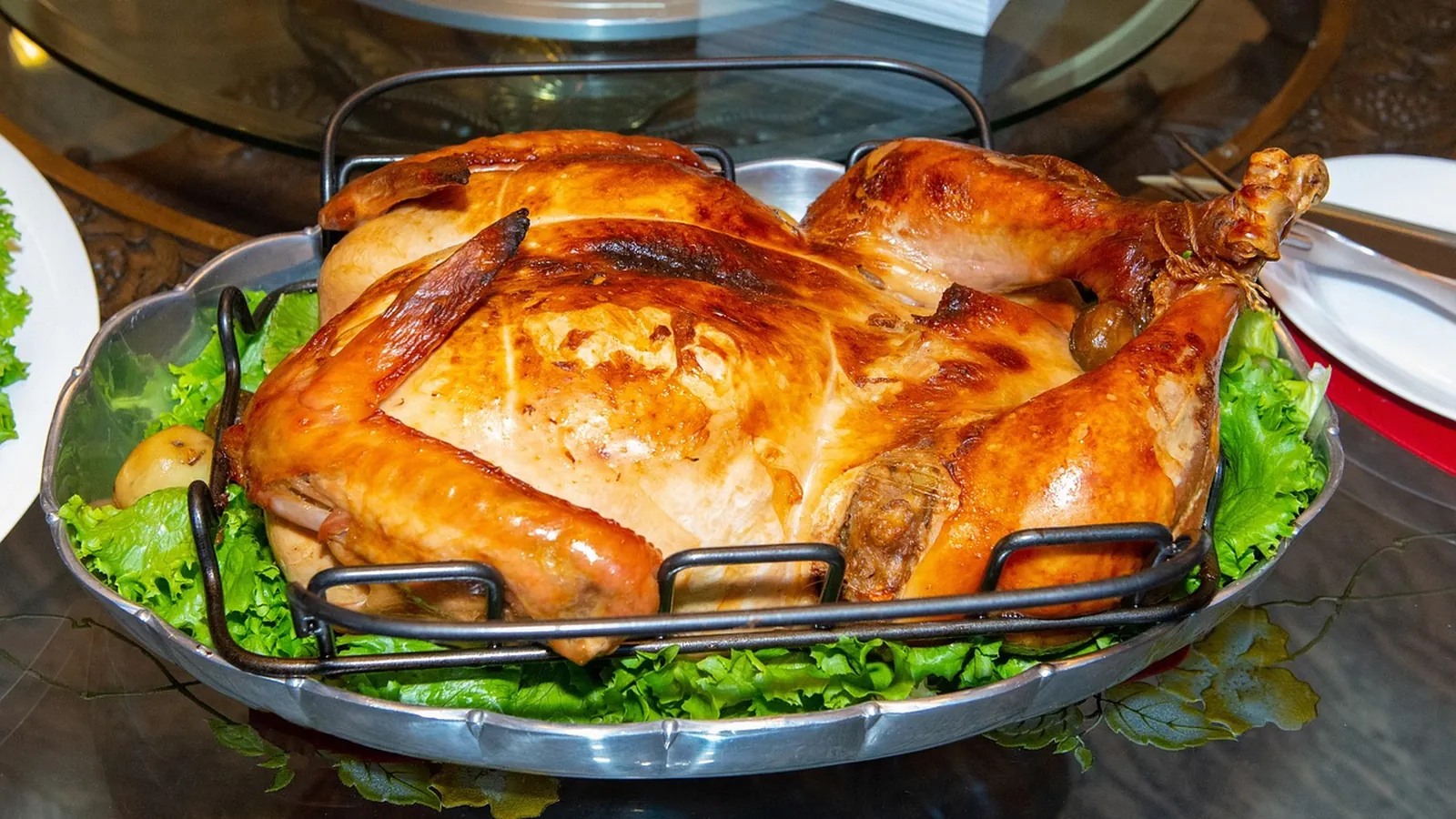
Resting lets the juices settle back into the meat, so less ends up on the cutting board. The temperature also climbs a few degrees while it sits. A rested bird stays hot enough to serve for a good while, and the drippings have time to become smooth gravy without lumps.
When the turkey is done too early or running late
Timing slips both ways, and each has a simple fix.
| What you see | Likely cause | Fix |
|---|---|---|
| Bird reads 165°F an hour before dinner | Oven runs hot, or a smaller bird than the label suggests | Rest it under foil and towels for up to an hour, or carve, cover and hold at 140°F or above |
| Breast is done, thighs are not | Thighs shielded by a deep pan, or a cold center | Remove and carve the breast; return the legs to the oven |
| Thermometer stuck in the 150s for an hour | Oven too cool, or the door opened too often | Raise the oven to 350°F and stop basting |
| Stuffing under 165°F after the meat is done | Stuffing packed tight or mixed cold | Scoop it into a dish and bake until the center reads 165°F |
| Skin browning far too fast | Oven runs hot or bird sits too high | Tent the breast with foil and lower the rack |
| Running an hour late with guests waiting | Partly frozen bird or underestimated weight | Spatchcock or cut the bird into parts; pieces finish much faster |
A turkey done too early is the easier problem. Carved meat in a covered pan with a splash of broth stays moist in a 200°F oven, as long as it holds 140°F or warmer. Hot food left out for more than 2 hours belongs in the trash, so serve or refrigerate before then.
Getting leftovers into the fridge
Once dinner wraps up, slice the meat off the bones and refrigerate it within 2 hours in a fridge at 40°F or below. Shallow containers cool faster than a whole carcass. The carcass makes a good base for a long-simmered turkey soup.
Carved turkey keeps for 3 to 4 days, and reheated portions should reach 165°F. More on how long leftover turkey lasts helps you decide what to freeze on day one. For timing other birds and roasts, the full cooking times collection has charts by size.
 Watching a turkey roast from oven to carving board
A timetable is easier to trust once you have seen how a turkey looks as it nears the finish. A clear roasting demonstration shows the browning, tenting and thermometer checks in order.
How to Cook a Turkey
By Preppy Kitchen on YouTube. Their method may vary a little from ours. Watch on YouTube
- Notice how deep golden the skin gets, the cue to tent the breast with foil roughly halfway through a 3 to 3 3/4 hour roast.
- Watch where the thermometer goes in, since the breast, inner thigh and wing all need to read 165°F.
- Compare the resting time with the 20-minute minimum before carving.


