Kitchen Tools
Which Kitchen Knife Is Worth Buying If You Can Only Own One Good One?
 By the CookClear writers
Checked against manufacturer instructions and test kitchen reviews
 Clear Answer
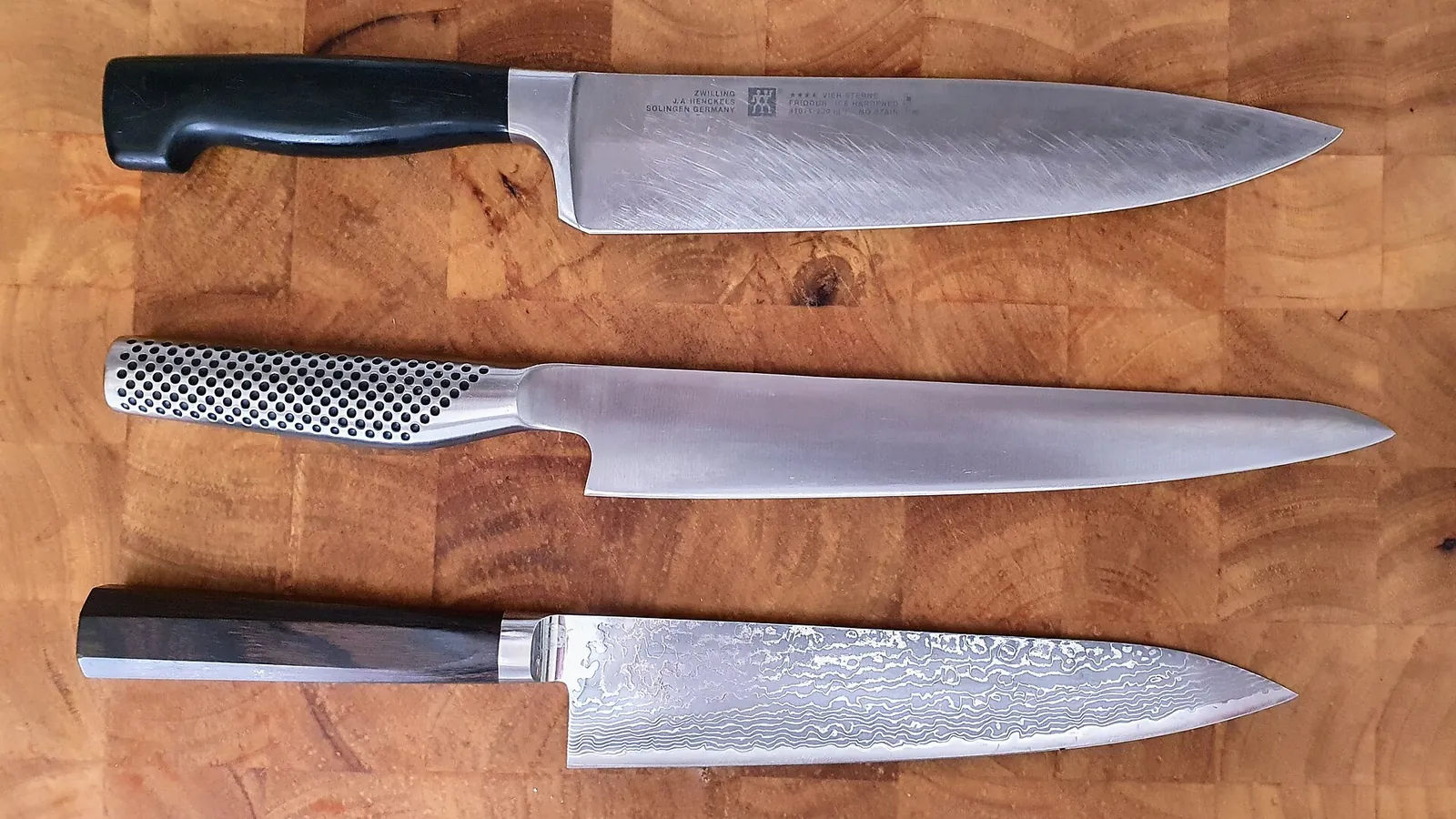
Buy an 8-inch chef's knife. It handles about 90 percent of home cooking, from mincing garlic to breaking down a chicken to slicing a watermelon, and nothing else covers that much ground. Pick one in stainless or high-carbon stainless steel with a comfortable handle and a weight that feels balanced near where the blade meets the handle.
A santoku is the only real contender, and it's a fine choice if your hands are small or you mostly push-cut vegetables. For everyone else, the chef's knife wins on reach, versatility and the ability to rock through herbs.
Why does a chef's knife beat every other single knife?
A chef's knife has a long, gently curved edge, a pointed tip and a tall heel. That shape gives you three tools in one blade. The tip handles fine work like scoring and trimming, the curved belly rocks through herbs and onions without crushing them, and the flat heel near the handle gives you power for squash, chicken joints and hard rinds.
Most other knives do one of those jobs well and the others badly. A paring knife can't cut a cabbage in half. A bread knife tears herbs and can't mince. A boning knife flexes too much for dense vegetables. The chef's knife is the generalist, which is what a one-knife kitchen needs.
What size chef's knife should you get?
Eight inches is the sweet spot for most home cooks. It's long enough to slice through a large onion or a roast in one stroke, or a ripe watermelon, and short enough to control on a standard 12 by 18 inch cutting board.
| Blade length | Best for | Downsides |
|---|---|---|
| 6 inches | Small hands, tiny kitchens, small boards | Too short for melons, cabbages, big roasts |
| 7 inches | Cooks who find 8 inches a bit long | Fewer options, slightly less reach |
| 8 inches | Nearly everyone; all-purpose cooking | Rarely any for typical home use |
| 9.5 to 10 inches | Big batches, large boards, confident cooks | Feels unwieldy at first, needs a big board |
If you've never used a big knife, 8 inches might feel large for a week or two. Give it time. Most people who start at 6 inches outgrow it quickly, and very few people find 8 inches too small.
Japanese gyuto knives (the Japanese take on a chef's knife) are measured a little differently, usually in millimeters. A 210 mm gyuto is roughly the equivalent of an 8-inch Western chef's knife.
Should your knife be German-style or Japanese-style?
Both styles are good. They differ in steel hardness, edge angle, weight and how much care you're willing to give it.
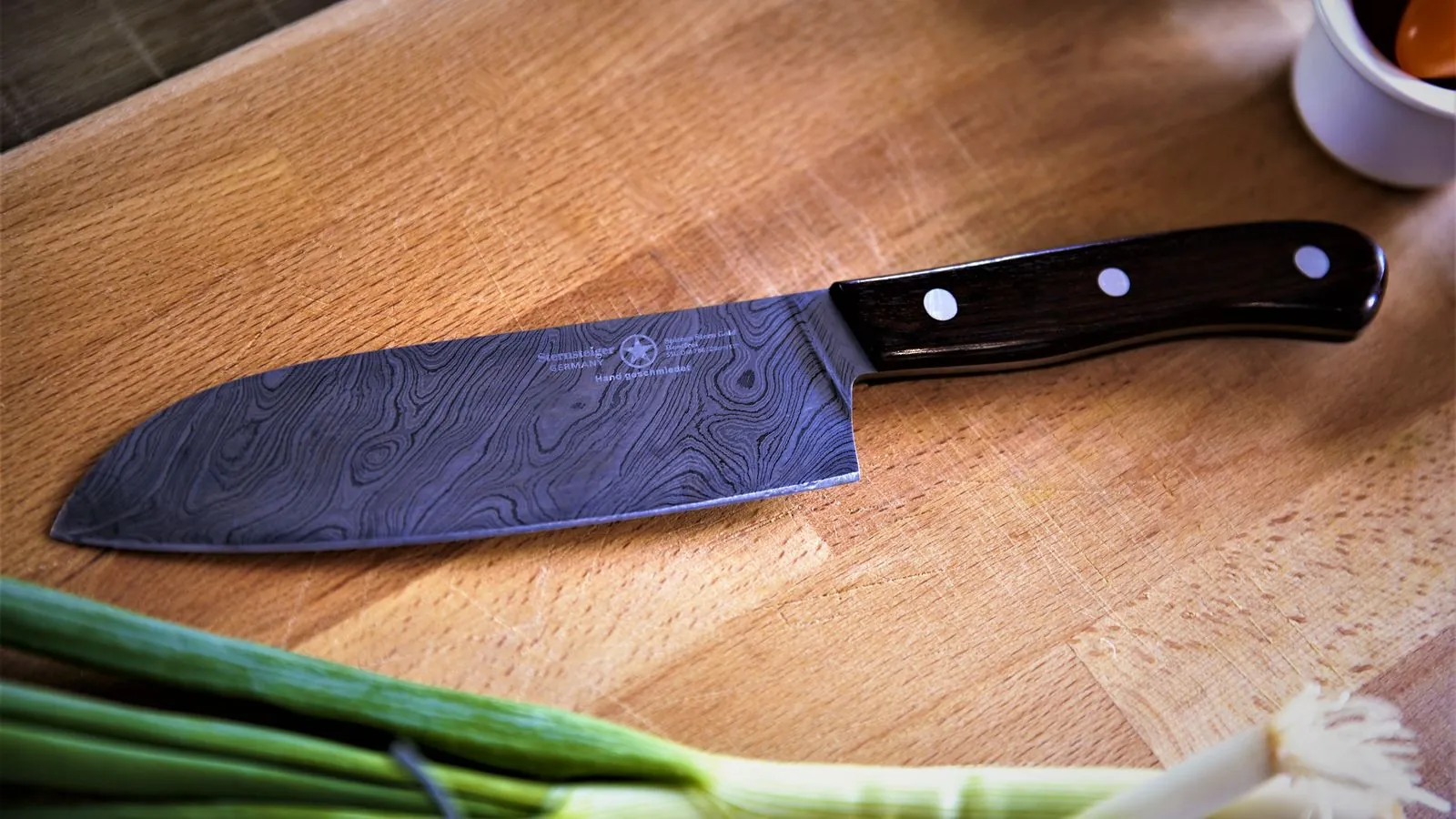
| Feature | German/Western style | Japanese style (gyuto) |
|---|---|---|
| Typical hardness | About 56 to 58 HRC | About 60 to 63 HRC |
| Edge angle per side | About 14 to 20 degrees | About 10 to 16 degrees |
| Weight | Heavier, often 7 to 9 oz | Lighter, often 5 to 7 oz |
| Edge profile | More curve, good for rocking | Flatter, good for push and pull cuts |
| Sharpness out of box | Sharp | Very sharp |
| Durability | Tough, forgiving, resists chips | Holds an edge longer, but can chip |
| Maintenance | Hone often, sharpen now and then | Hone less, sharpen on stones ideally |
German-style knives (think of the classic forged knives from Solingen makers like Wüsthof or Zwilling) use softer steel. The edge rolls over with use rather than chipping, and a few strokes on a honing steel push it back into line. That makes them forgiving if you scrape your board, cut near bones or occasionally get careless.
Japanese-style knives (Global, Shun, Tojiro and Mac are common examples) use harder steel ground to a thinner edge. They glide through onions and tomatoes with less effort and stay sharp longer. The tradeoff is that hard, thin edges can chip if you twist the blade in a squash, hit a bone or use a glass board.
If you cook a lot of meat with bones, tend to be rough on tools, or don't want to think about your knife, lean German. If you mostly cut vegetables and like a light, precise blade, lean Japanese. Plenty of makers now sell hybrids with Western handles and moderately hard steel around 58 to 60 HRC, which split the difference nicely.
Is a santoku better than a chef's knife?
A santoku is a Japanese all-purpose knife, usually 5 to 7 inches long, with a flatter edge and a rounded "sheep's foot" tip. It's lighter and shorter than most chef's knives, and many people find it less intimidating.
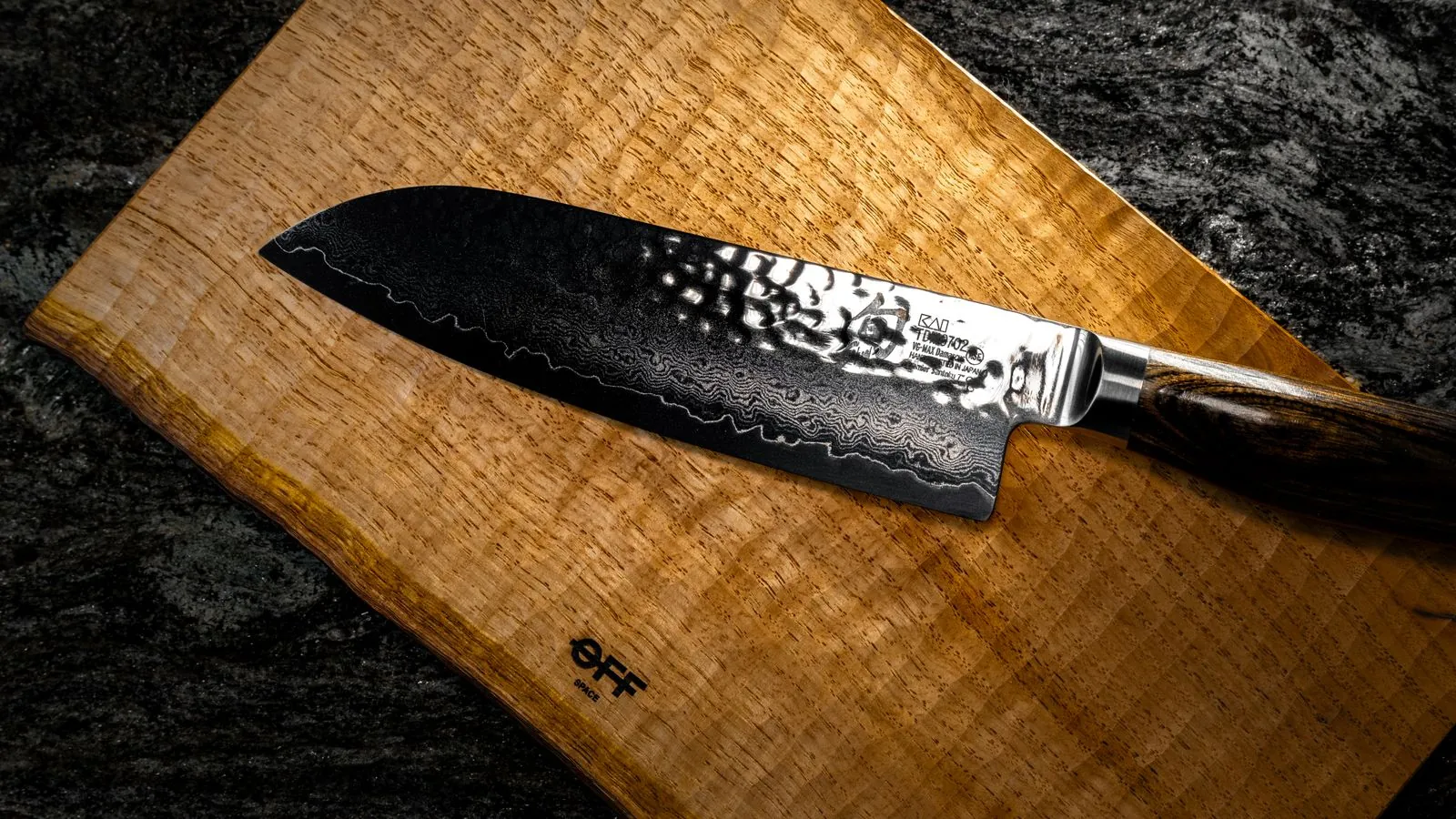
It's a reasonable single knife if:
- Your hands are small and an 8-inch blade feels awkward
- You mostly chop vegetables with an up-and-down or push-cut motion
- You work on a small board or in a cramped kitchen
- You rarely break down whole chickens or cut big squash
Where the santoku falls short is reach and the tip. The rounded nose isn't great for fine point work, and the flatter edge doesn't rock well for mincing herbs. The shorter length also struggles with large items like watermelon or a pork shoulder. For a one-knife kitchen, those gaps matter more than the extra comfort.
How do you tell a good chef's knife from a mediocre one?
You can't judge a knife by its price tag or the number of layers in its pattern. Damascus-style patterns are often just cosmetic cladding. What counts is the steel, the grind, the balance and how it feels in your hand.
Check these:
- Steel type. Look for stainless or high-carbon stainless. Named steels like X50CrMoV15, VG-10, AUS-8, AUS-10 and SG2 are all proven. Pure carbon steel gets very sharp but rusts and discolors if you leave it wet, which makes it a poor choice for a first and only knife.
- Hardness. Somewhere between 56 and 61 HRC suits most home cooks. Lower is tougher but dulls faster. Higher stays sharp longer but chips more easily.
- Blade thickness. Behind the edge, a good knife should be thin. A thick, wedge-shaped blade splits carrots and potatoes instead of slicing them. If a knife cracks a carrot in half before it reaches the board, it's too thick.
- Balance. Pinch the blade just ahead of the handle. A well-balanced knife sits level or tips very slightly toward the handle. A handle-heavy knife feels clumsy on long cuts.
- Handle comfort. Hold it in a pinch grip (thumb and index finger on the blade, other fingers around the handle). Nothing should dig into your knuckles or palm. Your knuckles should clear the board when the edge touches down.
- Full or partial bolster. A full bolster (the thick metal collar running down to the heel) adds weight but makes the heel hard to sharpen over time. A partial bolster or none at all is easier to maintain.
- Construction. Forged and stamped knives can both be excellent. Stamped blades are lighter and cheaper to make, and some of the most recommended budget knives are stamped. Don't pay extra just for "forged."
Does a good knife need to be expensive?
No. Test kitchens have repeatedly found that some inexpensive stamped chef's knives, the Victorinox Fibrox line being the best-known example, cut nearly as well as knives that cost several times more. What you give up is mostly fit, finish, and edge retention.
Spending more usually buys you harder steel that stays sharp longer, a thinner and more refined grind, nicer handle materials, and better fit around the bolster and spine. Those are real improvements, and if you cook every day you'll notice them. But a sharp cheap knife will always outperform a dull expensive one.
The smarter move is to put part of your money toward keeping the knife sharp. A honing rod plus either a whetstone or a decent manual sharpener will do more for your daily cooking than an upgrade in steel.
How do you keep one knife working for years?
A good chef's knife can last decades if you treat it reasonably well. Most knives that end up dull, chipped or rusty got that way from a few common habits.
- Hand wash and dry it right away. Dishwashers knock blades against other items, the heat can loosen handles, and the detergent is harsh on edges. Wash with warm soapy water, dry with a towel, and put it away.
- Use the right board. Wood or soft plastic boards are kind to edges. Glass, marble, stone and ceramic boards dull a knife in minutes.
- Hone regularly. A honing rod realigns the edge and doesn't remove much metal. For German-style knives, a few light strokes every couple of cooking sessions helps a lot. Use a ceramic rod or none at all for very hard Japanese steel.
- Sharpen a few times a year. Home cooks typically need a real sharpening every 3 to 6 months, depending on use. A whetstone around 1000 grit handles most of the work, with a finer stone around 3000 to 6000 grit for polishing.
- Store it safely. A magnetic strip, an in-drawer block, or a simple blade guard keeps the edge from banging into other tools.
- Scrape with the spine. When moving chopped food across the board, flip the knife and use the back. Dragging the edge sideways dulls it fast.
A quick sharpness test: slice a sheet of printer paper held in the air. A sharp knife slides through cleanly. If it catches, tears or slips off the edge of a tomato skin, it's time to hone or sharpen.
When would you add a second or third knife?
Once the chef's knife is part of your routine, you may notice a couple of jobs it handles awkwardly. That's when a second knife earns its place.
The most common additions, in order of usefulness:
- A serrated bread knife (8 to 10 inches). Crusty bread, tomatoes with tough skins, and layer cakes are easier with serrations. It also spares your chef's knife from crust that dulls it.
- A paring knife (3 to 4 inches). For hulling strawberries, peeling apples in your hand, deveining shrimp, and trimming small items.
Those three knives together cover nearly everything a home kitchen does. Big knife blocks with 12 or 15 pieces mostly add tools you'll rarely touch, and the money is better spent on one excellent chef's knife and a way to keep it sharp. If you slice a lot of potatoes paper thin, a mandoline used safely is the one extra worth considering.
Three things that mislead first-time knife buyers
Sharpness out of the box tells you very little about how a knife will perform in month six. Every knife ships sharp. What separates them is how well the steel holds that edge and how easily you can bring it back.
Weight is personal, not a quality marker. Some cooks love the momentum of a heavy German blade. Others feel it tiring their wrist after 10 minutes of prep. Neither is wrong.
Finally, a knife that you're afraid to use isn't a good knife for you. If a very hard, thin Japanese blade makes you nervous about chipping it, you'll baby it and reach for something worse. Buy the knife you'll use every day, a test worth applying to any kitchen tools you buy.
 What separates a good chef's knife from a frustrating one
Balance and handle comfort are hard to judge from a spec table. America's Test Kitchen runs affordable chef's knives through everyday tasks.
Equipment Review: Inexpensive Chef's Knives
By America's Test Kitchen on YouTube. Their method may vary a little from ours. Watch on YouTube
- Notice how each knife handles onions, herbs, and tomatoes, the jobs where the blade shape described above matters most.
- Watch the grip and the cutting motion, and ask whether an 8-inch blade looks comfortable for the hand holding it.
- Compare how the tester treats sharpness and edge, and tie it to the German versus Japanese differences in the table.