 Kitchen Tools
Is Your Oven Running Hot or Heating Unevenly, and How Do You Test It?
 By the CookClear writers
Checked against manufacturer instructions and test kitchen reviews
 Clear Answer
Put an oven thermometer on the center rack, heat to 350°F, and read it after 30 to 40 minutes; if it averages more than about 25°F off the dial, your oven runs hot or cold. To find uneven heat, bake a rack of white bread slices at 350°F for 8 to 10 minutes. The darkest slices mark your hot spots.
The thermometer tells you whether the whole oven is off, and the bread tells you where inside it the heat lands. Most home ovens have a little of both problems, and once you know the pattern you can cook around it.
What counts as "running hot," anyway?
No oven holds one steady temperature. The heating element or burner switches on, overshoots, shuts off, and the air cools until it kicks on again. America's Test Kitchen notes that even a well-calibrated oven can cycle as much as 25 degrees above and below the target, averaging out over time.
 On the menu9 questions
That means a single glance at a thermometer can fool you. Seeing 325°F on a 350°F setting is normal if you happened to catch the bottom of a cycle. The number to trust is the average across several cycles, and a European recipe in Celsius needs converting to Fahrenheit before any of this comparison makes sense.
Here is how to read your results:
| Average reading at a 350°F setting | What it means | What to do |
|---|---|---|
| 335 to 365°F | Normal | Nothing. Bake as written. |
| 366 to 380°F | Runs a bit hot | Set the dial lower by the difference, or recalibrate |
| 320 to 334°F | Runs a bit cold | Set the dial higher by the difference, or recalibrate |
| Above 380°F or below 320°F | Well off | Recalibrate; if it drifts again, call for service |
Most roasts, casseroles, and sheet-pan dinners tolerate an average error of around 25 degrees. Delicate things like popovers, soufflés, and Dutch babies do not, and neither do many cakes and cookies. ThermoWorks, which tests a lot of home ovens, puts the typical offset at about 25 to 50°F, so a surprising number of kitchens are working outside that comfortable range.
The thermometer test, step by step
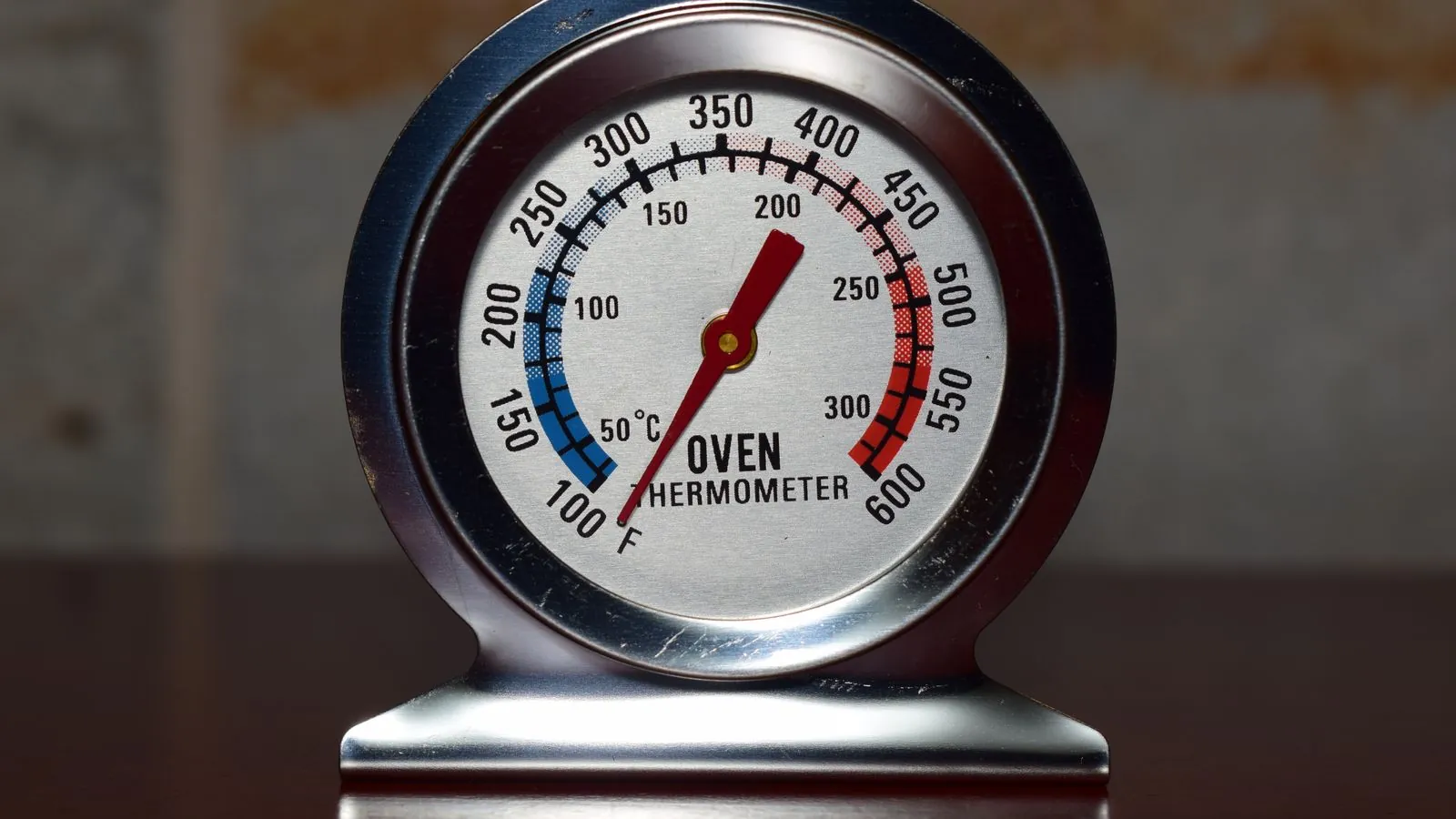
An inexpensive dial oven thermometer is enough. A probe thermometer with a wire that runs out the door is better, because you can read it without opening the oven and letting heat out. For the food itself, an instant-read thermometer is the matching tool.
- Start with the oven off and empty, with a rack in the center position.
- Set the thermometer in the middle of the center rack. If it hangs, clip it to the rack just above center.
- Set the oven to 350°F and close the door. Do not open it during the test.
- Wait. Read a digital probe after about 30 minutes; give a dial thermometer at least 40 minutes, since it responds slowly.
- Take several readings a few minutes apart (or use the min and max on a probe). Average the high and low.
- Subtract 350 from that average. The result is your oven's offset.
ThermoWorks offers a worked example: a high of 378°F and a low of 354°F average out to 366°F, an offset of 16°F. To bake at a true 350°F in that oven, you'd set the dial to about 334°F.
Repeat the test at 425°F if you roast a lot. Some ovens are close at moderate settings and drift further at high ones. If your oven has a convection mode, test that separately too, because the two modes can behave differently.
Do the beep and the preheat light mean the oven is ready?
Not really. The preheat signal usually tells you the air near the sensor reached the set point once. The walls, racks, and floor are still catching up, and the first cycle often overshoots. That's why the test calls for 30 to 40 minutes. For homemade bread, pizza, and anything that depends on a big blast of heat, giving the oven extra time after the beep makes a real difference.
No thermometer? Try the oven sugar test
Plain granulated sugar melts at about 367°F, which gives you a rough built-in checkpoint. Cooking for Geeks describes a simple version:
- Make two small foil trays, about 4 inches square with low sides, and put a spoonful of sugar in each.
- Bake the first one at 350°F for 20 minutes.
- Raise the oven to 375°F, wait 10 minutes, then bake the second one for 20 minutes.
In an accurate oven, the 350°F sugar stays granular and the 375°F sugar melts. If the first one melts, your oven runs hot. If the second stays dry and white, it runs cold. This only tells you which side of 367°F you're on, not by how much, so treat it as a quick check and buy a thermometer when you can.
How do you find hot spots inside the oven?
The toast test is the classic method, and it takes about 10 minutes.
- Preheat the oven to 350°F.
- Cover a wire rack (or a large sheet pan) edge to edge with slices of plain white sandwich bread.
- Slide it onto the middle rack and bake for 8 to 10 minutes.
- Pull it out without shifting the slices. Flip them over if the tops are hard to read.
- Snap a photo with the front of the oven at the bottom of the frame.
Dark slices mark hot zones and pale slices mark cool ones. Keep that photo on your phone as a map of your oven. It won't change much unless the oven is repaired or replaced.
If you want the full picture, run the test on a second rack too. King Arthur Baking did exactly this, with six slices on the center rack and six on an upper rack, and found the sides and back browned faster than the front and center, while the undersides on the lower setup came out much darker than the tops.
Signs in your everyday baking
You can often spot the signs your oven runs hot or uneven before you test it. Watch for these patterns:
- Recipes consistently finish early, or edges set and brown well before the center cooks. That points to an oven that runs hot.
- Recipes consistently run long, or cookies spread and stay pale. That points to an oven that runs cold.
- One side of a sheet of cookies is browner than the other. That's a hot spot, usually at the back or one side wall.
- Cake domes and cracks on one side while the other stays flat. Uneven heat is lifting one side faster.
- Bottoms burn while tops look underdone. The lower element is doing too much of the work, or the rack is too low.
One wonky result doesn't prove much. Recipes, pans, and ingredients all vary. Three or four bakes that lean the same way, though, are worth a test.
Why ovens heat unevenly in the first place
Most home ovens heat from a bake element or gas burner under the floor, with a broil element at the top. Hot air rises and moves along the walls, so the back and sides of the cavity tend to run hotter than the front. The door, with its glass and seals, loses heat fastest, which is why the front row of cookies is so often the palest.
The temperature sensor sits in one spot, usually on the back wall near the top. It only knows what's happening right there. If that corner runs cool compared with the center, the oven will keep heating and the middle will run hot, or the reverse.
Things that make it worse:
- Opening the door often, which dumps heat and triggers another heating cycle
- Crowding the oven with two full sheet pans, which blocks airflow
- Dark pans, which absorb more heat than light aluminum and brown faster
- Lining the oven floor with foil, which can reflect heat and block vents
- An aging sensor or element, which can drift over the years
What to do once you know your oven's quirks
You don't need a new oven. An oven thermometer, a stone, and a rotated pan are simple kitchen tool fixes that handle most of these problems.
| Problem | Fix |
|---|---|
| Whole oven runs hot or cold | Adjust the dial by your offset, or use the calibration setting in your manual |
| Back runs hotter than front | Rotate pans front to back halfway through |
| Bottoms burn | Move the rack up one position, or add a baking stone on the lowest rack |
| One side runs hot | Rotate pans side to side, and avoid that corner for delicate bakes |
| Big temperature swings | Keep a baking stone or heavy steel in the oven to add thermal mass |
Many digital ovens let you shift the temperature through a calibration menu. The exact steps vary by brand, so check the manual or the manufacturer's site. Older dial ovens may have a small adjustment screw behind the knob.
A baking stone, the same one you'd use for pizza dough, helps more than most people expect. King Arthur's tests found that a stone on the oven floor evened out browning and made the bottoms of toast lighter. A full 60-minute preheat worked better than a 20-minute one, and the stone also softened the temperature drop when the door was opened. In their home tests, a stone made a noticeable difference about two thirds of the time. Expect it to add to your preheat time, roughly 50 percent longer in the author's oven.
Rotating pans works well for cookies, sheet-pan vegetables, and roasts. Wait until whatever you're baking has set before you open the door. For cakes, wait until the top looks set, since an early jolt of cool air can make them sink.
When the problem is the oven, not you
Calibration and workarounds cover most cases. Some symptoms mean a part is failing:
- The offset changes a lot from one test to the next
- The oven takes much longer to preheat than it used to
- It overshoots wildly and never settles
- A gas oven has a weak or uneven flame, or an electric element has visible blisters or a dark, dead section
In those cases, a sensor, igniter, or element may need replacing. Those are usually affordable repairs compared with a new range, and a service technician can tell you quickly.
Even with a healthy oven, it's worth leaving a thermometer inside full-time. It costs little, it catches drift early, and it tells you when the oven is truly ready rather than when the beep says it is.
 What an oven thermometer shows that the dial hides
The gap between the dial setting and the temperature inside is easy to talk about and easier to understand once you see a thermometer reading. America's Test Kitchen shows why the dial cannot be trusted.
The Secret to Better Baking is a Good Oven Thermometer
By America's Test Kitchen on YouTube. Their method may vary a little from ours. Watch on YouTube
- Compare the thermometer reading with the dial setting, the same offset calculation used in the 350°F test above.
- Notice where the thermometer sits in the oven, since the test above puts it in the middle of the center rack.
- Think about how the reading would change if you waited the full 30 to 40 minutes after the preheat beep.


