Home / Measurements & Conversions
 Measurements & Conversions
What Does a Pinch, Dash or Smidgen Measure When a Recipe Says So?
 By the CookClear writers
Checked against US standard measures, NIST conversions and test kitchen weights
 Clear Answer
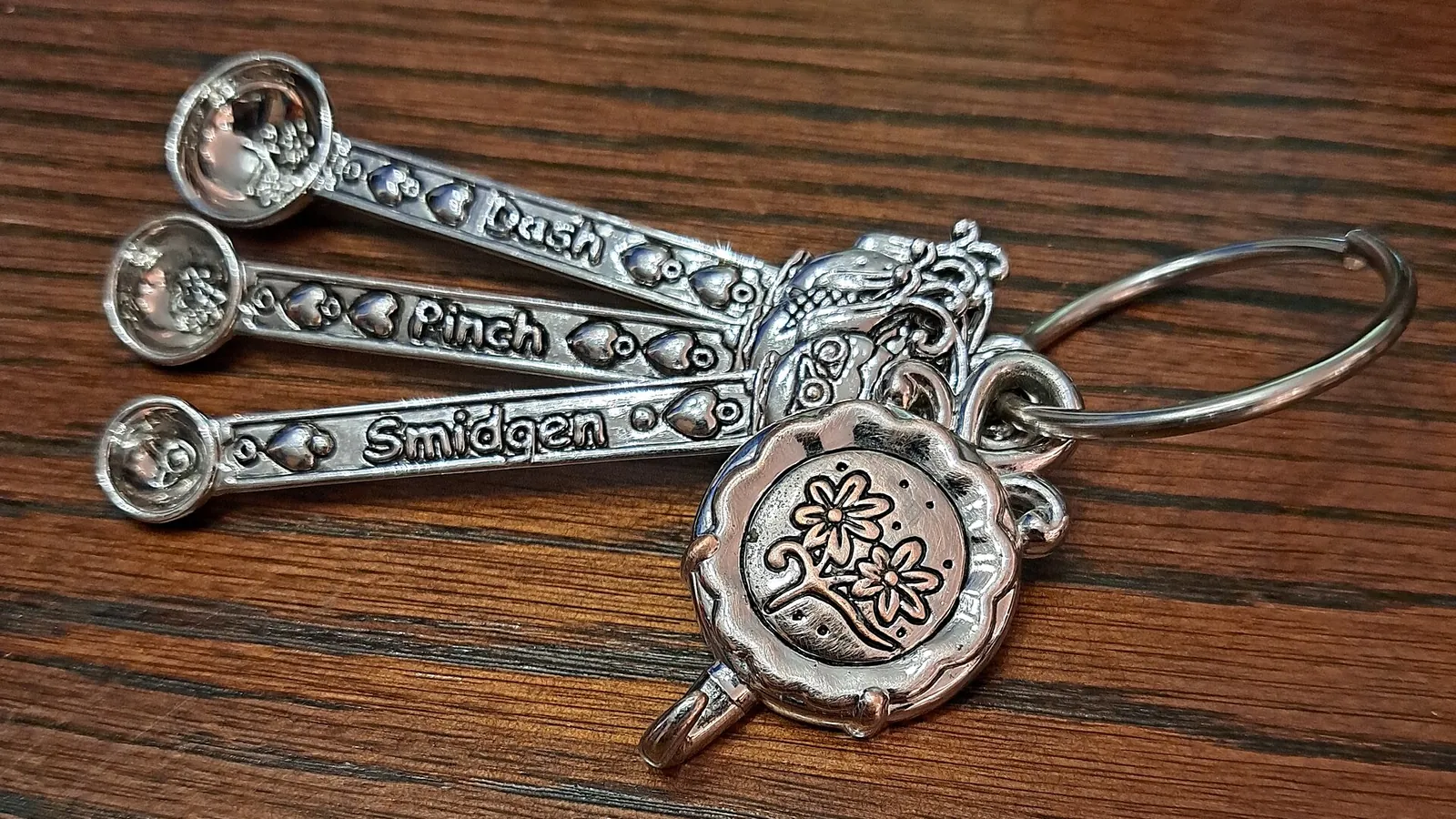
By the convention printed on most novelty measuring spoon sets, a pinch is 1/16 teaspoon, a dash is 1/8 teaspoon and a smidgen is 1/32 teaspoon, with a tad at 1/4 and a drop at 1/64. These are shared habits, not official units, so read them as a cook's best guess at a very small amount.
Nobody in government ever defined a pinch. The US teaspoon is a real unit, but the smaller words grew up in kitchens and bars, and the spoon makers who stamped them onto metal later picked one set of values and stuck with it.
How much is a pinch, dash or smidgen in teaspoons?
The values in this table follow the common mini spoon sets sold in the US. Each one is half of the next larger size, which makes them easy to remember. The milliliter column uses the US customary teaspoon, which is 1/6 of a fluid ounce, or about 4.93 mL.
| Name | Fraction of a teaspoon | About how many mL | How many fit in 1 teaspoon |
|---|---|---|---|
| Tad | 1/4 teaspoon | 1.2 mL | 4 |
| Dash | 1/8 teaspoon | 0.6 mL | 8 |
| Pinch | 1/16 teaspoon | 0.3 mL | 16 |
| Smidgen | 1/32 teaspoon | 0.15 mL | 32 |
| Drop | 1/64 teaspoon | 0.08 mL | 64 |
These are convention, not law. NIST, the agency that publishes US weights and measures, defines the teaspoon and tablespoon but not the words in this table. If you want the official steps above a teaspoon, the teaspoons in a tablespoon math is fixed at 3 to 1, and everything bigger in the measurements and conversions family builds from there.
Older sources disagree with the spoon sets. A reference table from around 1885 put a pinch at 1/8 teaspoon, twice the modern figure. A 1954 Angostura bitters booklet called a dash 1/6 teaspoon. So if a recipe is old, or comes from a bartender, the writer may have had a slightly bigger amount in mind. The modern spoon values are a fair middle ground.
How small is each one next to a regular teaspoon?
Smaller than most people picture. A pinch is 1/16 of a teaspoon, so if you poured a level teaspoon of salt onto a plate, you could split it into 16 pinches. A smidgen is half that, roughly what clings to your fingertip when you touch it to the salt.
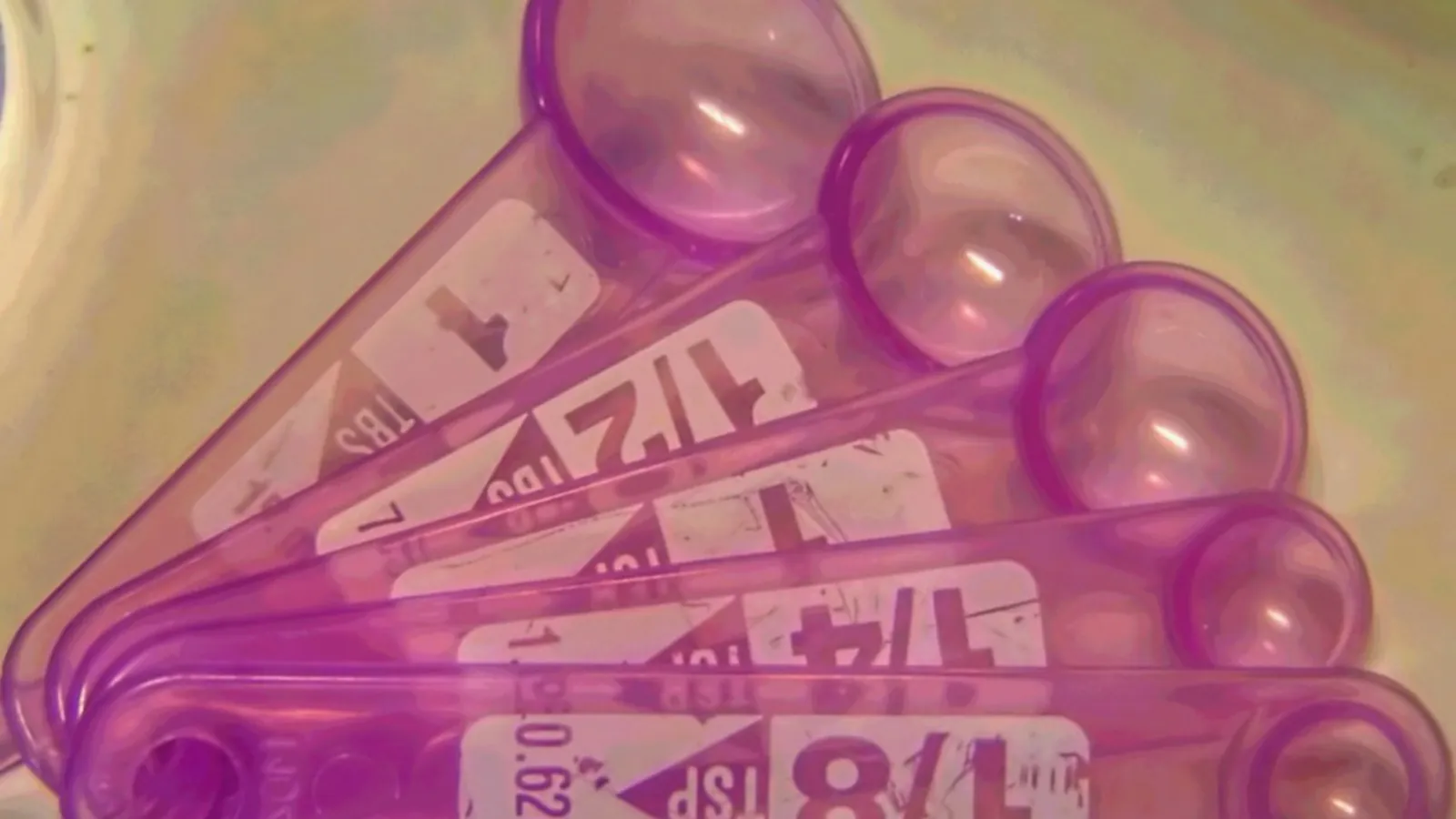
You can measure all of these without a novelty set:
- Tad. Use your 1/4 teaspoon, level.
- Dash. Fill the 1/4 teaspoon about halfway, or use a 1/8 teaspoon if your set has one.
- Pinch. Fill the 1/4 teaspoon about a quarter of the way, or half of a 1/8 teaspoon.
- Smidgen. Take what you think is a pinch, then knock half of it back into the jar.
- Drop. For liquids, one drop from a dropper bottle or the tip of a spoon. For dry goods it means barely any.
Most standard sets stop at 1/4 or 1/8 teaspoon, and that is plenty. Halving by eye is fine at this scale, because the difference between a careful and a sloppy pinch is a few grains.
How much is a pinch of salt in grams?
It depends on the salt, since the crystals take up different amounts of space. King Arthur Baking's ingredient chart lists 1 tablespoon of table salt at 18 grams, Morton kosher salt at 16 grams and Diamond Crystal kosher salt at 8 grams. Divide by 48 pinches per tablespoon and you get the figures in this table.
| Salt | Grams per tablespoon (King Arthur) | Grams per pinch (1/16 tsp) | Grams per dash (1/8 tsp) |
|---|---|---|---|
| Table salt | 18 | About 0.4 | About 0.75 |
| Morton kosher | 16 | About 0.33 | About 0.67 |
| Diamond Crystal kosher | 8 | About 0.17 | About 0.33 |
So a pinch of table salt carries more than twice the salt of a pinch of Diamond Crystal, even though both look like a pinch. If a recipe calls for "a pinch of salt" and you use flaky or coarse kosher salt, you can take a bigger pinch without overdoing it. The reverse is also true: fine table salt goes further.
That is also why most home kitchen scales are no help here. A typical scale reads in 1 gram steps, and a pinch weighs less than half a gram. The kitchen scale vs measuring cups question only tips toward the scale once amounts reach several grams.
How do you measure a pinch by hand?
The finger pinch is the original version, and it still works for seasoning. The trouble is that hands differ, and so do habits. A pinch between the thumb and one finger holds noticeably less than a pinch between the thumb and two fingers, and a pinch from a deep salt cellar holds more than one from a flat plate.
You can calibrate your own hand in two minutes:
- Pour a level 1/4 teaspoon of the salt you use most onto a small dark plate. That is 4 pinches by the spoon convention.
- Take pinches from your salt jar the way you normally would, dropping them in a second pile next to the first.
- Count how many it takes to match the 1/4 teaspoon pile by eye.
- If it takes about 4, your natural pinch matches the convention. If it takes 2, your pinch is a dash. If it takes 8, your pinch is closer to a smidgen.
- Repeat with your second most used salt, since a kosher salt pinch will behave differently.
Most cooks find they pinch with the thumb and two fingers for salt and the thumb and one finger for strong spices like cayenne or ground cloves. The stronger the ingredient, the smaller the grab.
How much is a dash of a liquid?
For liquids, a dash is usually a quick shake from a bottle with a pour restrictor, like hot sauce, Worcestershire sauce or bitters. By the spoon convention it is 1/8 teaspoon, about 0.6 mL. Bitters bottles are built to deliver small dashes, and older bar books range from 1/8 to 1/6 teaspoon.
For an open bottle with no restrictor, a dash is better measured with a spoon. Tipping an open bottle of vinegar or soy sauce and calling it a dash can easily put out a teaspoon or more.
Drops matter most with extracts. Almond and peppermint extracts are strong enough that a few drops change a whole batch of frosting, which is why a substitute for vanilla extract like almond needs a far lighter hand than a 1 to 1 swap.
Smidgen vs pinch: does the difference matter?
By the spoon values a smidgen is half a pinch, so two smidgens make a pinch, two pinches make a dash and two dashes make a tad. In practice, most cooks treat smidgen as "even less than a pinch, just a trace." If a recipe says a smidgen of cayenne, the writer is warning you that the ingredient is strong and that you should start tiny.
The gap between a smidgen and a pinch is about 0.15 mL. You will not taste that difference with salt in a pot of soup. You may notice it with ground cloves, cayenne, saffron, or anything with heat or a perfume-like smell.
When does a pinch matter, and when can you eyeball it?
A pinch is usually there for one of three reasons: to season, to balance, or to make a small chemical difference. The first two are forgiving; the third is not.
Times a rough pinch is fine:
- Salt in a sweet batter, frosting or whipped cream, where it rounds out the flavor
- A pinch of sugar in tomato sauce to soften acidity
- Black pepper, dried thyme or dried oregano in a soup or stew; if you are converting from fresh, the dried herb ratio matters more than the pinch itself
- Salt in pasta water, which is measured in tablespoons anyway; the salt in pasta water amount dwarfs any pinch
Times to measure with a spoon instead:
- Baking soda or baking powder, even small amounts; leaveners like baking soda react with acid, and too much leaves a soapy taste
- Cream of tartar in meringue, where the amount affects how the whites set, so follow any spoon amount the recipe gives
- Hot spices like cayenne, chipotle or ground cloves in a small batch
- Salt in bread dough, where yeast activity depends on the salt level; recipes give this in teaspoons or grams for good reason
- Anything you are scaling up, since 1 pinch times 8 is a dash times 4, which is half a teaspoon
If you swapped in salted butter for unsalted, skip the recipe's pinch of salt or cut it way back; the salt in salted butter usually covers it.
Why does my dish taste off when I followed "a pinch"?
When a pinch goes wrong, it is almost always one of these.
| What you notice | Likely cause | Fix |
|---|---|---|
| Too salty, even with "just a pinch" | Fine table salt pinched like coarse kosher salt | Use a smaller grab with table salt, or switch to the 1/16 teaspoon spoon |
| No salt flavor at all | Flaky or Diamond Crystal salt, which weighs about half as much per pinch | Use two pinches, or measure 1/8 teaspoon |
| Batch is fiery from cayenne | Three-finger pinch of a hot spice | Use a smidgen (thumb and one finger) and add more after tasting |
| Cookies taste soapy or metallic | Baking soda pinched instead of measured | Measure leaveners with a spoon every time |
| Scaled recipe tastes bland or harsh | Pinches not scaled with the rest | Convert pinches to teaspoons first: 16 pinches equal 1 teaspoon |
| Old spice gave no flavor | Ground spice past its best | Check how long your ground spices last and replace stale jars |
Taste as you go. A pinch added at the end is easy to fix; one too many is not.
Are pinch, dash and smidgen spoons worth buying?
They are cheap and handy if you bake a lot or cook from older family recipes that use these words. They also help new cooks, since the word on the spoon matches the recipe.
They are not required. A 1/4 and 1/8 teaspoon will get you a tad and a dash exactly, and a careful half of the 1/8 gets you a pinch. Sets vary a little by brand, so check the fractions stamped on the bowls.
 A pinch, a dash and a smidgen side by side
These amounts are tiny enough that a picture beats a description. A short demonstration of the mini spoons next to a finger pinch shows the scale much faster than reading fractions.
Measure a dash, pinch, and smidgen with Pappy
By Pappy's Kitchen Creations on YouTube. Their method may vary a little from ours. Watch on YouTube
- Compare the pinch spoon with the dash spoon; the dash should hold about twice as much, matching 1/16 versus 1/8 teaspoon.
- Notice how much salt a hand pinch picks up, then think about how many it would take to fill a 1/4 teaspoon (about 4 by the spoon convention).
- Watch which salt is used; a pinch of table salt weighs about 0.4 grams, more than twice a pinch of Diamond Crystal kosher.