Techniques
Why Do Cookies Spread Flat and Thin, and How Do You Keep Them Thick?
 By the CookClear writers
Checked against test kitchen and food science sources
 Clear Answer
Cookies spread flat when the fat melts before the flour and eggs have time to set, usually from butter that was too soft, too little flour, or an oven running cool. To keep them thick, chill the dough for at least 30 minutes and weigh your flour at about 125 grams per cup. Bake on a cool sheet at a true 350°F.
What actually happens inside a cookie as it bakes?
A ball of cookie dough is a race between two things. The butter starts melting around 90 to 95°F, which lets the dough slump and spread. Meanwhile, the eggs and flour need to heat to roughly 140 to 160°F before the proteins and starches firm up and lock the cookie's shape.
If the butter wins that race by a wide margin, the dough flows outward for several minutes before anything sets. You end up with a thin, lacy cookie with crisp edges and a greasy look. If the structure sets sooner, the cookie stays thicker and chewier.
Almost every fix works by changing one side of that race: keeping the fat colder, adding more structure, or getting the heat in faster.
The most common reasons cookies spread too much
These are listed roughly in order of how often they cause trouble in home kitchens.
| Cause | What you see | Fix |
|---|---|---|
| Butter too soft or partly melted | Greasy, very thin cookies with lacy edges | Use butter at 65°F (cool, dents with a press but holds shape) |
| Too little flour | Thin, wide cookies that run together | Weigh flour: about 125 g per cup of all-purpose |
| Oven runs cool | Cookies spread for a long time before browning | Check with an oven thermometer; preheat 20 minutes |
| Warm or greased baking sheet | Bottoms spread fast, edges thin | Use a room-temperature sheet lined with parchment |
| Too much sugar | Shiny, flat, crisp cookies | Follow the recipe exactly; don't add extra sugar |
| Overcreamed butter and sugar | Cookies puff, then collapse flat | Cream 2 to 3 minutes, not 6 to 8 |
| Dough not chilled | Spreads more on the first tray than later ones | Chill 30 minutes to 24 hours |
| Expired baking soda | Little lift, flat and dense | Replace soda every 6 months or test it |
Most flat batches come from two or three of these stacking up. Soft butter on a warm summer day plus a scooped (light) cup of flour is a very common combination.
How soft should the butter be for cookies?
Recipes say "softened" or "room temperature," and that phrase causes more flat cookies than anything else. A kitchen at 75°F or a stick of butter left out overnight gives you butter that is too warm for cookies.
What you want is butter around 65°F. It should bend without breaking, and your finger should leave a dent when you press it, but it should not look shiny or feel greasy. If your finger slides right through, the butter is too warm.
A simple way to get there: take butter out of the fridge 30 to 45 minutes before baking, or cut it into tablespoon pieces and let it sit 15 to 20 minutes. Never soften butter in the microwave for cookies. Even a few seconds too long melts part of the center, and melted spots in creamed butter turn straight into spread.
Some recipes, like many brown-butter or "chewy" cookies, call for melted butter on purpose. Those recipes are balanced for it, usually with extra flour or a required chill. If you swap melted butter into a recipe that wants softened butter, expect much flatter cookies.
Could the flour be the problem?
Very often, yes. A cup of all-purpose flour should weigh about 120 to 125 grams. If you scoop the measuring cup straight into the bag and level it, you might get 140 grams; if you spoon it in loosely, you might get 110. That swing changes how much structure holds the butter in place.
Spread usually comes from too little flour, which happens when the flour is very fluffy, sifted before measuring, or spooned in too gently. A kitchen scale removes the guesswork completely. If you don't have one, stir the flour in the bag, spoon it into the cup until it mounds, and level it with a knife.
Flour type plays a small part too. Cake flour and pastry flour have less protein, so cookies made with them spread more. Bread flour has more protein and gives a taller, chewier cookie. Swapping a quarter of the all-purpose for bread flour is an easy tweak if your cookies always run thin.
Does chilling cookie dough really stop spreading?
Chilling is the single most reliable fix, and it works in two ways. First, cold butter takes longer to melt in the oven, which gives the eggs and flour time to set. Second, during a long rest, the flour absorbs more of the liquid from the eggs, so the dough becomes stiffer and the sugar dissolves more evenly.
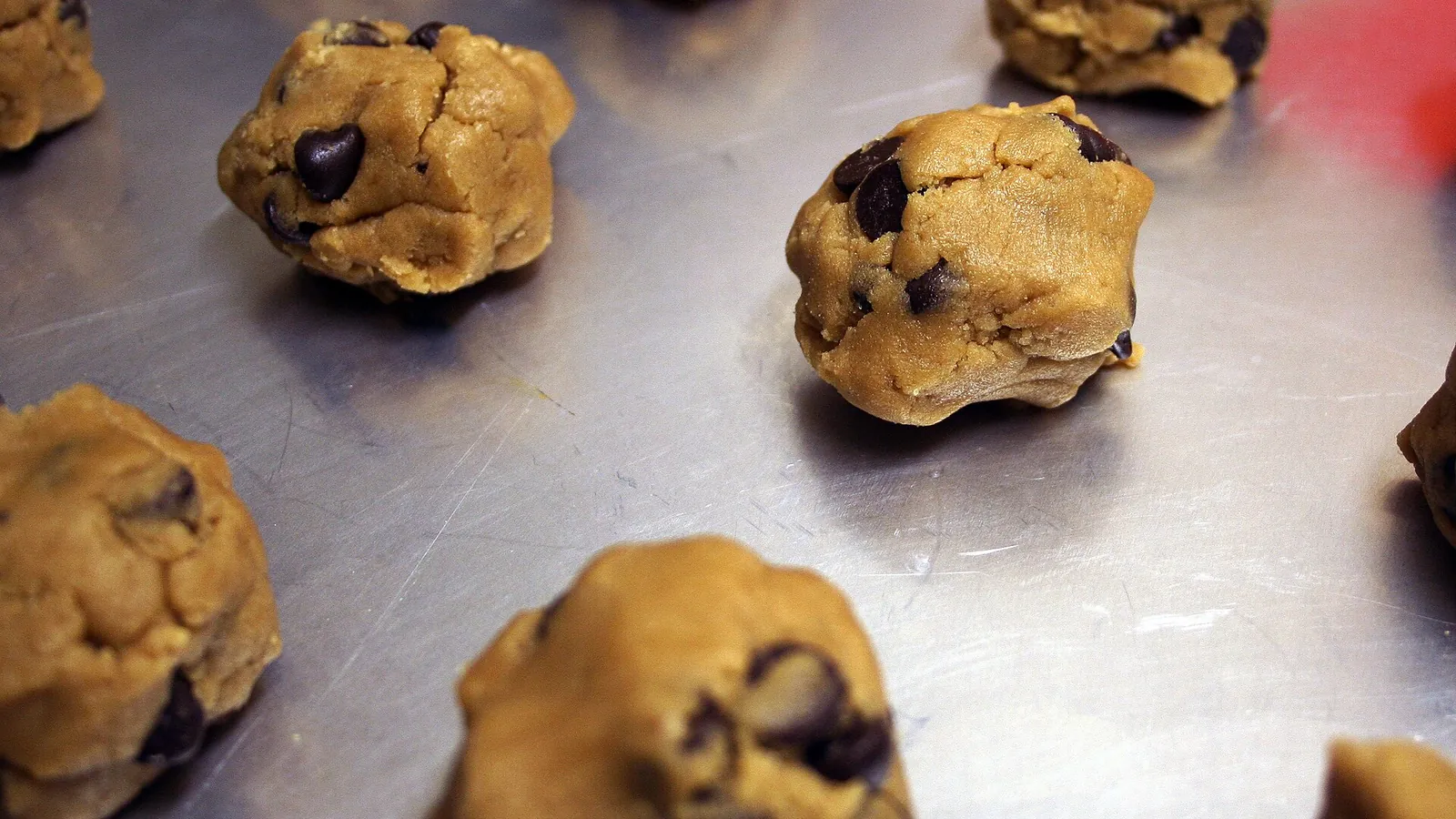
Chill time changes the result roughly like this:
- No chill: Most spread, thinnest cookie, paler color.
- 30 minutes to 1 hour: Noticeably less spread. Good for weeknight baking.
- 12 to 24 hours: Thicker cookies, deeper browning, a more toffee-like flavor.
- Up to 72 hours: Still works and tastes great, but returns flatten out past the 36-hour mark.
Scoop the dough into balls before chilling. Cold dough is hard to portion, and pre-scooped balls can go straight onto the sheet. If the dough has been chilled overnight and feels rock hard, let the balls sit 5 to 10 minutes so they bake evenly instead of staying raw in the center.
Raw dough contains raw egg and raw flour, so keep it in the fridge (40°F or below) while it rests, and don't leave scooped dough sitting at room temperature for more than 2 hours.
Is your oven lying to you?
Plenty of home ovens run 15 to 25°F off from the dial. A cookie baked at 325°F when you set 350°F spends extra minutes with melting butter and no setting, and that shows up as spread.
An inexpensive oven thermometer hung in the center of the rack shows the true temperature. Also give the oven a real preheat. Many ovens beep "ready" when the air hits temperature, but the walls are still catching up, so the temperature dips once you open the door. Waiting 15 to 20 minutes after the beep gives steadier heat.
Bake one sheet at a time on the middle rack if you're troubleshooting. Two sheets at once block airflow, and the top tray often spreads differently from the bottom one.
Baking sheets, parchment, and grease
The surface under the cookie makes more difference than most people expect.

- Use a cool sheet. Putting dough on a sheet that just came out of the oven starts melting the butter before the cookies go in. Rotate between two sheets or run a hot sheet under cold water and dry it.
- Line with parchment instead of greasing. Grease or cooking spray gives the dough a slick surface to slide across. Parchment gives a little grip.
- Be careful with silicone mats. They insulate the bottom, which can make cookies spread slightly more and brown less underneath.
- Prefer light-colored aluminum sheets. Dark sheets absorb more heat, which browns bottoms quickly but doesn't do much to stop spread at the top.
Can the mixing method cause flat cookies?
Yes, in two directions. Creaming butter and sugar beats air into the fat. A couple of minutes on medium speed is right for most chocolate chip recipes. If you cream for 6 to 8 minutes, as some cake recipes suggest, you pack the dough with air bubbles that inflate in the oven and then collapse, leaving a flat, wrinkled cookie.
Long mixing also warms the butter, especially in a stand mixer on a warm day. If the dough looks glossy and soft when you finish, that's a sign it got too warm. Chill it longer before baking.
After you add the flour, mix only until no dry streaks remain. That part has more to do with texture than spread, but overmixing at this stage also tends to warm the dough.
Sugar, eggs, and leavening
The ratio of sugar to flour has a big effect. Sugar melts and liquefies in the oven, so more sugar means more flow. White sugar also makes a crisper, flatter cookie than brown sugar, because brown sugar holds more moisture and is slightly acidic, which helps baking soda react and set the cookie sooner. A recipe with more brown sugar than white usually bakes up thicker.
Egg size plays a part as well. Most American recipes are written for large eggs, about 50 grams without the shell. Using extra-large or jumbo eggs adds liquid, and extra liquid means more spread.
Baking soda loses strength over time. If a box has been open for more than 6 months, test it: stir 1/4 teaspoon into 2 tablespoons of vinegar. Strong fizzing means it's fine. A weak reaction means it's time for a new box.
A quick fix for cookie dough that's already mixed
If you've made the dough and the first tray came out flat, you don't need to start over. Try these in order:
- Put the rest of the dough in the fridge for at least 30 minutes.
- Stir in 2 to 3 tablespoons of flour if the dough feels soft and sticky even after chilling.
- Check the oven temperature with a thermometer and adjust the dial.
- Swap to a cool, parchment-lined sheet.
- Make the dough balls taller rather than wider. A ball that is slightly taller than it is wide spreads into a thicker cookie.
Bake a test cookie or two after each change. It's faster than baking a full tray and guessing what helped.
When thin and crispy is what you want
Some people love thin, crunchy chocolate chip cookies, and recipes for them deliberately use melted butter, more white sugar, a little extra liquid, and no chilling. If your cookies are flat but you like them, nothing is wrong.
If you expected a thick, soft cookie and got a greasy wafer, work through the butter temperature, flour weight, chill time, and oven temperature first. Those four account for the vast majority of flat batches. Cold fat, accurate measuring and a true oven temperature carry over to most other baking techniques.
 Why dough temperature decides cookie thickness
Butter that is too soft is easy to miss until the tray comes out flat, and seeing the dough at each step shows what the right texture looks like. Bon Appetit's test kitchen works through the butter, mixing and baking.
Chris Makes Chocolate Chip Cookies | From the Test Kitchen
By Bon Appétit on YouTube. Their method may vary a little from ours. Watch on YouTube
- Compare the butter they start with against the cool, dentable texture described above, not shiny or greasy.
- Notice how long the butter and sugar are creamed, since the section above recommends 2 to 3 minutes rather than 6 to 8.
- Look at the shape of the dough balls and any chilling step, and compare the baked thickness with the chilling notes above.