 Cooking Times
How Long Do You Boil an Egg If You Want the Yolk Still a Little Runny?
 By the CookClear writers
Checked against USDA safe temperatures and test kitchen timing
 Clear Answer
Boil a large egg straight from the fridge for 6 minutes for a runny yolk, or 7 minutes for one that's jammy but still soft in the center. Lower it into water already at a rolling boil, then move it to ice water the moment the timer goes off, because a hot egg keeps cooking from the inside.
Those numbers assume a large egg, cold from the refrigerator, at or near sea level. Change any of those and the time shifts a little, which is why two people can follow the same "6 minutes" and get different eggs.
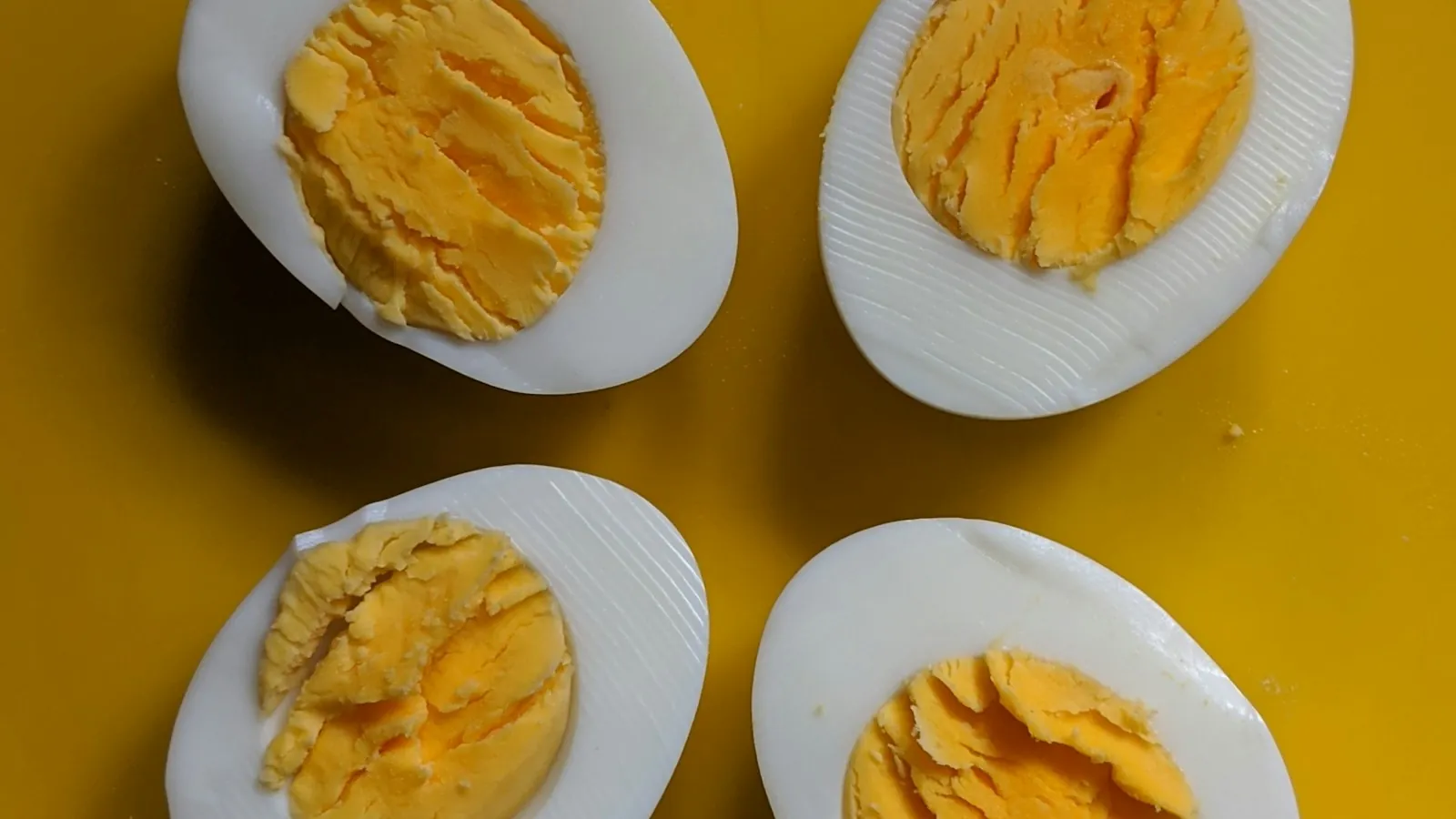
Minute by minute: what the yolk looks like
The difference between a liquid yolk and a fudgy one is about 60 to 90 seconds. These results are for a large, fridge-cold egg dropped into boiling water and shocked in ice water right after.
 On the menu12 questions
| Time in boiling water | White | Yolk | Good for |
|---|---|---|---|
| 5 minutes | Set at the edges, slightly loose near the yolk | Fully liquid, warm | Dipping toast soldiers, eating from an egg cup |
| 6 minutes | Fully set and tender | Runny, pours when cut | Toast, rice bowls, asparagus |
| 6 1/2 minutes | Fully set | Runny center, thickened edges | Salads, grain bowls |
| 7 minutes | Fully set | Jammy, holds its shape, glossy center | Ramen, avocado toast, packed lunches |
| 8 minutes | Firm | Mostly set, slightly soft dot in the middle | Halved on a salad, deviled eggs if you like them soft |
| 10 to 12 minutes | Firm | Fully set, pale and crumbly | Egg salad, classic deviled eggs |
If the question is "a little runny," most people mean the 6 1/2 to 7 minute range: the yolk sits up when you cut it, but the middle is still glossy and slightly loose. If you want it to flow onto your plate, go with 6.
Why start in boiling water instead of cold?
Starting eggs in cold water and bringing them up to a boil is the classic method for hard-boiled eggs, but it is a poor fit for soft ones. How fast the water heats depends on your stove, the size of the pot, and how much water is in it. A gas burner and a small saucepan might reach a boil in 5 minutes; an electric coil and a big pot could take 12. That spread doesn't matter for a fully cooked yolk, but it ruins a soft one when you are aiming for a 60-second window.
Dropping the eggs into water that is already boiling removes the guesswork. Every batch starts from the same temperature, so 6 minutes means the same thing every time. Eggs that hit hot water also tend to peel more easily, because the white sets quickly before it can bond tightly to the membrane under the shell.
Step by step for a runny yolk
- Fill a saucepan with enough water to cover the eggs by about 1 inch. Bring it to a full, rolling boil over high heat.
- Set up an ice bath. Fill a bowl with ice and cold water while you wait. Have it next to the stove.
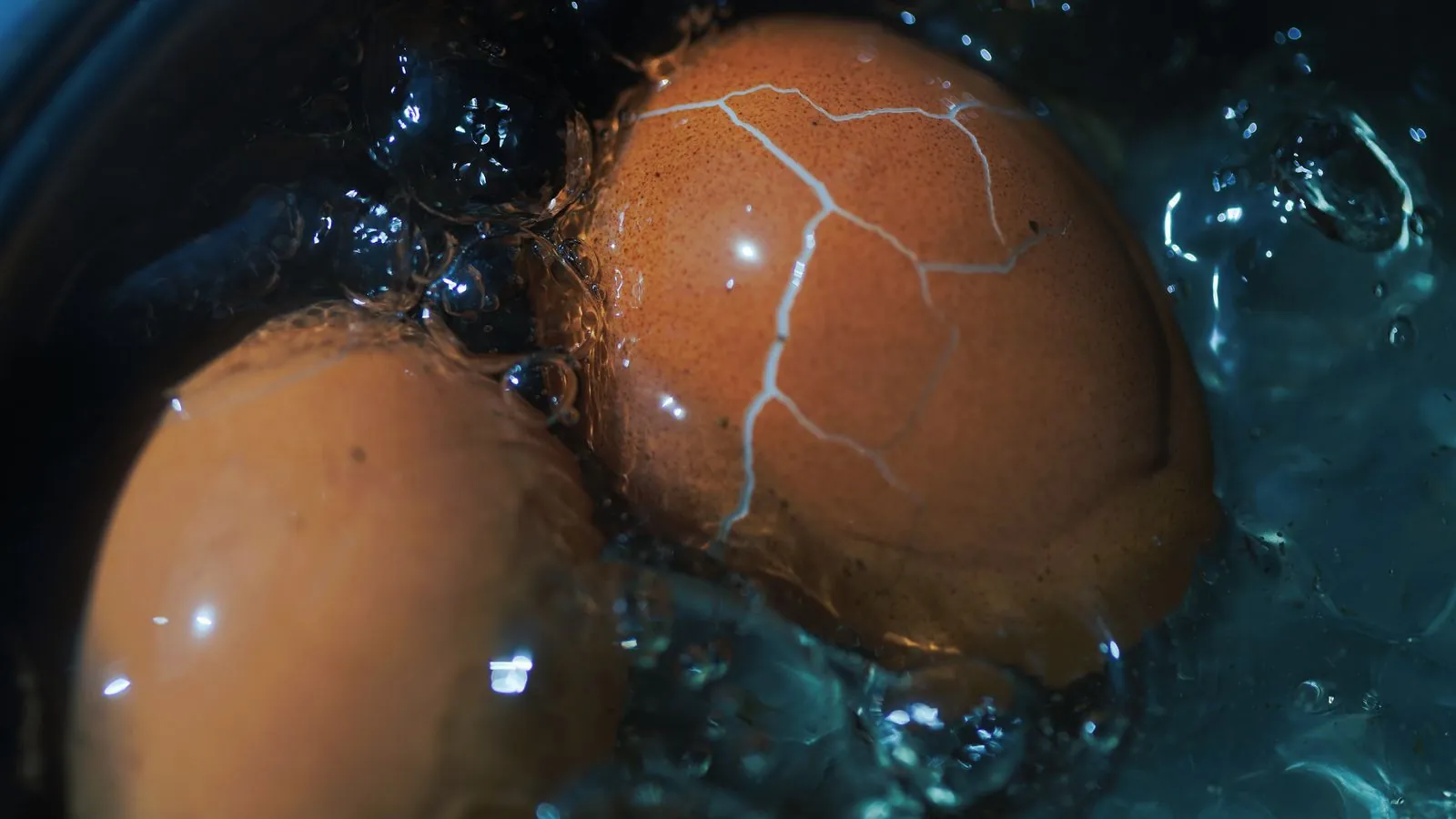
- Lower the eggs in gently. Use a slotted spoon or a spider so they do not crack on the bottom of the pot. Take them straight from the fridge.
- Start the timer as soon as the eggs go in. Set it for 6 minutes for runny or 7 for jammy.
- Turn the heat down slightly. The water will drop off the boil when the cold eggs go in. Let it come back to a steady, lively simmer rather than a violent boil, which can knock the eggs around and crack them.
- Move the eggs to the ice bath the second the timer rings. Leave them for at least 2 minutes, or up to 5 if you want them cool enough to handle easily.
- Peel and eat right away, or keep them in the shell if you are serving them in egg cups.
For more than four eggs at once, use a bigger pot with more water so the temperature does not crash when they go in. Six eggs in a small saucepan can drop the water far enough that you need to add 30 seconds or so.
Does egg size change the boiling time?
Yes, and more than people expect. These times are for large eggs, which are the standard in most US recipes. Smaller and larger eggs need adjusting so the heat reaches the center at the same rate. Subtract about 30 seconds for medium eggs. Add about 30 seconds for extra-large eggs and about 1 minute for jumbo ones.
Duck eggs usually need around 8 to 9 minutes for a runny yolk, and quail eggs about 2 1/2 minutes.
What if the eggs are at room temperature?
An egg that starts at room temperature (around 70°F) has a head start over one at refrigerator temperature (around 40°F or below). Cut about 1 minute off the timing if your eggs have been sitting out. A room-temperature large egg at 5 minutes behaves a lot like a fridge-cold one at 6.
The FDA recommends storing eggs at 40°F or below, so the cold-egg times make the better default.
Room-temperature eggs are also a little less likely to crack in hot water. A few minutes in warm tap water helps, as long as you shave that minute off the timer.
Adjusting soft-boiled eggs at high altitude
Water boils at a lower temperature the higher you go. At sea level it boils at 212°F; at 5,000 feet it boils at roughly 203°F, and at 7,500 feet it is closer to 198°F. Cooler water cooks the egg more slowly, so you need more time to get the same result.
A reasonable rule is to add about 30 seconds at 3,000 feet, about 1 minute at 5,000 feet, and up to 2 minutes at 8,000 feet and above. Treat those as a starting point. Cook one test egg, cut it open, and write down what you got, because stoves and pots vary as much as elevation does. Water that boils cooler slows everything on the stove, so pasta and rice need extra time at elevation too, and any of your stovetop cooking times is worth a test run.
Is a runny yolk safe to eat?
A runny yolk means the egg is not fully cooked, so there is some risk of Salmonella. The USDA and FDA recommend cooking eggs until both the white and the yolk are firm, and cooking egg dishes to 160°F. A 6 minute egg does not reach that throughout the yolk.
For most healthy adults, the risk from a fresh, properly refrigerated egg is low, and soft-boiled eggs are a common breakfast. The groups the FDA flags as higher risk are young children, older adults, pregnant people, and anyone with a weakened immune system. For them, the safer choice is to use pasteurized in-shell eggs, which are heat-treated to kill bacteria and still cook up with a soft yolk, or to cook eggs until firm.
A few habits lower the risk for everyone:
- Buy eggs from a refrigerated case and refrigerate them at home at 40°F or below.
- Skip any egg with a cracked or dirty shell.
- Use eggs by the date on the carton.
- Eat soft-cooked eggs soon after cooking. Do not leave them at room temperature for more than 2 hours.
How to peel a soft-boiled egg without wrecking it
Soft-boiled eggs are delicate. The white is tender and the yolk is under a bit of pressure, so a rough peel can split the whole thing open. The ice bath helps twice: it stops the cooking and it firms up the white enough to handle.
Tap the wide end of the egg on the counter first. That end has an air pocket, so the shell comes away easily there and gives you a starting point. Then gently crack the shell all over by rolling the egg under your palm with light pressure. Peel under a thin stream of cool water or in the ice bath itself, which helps slip the membrane off.
Very fresh eggs are harder to peel than eggs that are a week or two old, because the white clings more tightly to the shell membrane. If you buy eggs specifically for soft-boiling, letting them sit in the fridge for several days first makes peeling noticeably easier.
Can you make soft-boiled eggs ahead?
Jammy eggs (7 minutes) hold up well. Peel them after the ice bath and refrigerate them in a covered container for up to 3 or 4 days. They are the eggs you see in ramen shops, often marinated overnight in a mix of soy sauce, mirin, and water.
Runny 6 minute eggs are better eaten fresh, but you can reheat them. Leave them in the shell after chilling, refrigerate, and when you want one, lower it into very hot tap water (not boiling) for about 5 minutes. That warms the egg through without cooking the yolk further. Boiling water will push it toward hard-cooked within a couple of minutes.
Other ways to get the same result
Steaming, the same setup you would use for steamed broccoli, is a reliable alternative. Bring about 1/2 inch of water to a boil in a covered saucepan, add the cold eggs, cover, and cook for about 6 1/2 minutes for a runny yolk. Because only a little water is involved, it comes back up to temperature fast, and adding more eggs barely changes the timing.
An electric pressure cooker also works. On a rack with 1 cup of water, large eggs cooked on low pressure for 3 minutes, followed by a quick release and an ice bath, come out with soft, runny yolks. Results vary more by model than with a pot on the stove, so test one before you make a dozen. If you would rather skip the shell entirely, poaching an egg or making soft scrambled eggs gives a similar rich, soft yolk.
Troubleshooting common problems
The yolk was hard even at 6 minutes. Your eggs were probably smaller than large, at room temperature, or left to sit in the hot pot after the timer. Get them into the ice bath right away and check the size on the carton.
The white was still runny around the yolk. Either the water was not at a full boil when the eggs went in, the pot was crowded, or the eggs were jumbo. Add 30 seconds and use more water.
The shells cracked in the pot. Lower the eggs gently instead of dropping them, and turn the heat down to a strong simmer once they are in.
There is a green ring around the yolk. That only happens with overcooked eggs, when iron in the yolk reacts with sulfur from the white. You will not see it at 6 or 7 minutes.
 Can you judge a 6 minute yolk by eye?
Yolk set is hard to picture from a table of minutes, and the difference between runny and jammy is only about a minute. Watching the cut eggs side by side gives you a visual target.
How to Boil an Egg
By John and Lisa's Kitchen and Home on YouTube. Their method may vary a little from ours. Watch on YouTube
- Compare the yolk at each cooking time with the minute by minute table above, especially the 6 and 7 minute rows.
- Notice how the eggs go into water that is already at a full boil, and how quickly they move to the ice bath.
- Look at how the white holds together around the yolk, since a fully set, tender white is the sign of the right timing.


