Techniques
Which Tricks Stop Crying When Cutting Onions, and Which Are Myths?
 By the CookClear writers
Checked against test kitchen and food science sources
 Clear Answer
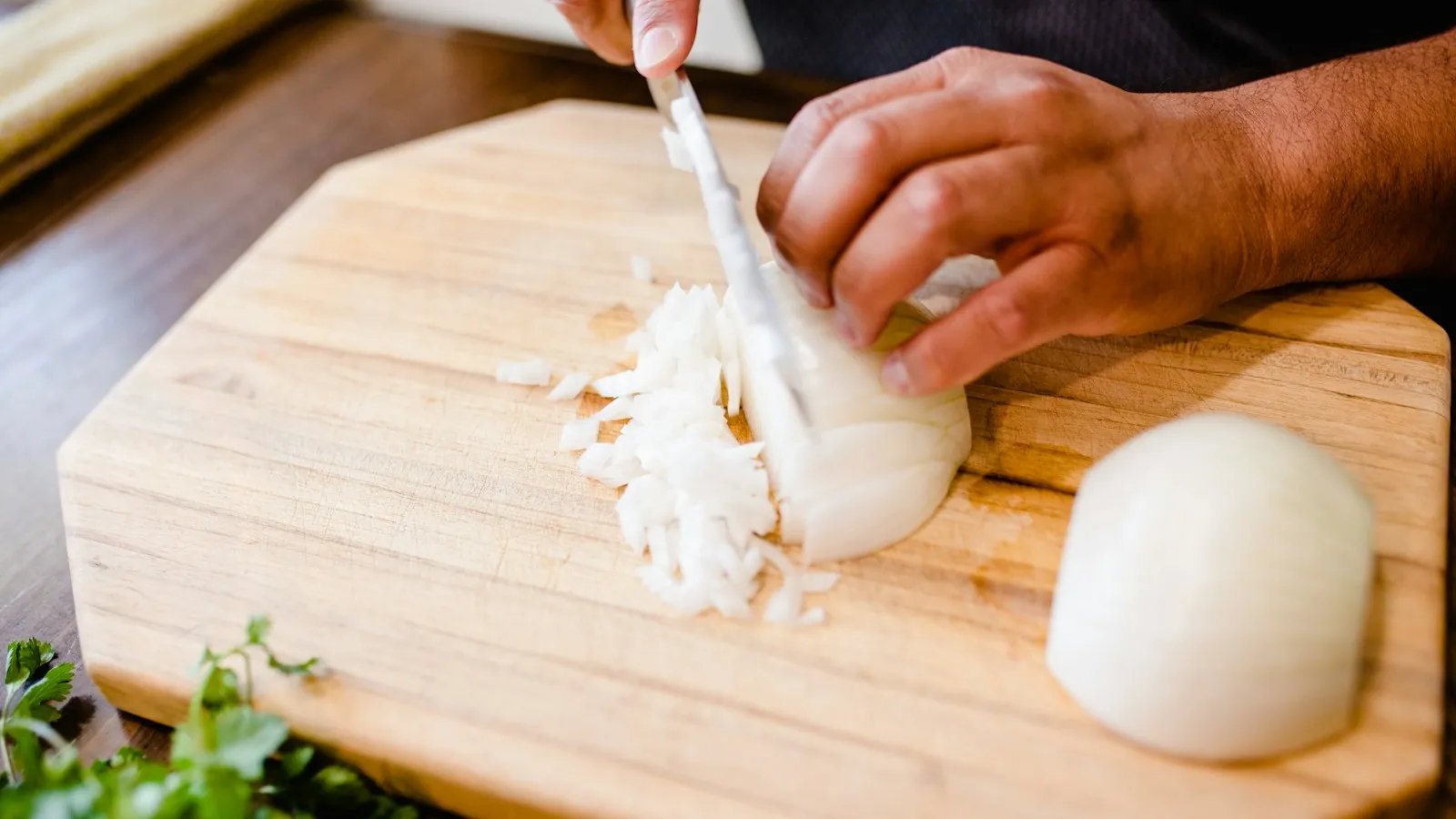
A very sharp, thin knife used with slow, steady strokes is what stops you from crying when cutting onions. A 2025 Cornell study found dull, thick blades threw up to 40 times more droplets of onion juice, and fast cuts made up to four times more. For big batches, sealed goggles are the only thing that blocks the irritant completely.
The rest of the folk remedies (bread in your mouth, a candle, chewing gum) range from weak to useless.
Why do onions make you cry in the first place?
An intact onion is mostly calm. The trouble starts when the knife breaks cells open. That damage lets an enzyme mix with sulfur compounds that were kept apart inside the cell, and a quick chain reaction produces a volatile gas called syn-propanethial-S-oxide.
That gas drifts up, reaches the moisture on the surface of your eyes, and irritates the nerves there. Your eyes respond the only way they know how: they flood with tears to rinse it away.
Two things follow from that. First, the fewer cells you crush, the less gas you make. Second, anything that keeps the gas from reaching your eyes (distance, airflow, a physical barrier) helps. Every method that works does one or both.
What did the Cornell knife study find?
In October 2025, researchers at Cornell published a study in the Proceedings of the National Academy of Sciences that filmed onions being cut with high-speed cameras. They watched what happens in the instant the blade pushes through the layers.
The blade presses the onion's outer skin inward before it breaks through. When it finally ruptures, juice sprays out as a fine mist. Here is what they measured, per Cornell's own summary and Smithsonian's coverage of the paper:
| What they tested | What they found |
|---|---|
| Distance the mist travels | Up to about two-thirds of a meter (roughly 2 feet), enough to reach your face |
| Droplet speed | Estimated 5 to 40 meters per second |
| Dull or thick blade vs. sharp, thin blade | Dull/thick blades produced up to 40 times more droplets |
| Fast vs. slow cutting | Faster cuts produced up to 4 times more droplets |
| Onions refrigerated 12 hours | Released a noticeably larger volume of droplets than room-temperature onions |
The researchers' plain advice: cut slowly with a sharpened blade. That lines up with what experienced cooks have said for decades, and the study explains the mechanism. A dull edge mashes and bursts layers. A sharp one slices through them with less pressure, so less juice gets launched toward you.
The methods that help, ranked
Here is how I'd order them, from most to least useful in a normal home kitchen:
- Sharpen your knife. This is the single biggest change for most people, and it makes every other kitchen task easier too. A thin chef's knife or santoku with a fresh edge beats a heavy, dull blade every time.
- Slow down a little. You don't need to cut in slow motion. Just stop hacking. Use smooth, controlled strokes that let the edge do the work instead of pressing down hard.
- Get air moving across the board. Turn on the range hood and cut near it, or point a small fan so it blows sideways across your cutting board (not toward your face). This carries the gas away before it rises to eye level.
- Leave the root end for last. The root area has the highest concentration of the compounds that cause tearing, according to the National Onion Association. Standard dicing technique already leaves it intact to hold the layers together, then you throw it out.
- Stand back and keep your face up. The mist travels roughly 2 feet. Keeping your head above and slightly back from the board, instead of hunched over it, buys you real distance.
- Wear sealed goggles for big jobs. Swim goggles or purpose-made onion goggles that seal around the eyes block the gas completely. Regular glasses help only a little, since gas flows around the edges.
You don't need all six. A sharp knife plus a running range hood handles one or two onions for most people.
Does chilling the onion first still make sense?
The old tip, repeated by the National Onion Association, is to chill onions for at least 30 minutes before cutting. The reasoning is that cold slows the chemical reaction that makes the gas. The association quotes food chemist Robert L. Wolke saying a refrigerator-cold onion causes tearing only 25 percent as quickly as a room-temperature one.
The Cornell team, however, found that onions refrigerated for 12 hours threw off a noticeably larger volume of droplets when cut. So you have two effects pulling in opposite directions: cold may slow the chemistry, while a chilled onion may spray more juice on impact.
My take: a short chill isn't harmful, and plenty of cooks swear by it, but don't count on it as your main fix. If you try it, pair it with a sharp knife so you're not canceling out the benefit with a mist of extra droplets. Skip the freezer, because a partly frozen onion turns mushy and watery once it thaws and cooks.
One more storage note: whole, uncut dry onions keep best in a cool, dark, ventilated spot, not the fridge (and keeping onions away from potatoes matters, since onion gases can speed potato sprouting), so chilling is a pre-cutting step rather than a storage habit.
Which popular tricks don't work?
Plenty of remedies get passed around because they feel like they should work:
- Bread or a spoon in your mouth. The idea is that it "absorbs" the gas. The gas reaches your eyes directly through the air, not through your mouth, so this does little. Any benefit is probably from changing how you breathe and where you hold your head.
- A lit candle next to the board. The claim is the flame burns off the gas. The amount of air a small candle moves is tiny compared to the spray coming off the board. A range hood is far more effective and safer.
- Chewing gum. Same problem as the bread. Your mouth isn't the route.
- Regular eyeglasses. Somewhat helpful as a partial shield against direct droplets, but gas flows around open frames.
- Rinsing the cut onion under running water. This does reduce fumes because the gas dissolves into the water, but it also rinses away flavor and makes the pieces wet, which hurts browning. It's a reasonable trade for raw onions you'll soak anyway, less so for anything you plan to sauté.
Cutting submerged in a bowl of water also technically works, but it's slow, awkward, and riskier for your fingers. I wouldn't bother.
Are some onions easier on the eyes?
Yes. Onion varieties differ a lot in how much tear-producing compound they make. Sweet onions are generally milder to cut than pungent yellow storage onions, which is why some people find a Vidalia much gentler than a standard yellow.
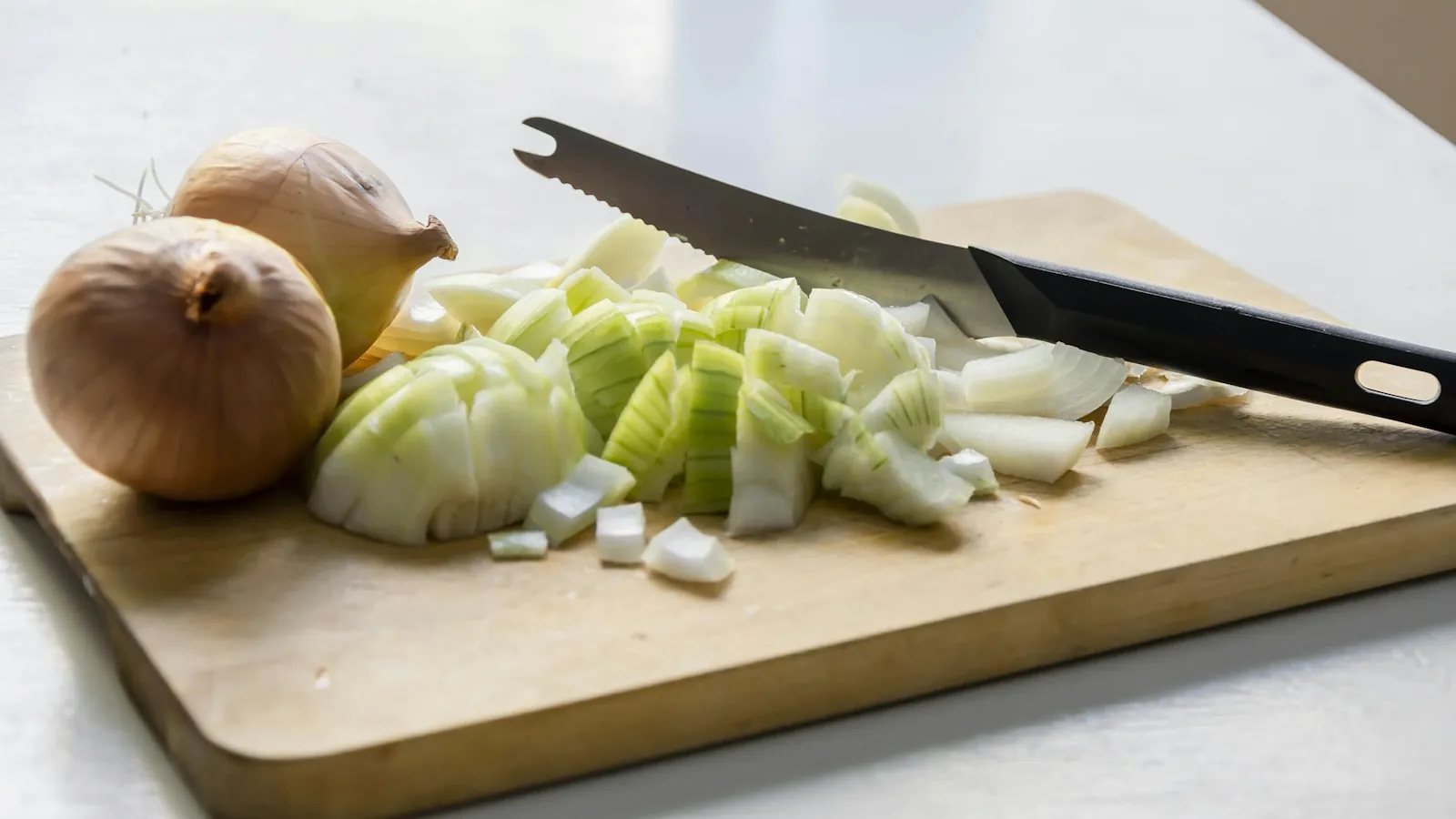
There are also onions bred specifically for this. Sunions, developed by Bayer Crop Science through more than three decades of conventional cross-breeding, were launched in the U.S. as a "tearless" onion. According to the company's launch material, their tear-causing compounds decline during storage instead of holding steady or rising the way they do in most onions. They're seasonal and not in every store, but if you see them and onions are your nemesis, they're worth a try.
Here's a quick comparison of where common types usually land:
| Onion type | Typical tearing | Best uses |
|---|---|---|
| Yellow storage onion | Strong | Soups, stews, caramelizing, most cooked dishes |
| White onion | Moderate to strong | Salsas, Mexican dishes, stir-fries |
| Red onion | Moderate | Raw in salads, pickling, grilling |
| Sweet onion (Vidalia, Walla Walla) | Mild | Raw slices, onion rings, quick sautés |
| Bred low-tear onion (e.g., Sunions) | Very mild | Anywhere you'd use a sweet onion |
| Shallot | Moderate | Vinaigrettes, pan sauces |
Treat this as a rough expectation rather than a rule. Growing conditions and how long the onion has been stored both change how sharp it is.
How should you dice an onion without crying?
Good technique and fewer tears overlap almost completely, because clean cuts crush fewer cells. This is the standard method:
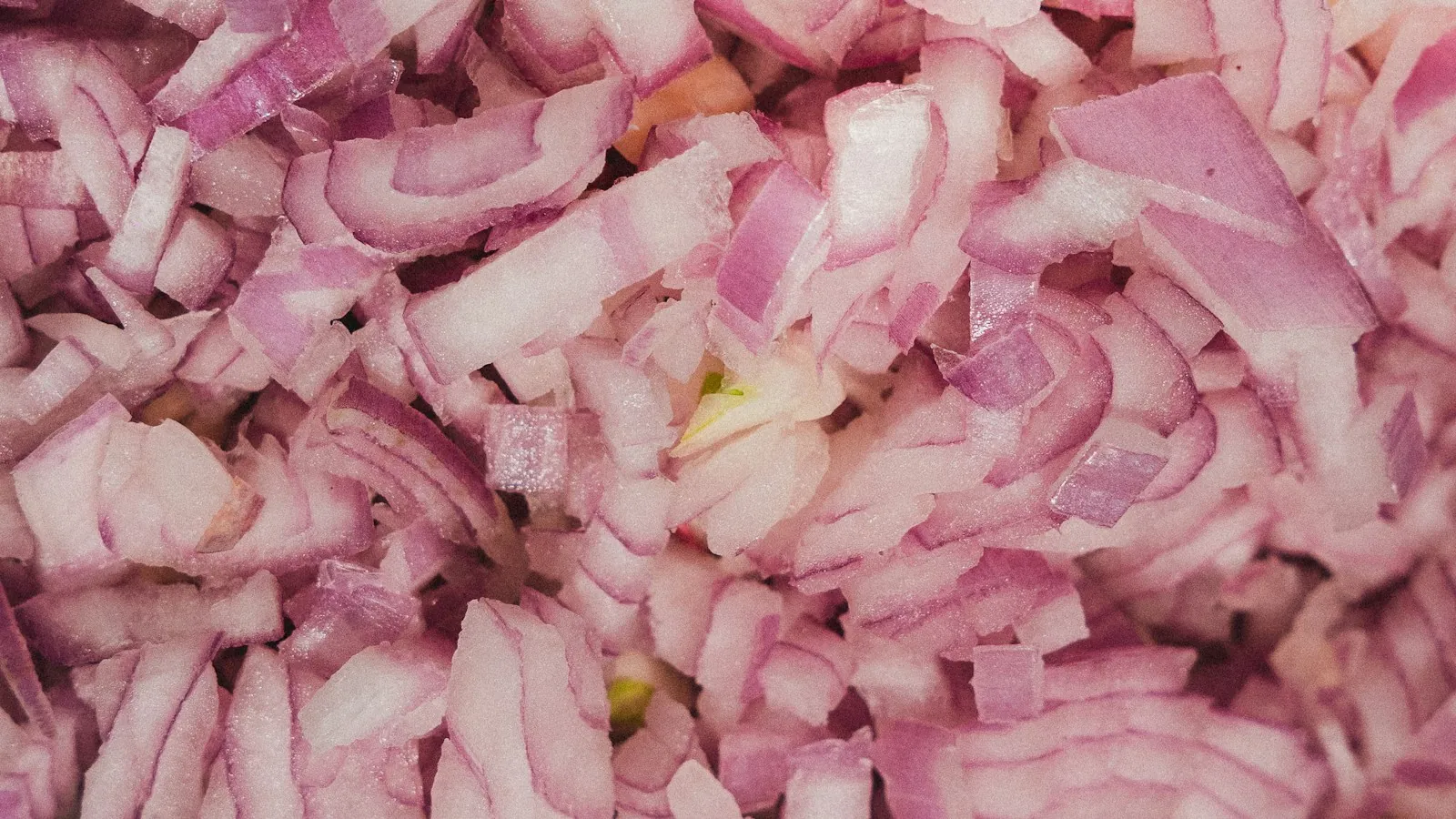
- Trim the top, not the root. Cut off the stem end, then halve the onion straight through the root. Peel off the papery skin and the first tough layer.
- Lay each half flat. The flat side goes down so the onion can't roll.
- Make vertical cuts toward the root. Slice from the trimmed end toward the root, stopping just short of it so the layers stay attached. Spacing sets your dice size: about 1/4 inch apart for a fine dice, 1/2 inch for a medium one.
- Add a couple of horizontal cuts if you want an even dice. Optional. Many cooks skip them, and America's Test Kitchen teaches a "leapfrog" method that drops them entirely.
- Cross-cut into dice. Slice across your earlier cuts, moving back toward the root. Let the knife glide forward and down instead of pushing straight down.
- Stop at the root and toss it. That last chunk is the most potent part of the onion and the hardest to dice neatly anyway.
Work at a steady, unhurried pace, since the study suggests rushing costs you tears. Speed comes with practice, and other knife techniques build on the same clean cuts.
What about contact lenses and sensitive eyes?
Some contact lens wearers report that onions bother them less, likely because the lens covers part of the eye's surface. Others find the irritation lingers more. There's no solid research either way, so go by your own experience.
If your eyes are especially sensitive, go straight to the reliable stack: sharp knife, range hood on, root last, and goggles for anything more than one or two onions. If your eyes are irritated after cutting, rinse them with clean, cool water and wash your hands before touching your face, since onion juice on your fingers will sting too.
How do you prep a big batch without suffering?
When you're dicing five pounds for a pot of chili, French onion soup or a pan of caramelized onions, small tricks run out of steam. A few things make a real difference at volume:
- Use a food processor for part of it. Pulse halved, peeled onions in short bursts. The lid keeps most of the gas contained, though you'll get a blast when you open it, so step back and give it a few seconds. For even slices, a mandoline with its guard is quick too.
- Work in rounds. Peel and halve all the onions first, then dice them in batches with breaks in between. Step away from the board to let your eyes recover.
- Keep finished onions covered. A bowl with a plate or lid on top stops cut pieces from releasing gas into your workspace while you keep going.
- Wear the goggles. This is the case where they earn their spot in the drawer.
Wipe your board and knife clean between rounds as well. Juice that pools on the board keeps releasing gas.
 Cutting an onion with a sharp knife and root on
Knife angle and stroke speed are hard to picture from a description. Gordon Ramsay demonstrates a clean dice with the root left on.
Dicing An Onion
By Gordon Ramsay on YouTube. Their method may vary a little from ours. Watch on YouTube
- Watch the pace of the strokes and compare it with the advice to cut smoothly rather than hack.
- Notice that the root end stays attached while the vertical cuts run toward it, as in the dicing steps above.
- Look at how far the cook's face sits from the board, given that the mist travels roughly 2 feet.