Home / Measurements & Conversions
 Measurements & Conversions
What Convection Oven Conversion Keeps a Regular Recipe on Track?
 By the CookClear writers
Checked against US standard measures, NIST conversions and test kitchen weights
 Clear Answer
For a convection oven conversion, lower the recipe's temperature by 25°F or cut the baking time by about 25 percent, and start checking for doneness early. GE, Whirlpool and KitchenAid all point to that 25°F drop, and many newer ovens make it for you automatically. Pick one change, not both, the first time you try a recipe.
Why the 25°F rule exists
A convection oven has a fan, and many models add a third heating element around that fan. The moving air strips away the thin layer of cooler air that clings to food in a still oven, so heat reaches the surface faster. Food browns sooner and cooks a little quicker at the same dial setting.
Dropping the temperature 25°F slows the outside down enough that the inside can keep up. GE's owner's manuals tell cooks to "reduce baking temperature by 25°F" on convection bake. America's Test Kitchen gives the same starting point: drop the oven 25 degrees the first time you make a recipe on convection, then adjust.
The other route is to keep the recipe temperature and shorten the time. KitchenAid's advice is to reduce the temperature by 25°F or decrease cooking time by about 25 percent. America's Test Kitchen notes that some manufacturers suggest 25 to 50 degrees lower and a time cut closer to 30 percent. We follow the 25°F and 25 percent figures because they are the most common in manuals and the least likely to leave food underdone.
Convection temperature and time conversion chart
These are the standard conversions using the 25°F rule and the 25 percent time cut. Use one column or the other, not both together.
| Recipe says (regular oven) | Convection: lower the temperature | Or keep temperature and shorten the time |
|---|---|---|
| 325°F for 40 minutes | 300°F, about 40 minutes | 325°F, about 30 minutes |
| 350°F for 12 minutes | 325°F, about 12 minutes | 350°F, about 9 minutes |
| 350°F for 60 minutes | 325°F, about 60 minutes | 350°F, about 45 minutes |
| 375°F for 20 minutes | 350°F, about 20 minutes | 375°F, about 15 minutes |
| 400°F for 30 minutes | 375°F, about 30 minutes | 400°F, about 23 minutes |
| 425°F for 25 minutes | 400°F, about 25 minutes | 425°F, about 19 minutes |
| 450°F for 16 minutes | 425°F, about 16 minutes | 450°F, about 12 minutes |
With the lower temperature, food often still finishes a few minutes ahead of the recipe, so the times in the middle column are the upper limit. If you also need to switch a European recipe from Celsius, do that oven temperature conversion first, then take off the 25°F.
Does your oven already convert the temperature for you?
Many do, which is how people end up lowering the heat twice. GE calls its feature Auto Recipe Conversion. When it is on and you enter 350°F on convection bake, the display shows 325°F. GE's manual is clear that this feature changes only the temperature, not the cooking time.
Whirlpool's support pages describe the same thing from the other side: a 350°F setting that shows 325°F after preheating is normal on ovens with convection conversion. Whirlpool also notes that some ovens reduce both the temperature and the cooking time when you choose convection.
To tell what your oven does:
- Set convection bake to 350°F and watch the display. If it drops to 325°F on its own, the oven converts for you.
- Look in the owner's manual for words like "auto convert," "convection convert," or "recipe conversion."
- If your oven converts, type in the recipe temperature exactly as written and do not subtract anything yourself.
- If it does not, subtract 25°F before you press start.
An oven thermometer on the center rack tells you what the oven really reaches, which matters more than the display. If the reading is off by more than 25°F, an oven that runs hot will throw off every conversion, so fix that number first.
Does convection cook faster for every food?
Mostly, yes. Convection cooks faster because moving air carries heat into the surface more efficiently, but the gain depends on the food's shape. Flat foods with lots of exposed surface, like cookies, sheet pan vegetables and chicken pieces, speed up the most. Dense, deep foods like a thick casserole in a tall dish change less.
America's Test Kitchen found that a roast chicken on convection roast finished 10 to 15 minutes sooner than in a standard oven, with darker, more even skin, and that was with no temperature change. In the same tests, yeasted bread needed no change to time or temperature at all.
An air fryer is a small, strong convection oven. Its basket heats up fast, so skipping the air fryer preheat costs little, while a full-size oven still needs the full preheat before convection baking.
Convection bake vs convection roast: which setting to choose
Many ovens offer two convection modes. They use the fan differently, and the conversion is different for each.
- Convection bake. Gentler heat for baked goods, casseroles and multiple racks of cookies. Lower the recipe temperature by 25°F here, or let auto conversion do it.
- Convection roast. Uses more of the top element along with the fan for browning. KitchenAid says you can usually keep the temperature the same for roasting proteins and just check doneness earlier.
- Regular bake. No fan. The right choice for anything delicate or tall and soft that needs still air to rise.
Whole poultry, large cuts of meat, bone-in cuts and hearty vegetables are what convection roast does best. For the bird itself, start checking about 15 minutes before a whole chicken's usual roasting time and go by the thermometer, which should read 165°F.
Which foods benefit most from convection?
The fan helps anything that should brown, crisp or dry out a little. It also evens out heat across racks, which is why manuals single out batch baking. GE's manual says cookies, muffins, biscuits and other quick breads give very good results with multi-rack baking.
Good candidates:
- Cookies, especially two or three sheets at once
- Roasted vegetables, potatoes and Brussels sprouts
- Whole chicken, turkey parts, pork roasts and beef roasts
- Pizza, pie crusts and puff pastry
- Casseroles and gratins with a browned top
Vegetables come out crisper because the moving air carries steam away from the pan. If yours still steam, crowding is usually the cause, and soggy roasted vegetables mostly need more room on the sheet.
Which foods should you not cook with convection?
Some foods do worse with the fan, and lowering the temperature does not save them. Use regular bake for these:
- Custards, cheesecakes and creme brulee. They need slow, gentle heat. Moving air browns and dries the top before the center sets, which leads to cracks.
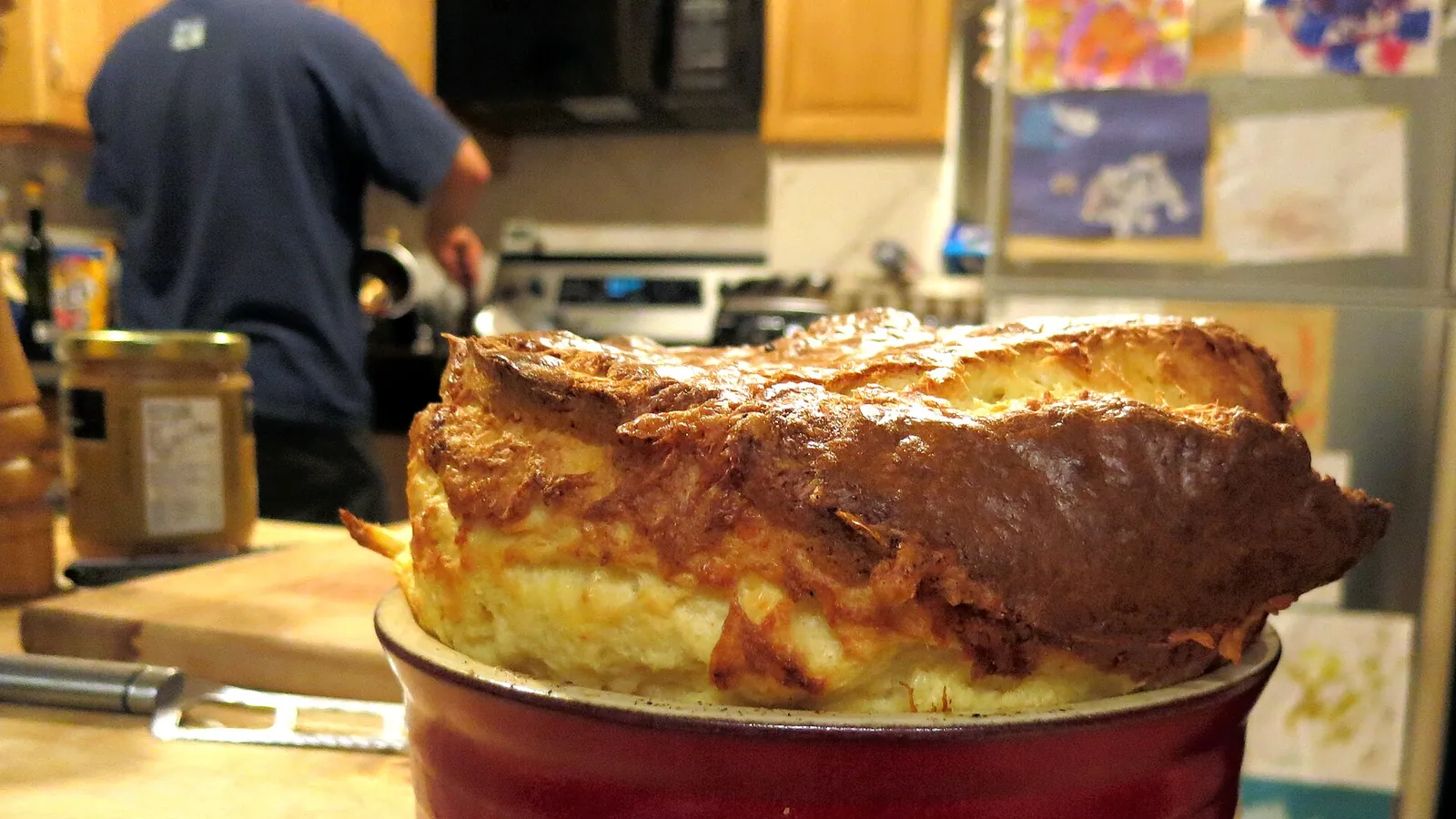
- Souffles. KitchenAid lists them with custards and fish fillets as items to keep off convection roast. They need still air to climb evenly.
- Tall, delicate cakes. America's Test Kitchen advises against convection for high-sugar chiffon and angel food cakes. In its tests, yellow layer cakes gained nothing and needed the 25°F drop just to keep the surface from drying.
- Quick breads and cakes that should dome. The outside sets before the batter finishes rising, so you get a peaked or lopsided top.
- Very light toppings. Bread crumbs, shredded coconut and parchment that is not weighed down can blow around.
Which pans work best for convection baking?
Pan choice matters more with convection because the air has to reach the food. GE's manual recommends a flat sheet for cookies and a low-sided pan for dishes like oven-baked chicken, since high sides block the airflow. It also says pans should not touch each other or the oven walls.
| Pan | How it does with convection | What to adjust |
|---|---|---|
| Rimless or low-rimmed metal sheet | Best airflow, most even browning | Nothing, ideal for cookies and roasting |
| Dark or nonstick metal pan | Browns faster than shiny metal | Check 3 to 5 minutes early |
| Shiny aluminum pan | Even, moderate browning | Standard conversion works |
| Glass or ceramic dish | Heats slowly, holds heat | Fine for casseroles, check bottoms |
| Deep roasting pan or tall dish | Sides block the air | Switch to a low pan or a rack on a sheet |
GE's manual notes that metal heats fastest, dark or matte pans bake faster than shiny ones, and glass or ceramic cooks more slowly. The 3 to 5 minute early check is our own cushion, not a manufacturer figure. Thin sheet pans can buckle under strong convection heat too, so a warped baking sheet is worth replacing if it rocks on the rack.
For multiple racks, GE suggests spacing them out: two racks in positions B and D, three racks in A, C and E on its rack labels. Multi-rack baking can add a few minutes, but you still finish sooner than baking one sheet at a time.
When to check doneness in a convection oven
Check early, every time you convert. KitchenAid's advice is to check baked goods early and check roasted meats when about three-quarters of the cooking time has passed. On a 60 minute roast, that means your first look is at 45 minutes.
Doneness cues to use:
- Baked goods. The top springs back when pressed lightly, and a toothpick comes out clean or with a few moist crumbs.
- Cookies. Edges are set and golden while the centers still look slightly soft.
- Casseroles. The edges bubble and the top is browned.
- Meat and poultry. An instant-read thermometer is the only reliable test, and KitchenAid calls internal temperature the most reliable indicator. A good instant-read thermometer takes the guessing out of the earlier finish.
Let roasted meats rest 10 to 20 minutes after they come out, as KitchenAid recommends.
What went wrong with my convection bake?
The result usually points straight at the cause.
| What you see | Likely cause | Fix |
|---|---|---|
| Dark tops, raw centers | Temperature not lowered, or lowered twice the wrong way | Drop 25°F, or check if auto convert is on |
| Pale and dry after full recipe time | Lowered temperature and also cut time | Use only one adjustment |
| Cookies spread thin | Oven too hot or fan drying edges unevenly | Confirm the 25°F drop and chill the dough |
| Cake peaked or cracked on top | Fan set the crust before the rise finished | Bake cakes on regular bake |
| One sheet browner than the other | Pans touching or blocking airflow | Space pans and stagger racks |
| Roast browned outside, underdone inside | Pan too deep or very large cut | Use a low pan and go by the thermometer |
Spreading cookies have other causes too, like warm butter or too little flour, and chilling cookie dough solves many of them. Measurement swaps beyond the oven, like cups to grams, are all collected under measurements and conversions.
 Seeing the 25°F drop and the airflow at work
Seeing how the fan and the pan change browning on the same food makes the temperature and pan advice click.
Convection vs. conventional ovens explained
By CNET on YouTube. Their method may vary a little from ours. Watch on YouTube
- Notice whether the oven is set 25°F below the recipe temperature, or kept at the recipe temperature with a shorter time.
- Look at how low-sided pans and spaced racks leave room for air to move around each sheet.
- Watch when doneness gets checked, ideally around three-quarters of the original time for roasts.